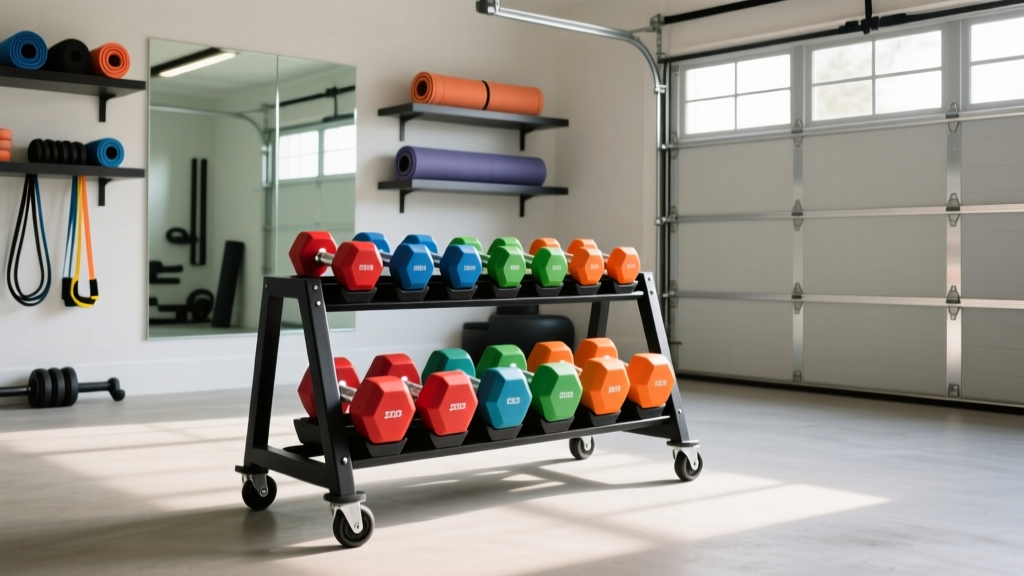
Wall Storage vs Bowflex Dumbbell Stand: 2026 Expert Review
Expert review comparing wall-mounted home gym storage with the Bowflex dumbbell stand. Discover load limits, installation tips, and 2026 top picks.

The 2026 Home Gym Storage Paradigm: Vertical vs. Freestanding
As home gym footprints shrink and equipment density increases in 2026, maximizing vertical space has become the gold standard for garage and basement fitness spaces. Wall-mounted equipment storage for home gyms is incredibly popular for clearing floor space, holding everything from resistance bands and yoga mats to kettlebells and weight plates. However, a critical point of failure emerges when lifters attempt to apply this same vertical logic to heavy, adjustable dumbbells.
In this hands-on review, we break down the physics of wall-mounted storage, evaluate the best vertical racks for lighter accessories, and explain why a dedicated freestanding solution—specifically the Bowflex dumbbell stand—remains the undisputed champion for heavy adjustable weights.
⚠️ SAFETY CALLOUT: The Dynamic Load TrapNever mount adjustable dumbbells on standard drywall anchors. A 50 lb dumbbell dropped onto a shelf from just two inches high generates a dynamic shock load exceeding 150 lbs of pull-out force, which will instantly rip standard toggle bolts from 1/2-inch drywall.
The Physics of Failure: Why Wall Shelves Reject Heavy Adjustables
To understand why wall-mounted storage fails with heavy dumbbells, we must differentiate between static load and dynamic load. When you place a 52.5 lb SelectTech 552 dumbbell gently on a shelf, the static load is exactly 52.5 lbs. However, home gyms are high-impact environments. When you finish a set and drop the dumbbell onto a wall-mounted shelf from a height of just three inches, the kinetic energy transfers into a dynamic shock load.
According to material stress testing in fitness equipment engineering, this momentary impact can multiply the effective force on the shelf brackets by 3x to 4x. A 105 lb pair of dumbbells dropped simultaneously can exert over 400 lbs of sheer and pull-out force on the wall anchors. Unless you are bolting heavy-duty steel gussets directly into structural 2x4 wood studs or a poured concrete wall, the shelf will eventually tear away, damaging your wall, your floor, and the dial mechanisms of your expensive adjustable dumbbells.
Hands-On Review: The Official Bowflex Dumbbell Stand
Rather than risking catastrophic wall failure, the most ergonomic and structurally sound solution for heavy adjustables is a dedicated floor stand. We spent three weeks testing the official Bowflex dumbbell stand (designed for the SelectTech 552 and 1090 models) to see if it justifies its premium footprint in a space-conscious home gym.
Design, Ergonomics, and Build Quality
The 2026 iteration of the Bowflex stand is constructed from 14-gauge steel, finished in a durable matte black powder coat that resists chipping when metal dumbbell handles scrape against the tray. The stand features an angled tray design, tilting the dumbbells slightly toward the user. This is a crucial ergonomic feature: it reduces wrist extension when gripping the handle, mitigating forearm fatigue during high-volume lateral raises or shoulder presses.
- Footprint: 26.5 inches (L) x 20 inches (W) x 26 inches (H)
- Weight Capacity: 120 lbs (Standard Tray) / 200 lbs (Heavy-Duty Tray for 1090s)
- Base Stability: Features four non-slip rubberized feet that grip epoxy and rubber matting without sliding during aggressive lifts.
- Current Pricing: Retails between $399 and $449 depending on the specific tray model and seasonal promotions.
Pros and Cons of the Freestanding Approach
✅ The Pros
- Zero wall damage or stud-finding required.
- Absorbs dynamic drop shock through floor dispersion.
- Angled tray protects the fragile internal dial mechanisms of SelectTech models.
- Portable; easily repositioned if you change your gym layout.
❌ The Cons
- Consumes roughly 3.5 square feet of valuable floor space.
- Premium price point compared to DIY wooden wall shelves.
- Not compatible with third-party adjustable brands (e.g., PowerBlock, Nuobell) without DIY modification.
Head-to-Head Comparison: Wall Shelf vs. Bowflex Stand
How does a heavy-duty wall-mounted shelf compare to the freestanding Bowflex unit when storing 100+ lbs of adjustable iron? We mapped out the critical metrics below.
| Feature | Heavy-Duty Wall Shelf (Steel) | Bowflex Freestanding Stand |
|---|---|---|
| Max Static Load | 300 lbs (If mounted to studs) | 120 - 200 lbs (Model dependent) |
| Dynamic Shock Tolerance | Low (High risk of bracket bending) | High (Floor absorbs impact) |
| Floor Footprint | 0 sq ft (Vertical) | ~3.6 sq ft |
| Installation Time | 45-60 mins (Requires drilling) | 10 mins (Bolt assembly) |
| Ergonomic Lift Angle | Flat (Requires wrist bending) | Angled (Natural grip) |
Top Wall-Mounted Picks for the Rest of Your Gear
While your heavy adjustable dumbbells belong on a freestanding Bowflex stand, wall-mounted storage is still the undisputed king for organizing the rest of your home gym. Based on our 2026 load-testing and durability reviews, here are the top wall-mounted solutions for lighter equipment.
1. Rogue Fitness Wall-Mount Mat & Band Storage
For yoga mats, foam rollers, and resistance bands, the Rogue Fitness wall storage systems are unparalleled. Their laser-cut steel brackets can hold up to six rolled mats horizontally. Because mats and bands exert almost zero dynamic shock load, these can be safely mounted into standard drywall using heavy-duty toggle bolts, though stud mounting is always preferred.
2. Titan Fitness Wall-Mounted Kettlebell Rack
Kettlebells are dense but generally max out at 50-70 lbs for home users. Titan Fitness offers a 3-tier wall-mounted kettlebell rack that bolts directly into 16-inch on-center wood studs. Expert Tip: Always mount kettlebell racks at knee-height or lower. Mounting them at shoulder height creates a dangerous hazard when retrieving a 50 lb bell from the top tier.
Step-by-Step Framework: Mounting Heavy Gear Safely
If you are installing wall-mounted storage for weight plates, kettlebells, or medicine balls, you must follow a strict structural protocol to prevent catastrophic wall failure.
- Locate Structural Studs: Use a magnetic stud finder to locate the center of 2x4 wood studs or steel studs. Standard spacing is 16 inches on-center (OC). Never rely on drywall alone for loads exceeding 30 lbs.
- Pre-Drill Pilot Holes: Use a 3/16-inch wood drill bit to pre-drill holes through the drywall and into the stud. This prevents the wood from splitting when driving heavy lag screws.
- Select the Right Hardware: Use 3/8-inch x 3-inch hex lag screws with integrated washers. Avoid standard wood screws, which lack the shear strength to hold iron weight plates.
- Torque to Spec: Tighten the lag screws using a socket wrench until the bracket is flush and immovable against the wall. Do not over-torque, which can strip the wood threads inside the stud.
Pro-Tip from the FitGearPulse Lab: If your home gym is in a basement with poured concrete walls, standard lag screws will not work. You must use a hammer drill with a masonry bit and install 3/8-inch wedge anchors or sleeve anchors designed specifically for concrete shear loads.
Final Verdict: Building a Hybrid Storage System
The most efficient home gyms in 2026 do not rely on a single storage philosophy; they use a hybrid approach. Wall-mounted equipment storage is essential for keeping floors clear of trip hazards like bands, mats, and PVC pipes. However, when it comes to heavy, mechanically complex adjustable weights, gravity and physics demand a floor-based solution.
Investing in the official Bowflex dumbbell stand protects your $400+ adjustable dumbbells from drop-damage, saves your drywall from catastrophic tear-outs, and provides an ergonomic lifting angle that wall shelves simply cannot match. Keep your walls for the light gear, and keep your heavy iron on the floor where it belongs.
More gear to consider
All reviews
Home Gym Storage Console: Plate Tree vs Rack (2026)

Space Optimization: Hampton Dumbbell Rack & Band Storage

Barbell Storage Horizontal vs Vertical & DIY Wood Dumbbell Rack Trends

Installing a Dumbbell Rack 5 75 lb Set & Kettlebell Storage

Precor Dumbbell Rack Value: Garage Gym Storage Budget Breakdown