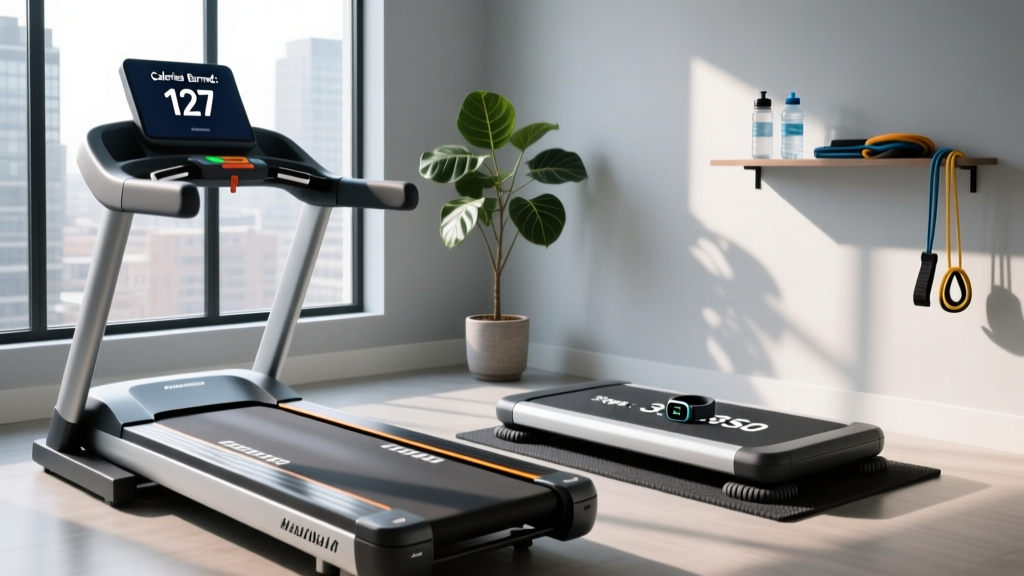
Walking Pad vs Treadmill Setup: How to Burn More Calories on Treadmill
Compare walking pad and treadmill setups for your home gym. Learn installation tips and proven strategies on how to burn more calories on treadmill.

Choosing the right cardio equipment for your home gym in 2026 often comes down to a battle of spatial logistics versus biomechanical output. The under-desk walking pad has exploded in popularity for remote workers, while the traditional motorized treadmill remains the undisputed king of high-intensity cardiovascular conditioning. But how do you actually set them up safely, and more importantly, how do you configure your routine to maximize caloric expenditure?
This comprehensive guide provides a complete setup and installation walkthrough for both machine types, followed by a deep-dive review comparing their real-world performance. Finally, we will break down the exact science and hardware manipulation required to answer the most common fitness query: how to burn more calories on treadmill equipment versus a flat walking pad.
The Unboxing Reality: Footprint, Weight, and Power Requirements
Before you unbox any cardio machine, you must audit your space and electrical infrastructure. The installation failure rate spikes when users ignore power draw and clearance metrics.
Walking Pad Logistics
- Weight & Footprint: Models like the WalkingPad C2 or R2 weigh between 55 and 62 lbs. They fold down to roughly 55 x 28 x 5 inches, making them easy to slide under a bed or sofa.
- Power Draw: Most walking pads feature 1.0 to 1.5 HP motors. They draw minimal amperage and can safely share a standard 15-amp household circuit with other low-draw electronics.
- Flooring Edge Case: Never place a walking pad on thick, high-pile carpet. The motor compartment sits flush against the ground, and carpet fibers block the ventilation grates, leading to thermal shutdowns within 45 minutes of continuous use.
Traditional Treadmill Logistics
- Weight & Footprint: A standard home treadmill, such as the Sole F63 or NordicTrack EXP 7i, weighs between 180 and 250 lbs. The running deck requires a minimum footprint of 70 x 30 inches.
- The 20-Inch Safety Rule: You must leave at least 20 inches of unobstructed clearance behind the treadmill. If a user falls, the safety magnetic key will detach, but momentum will carry them backward. Hitting a wall or furniture immediately behind the belt causes severe friction burns.
- Electrical Isolation: Treadmills with 3.0 CHP (Continuous Horsepower) or higher motors require a dedicated 15-amp or 20-amp circuit. Plugging a 3.0 CHP treadmill into a shared circuit with an air conditioner or space heater will cause the breaker to trip mid-stride when the motor surges during incline transitions.
Step-by-Step Installation Walkthrough
Phase 1: Walking Pad Ergonomic Integration
- Unfolding and Locking: Deploy the walking pad and engage the hinge locking pins. If the hinge is loose, the belt will track sideways within the first mile.
- Desk Height Calibration: For under-desk use, your desk surface must be between 40 and 45 inches from the floor (accounting for the 5-inch height of the walking pad base) to keep your monitor at eye level.
- Anti-Fatigue Matting: Place a high-density EVA foam mat at the front of the walking pad. When you step off the moving belt, stepping onto a hard floor repeatedly causes micro-trauma to the calcaneus (heel bone).
Phase 2: Traditional Treadmill Assembly & Calibration
- Upright Assembly: Always use two people to lift the uprights. The pivot bolts must be threaded by hand first to prevent cross-threading the soft steel inserts.
- Belt Tensioning: Factory belts are often over-tightened to prevent shipping damage. Test the tension by lifting the belt in the center of the deck. It should have exactly 2 to 3 inches of vertical deflection. Use a 3/16-inch hex key on the rear roller bolts to adjust. Over-tightening will destroy the drive motor bearings within six months.
- Incline Motor Calibration: Before stepping on the belt, run the incline from 0% to 15% and back down. This initializes the optical encoder and ensures the lift motor recognizes its absolute zero position.
Hardware Review: Walking Pad vs. Traditional Treadmill
When reviewing these machines through the lens of long-term fitness adaptation, the hardware limitations become glaringly obvious.
Expert Verdict: Walking pads are exceptional tools for NEAT (Non-Exercise Activity Thermogenesis) accumulation. They are perfect for hitting 8,000 to 10,000 steps while working. However, they max out at 4 to 6 mph and feature a 0% fixed incline. If your goal is cardiovascular conditioning, VO2 max improvement, or aggressive weight loss, the traditional treadmill's incline motor and speed range make it the superior hardware investment.Mastering the Incline: How to Burn More Calories on Treadmill
If your primary goal is weight loss and you are researching how to burn more calories on treadmill equipment, you must manipulate the machine's incline and speed variables to increase your Metabolic Equivalent of Task (MET). According to data from Harvard Health Publishing, walking at a brisk pace on a flat surface burns roughly half the calories of walking at an incline.
Here are three hardware-backed strategies to maximize caloric output on a traditional treadmill:
1. The 12-3-30 Protocol (Incline Dominance)
Set the treadmill to a 12% incline, 3 mph speed, for 30 minutes. This forces the posterior chain (glutes and hamstrings) to do the heavy lifting. A 180-lb individual will burn approximately 380 calories during this 30-minute window, compared to just 140 calories on a flat walking pad at the same speed.
2. Heart Rate Zone 2 Intervals
Using a chest strap monitor, adjust the treadmill speed and incline to keep your heart rate between 60% and 70% of your maximum. The American Heart Association recommends targeting specific heart rate zones for optimal cardiovascular adaptation. Traditional treadmills allow for micro-adjustments in 0.5% incline increments, allowing you to dial in this zone perfectly—something a flat walking pad cannot do.
3. Weighted Vest Integration (Advanced)
Adding a 10-lb to 20-lb weighted vest while walking at a 5% to 10% incline increases caloric burn by up to 15%. Warning: Never use hand weights while walking on an incline; this alters your natural gait cycle and places asymmetric shear force on the lumbar spine.
Caloric Expenditure Matrix: Walking Pad vs. Treadmill
| Equipment Setup | Speed / Incline | Duration | Est. Calorie Burn (180 lb user) | Primary Muscle Engagement |
|---|---|---|---|---|
| Walking Pad (Flat) | 3.0 mph / 0% | 30 mins | 145 kcal | Calves, Hip Flexors |
| Walking Pad (Brisk) | 4.5 mph / 0% | 30 mins | 210 kcal | Quads, Calves |
| Treadmill (Moderate) | 3.5 mph / 5% | 30 mins | 285 kcal | Glutes, Hamstrings |
| Treadmill (12-3-30) | 3.0 mph / 12% | 30 mins | 380 kcal | Glutes, Core, Calves |
| Treadmill (HIIT Sprints) | 8.0 mph / 2% | 20 mins | 310 kcal | Full Lower Body, CNS |
Long-Term Maintenance to Protect Your Investment
Regardless of whether you choose a $400 walking pad or a $1,500 traditional treadmill, mechanical failure is usually the result of user negligence rather than manufacturing defects.
- Silicone Lubrication: Both machine types require 100% pure silicone treadmill lubricant. Apply 1 oz under the belt every 150 miles or every 3 months. Never use WD-40 or petroleum-based products, which will melt the PVC belt backing and destroy the MDF deck.
- Static Electricity Mitigation: In dry winter climates, static buildup can fry the treadmill's lower control board. Ensure your treadmill is plugged into a properly grounded 3-prong outlet, and consider running a humidifier in the gym space to keep ambient humidity above 30%.
- Belt Tracking: If the belt drifts to the left, tighten the left rear roller bolt by a quarter turn, or loosen the right bolt by a quarter turn. Always make adjustments while the belt is running at 3 mph, and never adjust more than a quarter turn at a time.
Final Verdict: Which Setup is Right for You?
If your home office setup demands a machine that disappears when not in use, and your primary goal is simply to avoid the sedentary dangers of sitting, a walking pad is an excellent, low-friction installation. However, if you have the dedicated floor space, the electrical infrastructure, and a desire to actively manipulate variables to maximize fat loss, the traditional treadmill is mandatory. By leveraging incline protocols and understanding the biomechanics of your machine, you can transform a standard home cardio session into a highly efficient metabolic engine.
More gear to consider
All reviews
Elliptical vs Treadmill: 2026 Trends & LSRZ Sport Treadmill Data

Beyond the Treadmill Safety Key: Upright, Recumbent & Spin Care
How Much is a Mile on a Treadmill? Motor HP & Wear Guide

Top Under Desk Treadmills With a Treadmill Handle (2026 Review)

Compact Bikes: Layouts & Does Oura Ring Track Steps on Treadmill?
