Space Planning: Used Treadmill vs Air Bike & Assault Bike
Optimize your home gym layout with our space planning guide. Compare the footprint of a used treadmill against the Rogue Echo and AssaultBike ProX.

The 2026 Home Gym Cardio Dilemma: Footprint vs. Function
As home fitness spaces evolve in 2026, the battle for square footage is more competitive than ever. Whether you are converting a two-car garage, partitioning a basement, or dedicating a spare bedroom to your training, spatial efficiency dictates your equipment choices. The ultimate cardio layout debate frequently narrows down to a specific crossroads: do you allocate 25 square feet to a motorized giant, or do you embrace the high-intensity, compact footprint of an air bike?
This guide provides a rigorous spatial and layout analysis comparing the two dominant air resistance bikes on the market—the Rogue Echo Bike V3 and the AssaultBike ProX—against the spatial realities of integrating a used treadmill into a constrained floor plan. We will examine dimensional clearances, environmental overhead, and the hidden spatial traps that ruin home gym layouts.
Air Bike vs. Assault Bike: The Space-Saving Heavyweights
When designing a high-output cardio zone without sacrificing floor space for free weights or racks, air bikes are the undisputed champions of density. However, not all air bikes share the same spatial DNA. The market leaders, Rogue Fitness and Assault Fitness, have engineered their flagship models with distinct geometries that affect how they slot into a room.
Dimensional Deep Dive: Rogue Echo V3 vs. AssaultBike ProX
To understand how these machines fit into your layout, we must look past the marketing and examine the exact chassis measurements. Below is a spatial comparison matrix based on manufacturer specifications and independent floor testing.
| Spatial Metric | Rogue Echo Bike V3 | AssaultBike ProX |
|---|---|---|
| Length (Footprint) | 58.5 inches | 59.0 inches |
| Width (Handlebar Arc) | 29.5 inches | 29.0 inches |
| Height (Static) | 53.0 inches | 52.0 inches |
| Total Floor Area | 12.0 sq ft | 11.9 sq ft |
| Required Rear Clearance | 12 inches | 12 inches |
| Corner Placement Viability | Moderate (Wide stabilizer) | High (Compact rear base) |
While the total floor area is nearly identical at roughly 12 square feet, the Rogue Echo Bike V3 features a significantly wider and heavier front stabilizer bar. This makes it incredibly stable during high-RPM sprints but slightly more cumbersome to tuck into tight alcoves. Conversely, the AssaultBike ProX utilizes a more tapered rear footprint, allowing it to slide closer to walls or power racks when not in use.
The Vertical Threat: Ceiling Height Calculations
A common layout failure occurs when buyers forget to calculate the dynamic vertical envelope. The static height of an air bike is roughly 53 inches. However, you must add the user's inseam and torso length, plus the upward reach of the handlebars during standing climbs.
⚠️ The Ceiling Rule: For any user over 5'10", you must maintain a minimum ceiling height of 96 inches (8 feet) directly above the air bike. If you are installing your cardio zone in a basement with drop ceilings or exposed HVAC ductwork, map the ductwork directly above the bike's intended coordinates to prevent knuckle strikes during maximum-effort intervals.The Used Treadmill Factor: Spatial Traps & Clearance Rules
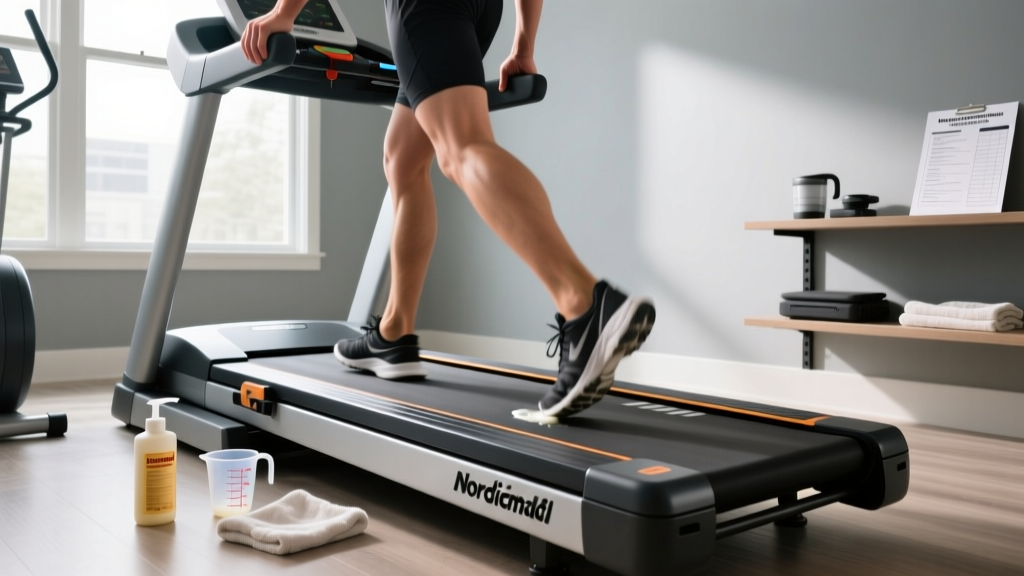
While air bikes offer a 12-square-foot solution, many home gym owners still crave the steady-state zone 2 cardio that only a treadmill can provide. Purchasing a used treadmill (such as a second-hand Sole F80 or NordicTrack 1750) is a financially sound move, often saving $800 to $1,200 compared to retail. However, from a spatial design perspective, a used treadmill introduces severe layout constraints that air bikes simply do not possess.
The 'Folding' Myth in Second-Hand Markets
Most used treadmills on the secondary market are sold as 'folding' models. Space-conscious buyers assume they can fold the deck up after their run, reclaiming 40% of the room. In reality, the hydraulic lift shocks on folding treadmills degrade significantly after 5 to 7 years of use. When buying a used treadmill, you must assume the folding mechanism is compromised or will fail shortly. Therefore, your floor plan must permanently allocate the full deployed footprint—typically 82 inches long by 35 inches wide (roughly 20 square feet)—plus operational clearances.
Mandatory Safety Clearances
Unlike an air bike, which only requires a small buffer for air displacement, a motorized treadmill carries strict safety mandates. The National Strength and Conditioning Association (NSCA) and various consumer safety bodies emphasize that treadmills require massive rear clearances to prevent entrapment and severe friction burns in the event of a fall.
Layout Mandate: You must maintain a minimum of 24 inches of clear space on both sides of the treadmill belt, and a minimum of 36 inches (preferably 48 inches) of unobstructed space directly behind the rear roller. Never place a used treadmill facing a wall where the rear clearance pushes into a doorway or a heavy dumbbell rack.
Environmental Overhead: Electrical and Flooring Spatial Constraints
Space optimization is not just about the physical dimensions of the machine; it is also about the environmental infrastructure required to support it. This is where the divergence between air bikes and used treadmills drastically alters your room's layout.
Electrical Zoning
A used treadmill with a 3.0 to 4.0 continuous horsepower (CHP) motor will draw between 12 to 15 amps under load. Building codes and safety standards dictate that this equipment must be plugged into a dedicated 15-amp or 20-amp circuit. If your basement or garage shares a circuit with a freezer, a window AC unit, or your main lighting, the treadmill's startup surge will trip the breaker. This electrical requirement often forces home gym owners to place the treadmill near specific wall outlets, severely limiting layout flexibility.
Air bikes, being entirely human-powered, require zero electrical infrastructure. You can place a Rogue Echo or AssaultBike in the center of a room, in an uninsulated detached garage, or on a covered patio, granting you 100% spatial freedom.
Flooring and Vibration Dampening
When laying out your cardio zone, consider the subfloor. A used treadmill generates low-frequency harmonic vibrations that travel through floor joists, often rattling drywall and disturbing occupants in rooms directly below. To mitigate this, you must allocate space for a heavy-duty equipment mat or interlocking 3/4-inch rubber horse stall mats beneath the treadmill. Air bikes, despite their high user wattage, transfer minimal downward force to the floor, allowing them to sit directly on standard EVA foam tiles or even bare concrete without acoustic penalties.
Strategic Zoning: Where to Place Your Cardio Anchor
To finalize your 2026 home gym layout, follow this step-by-step spatial zoning framework to ensure optimal traffic flow, safety, and equipment longevity.
- Establish the 'Heavy Drop' Zone: Map out your deadlift platform and squat racks first. This is your primary structural anchor.
- Assign the Cardio Perimeter: Place your air bike or used treadmill along the exterior walls, but maintain a 6-inch gap from the drywall to allow for baseboard airflow and prevent sweat corrosion on the paint.
- Calculate the Airflow Cone: Air bikes push 40 to 50 CFM (cubic feet per minute) of air forward. If you place your AssaultBike ProX facing a wall that is less than 5 feet away, the air will bounce back, creating a turbulent, suffocating microclimate. Always face air bikes toward the center of the room or an open garage door.
- Verify the Treadmill Egress: If using a used treadmill, stand at the rear roller and ensure you have a 4-foot unobstructed path to the nearest exit or open floor space. Never trap the user between the treadmill and a wall.
Final Verdict: Maximizing Your Square Footage
Choosing between a used treadmill and an air bike ultimately comes down to your spatial tolerance and training goals. If your home gym is under 150 square feet, or if your ceiling height dips below 8 feet, the used treadmill is a spatial liability. The mandatory rear clearances, electrical demands, and failing hydraulic hinges of second-hand models will consume your floor plan and dictate your room's traffic flow.
Conversely, if your layout demands maximum caloric output per square foot, the Rogue Echo Bike V3 and AssaultBike ProX are unparalleled. They require less than 12 square feet of floor space, demand zero electrical infrastructure, and can be easily rolled into a corner when it is time to load up the barbell. By respecting the dimensional realities and environmental overhead of your chosen cardio machine, you can engineer a home gym that feels expansive, safe, and built for the long haul.
More gear to consider
All reviews
XTERRA Fitness TRX3500 Treadmill Motor Size & Troubleshooting

Best Treadmill for Glute Growth: Folding Small Space Reviews & Care

Does Hotworx Have Treadmills? The Ultimate Home Stair Climber Guide
Under Desk Treadmill Review: Treadmill Making Clicking Noise (2026)
ProForm Power 795 Treadmill vs Walking Pad: 2026 Review