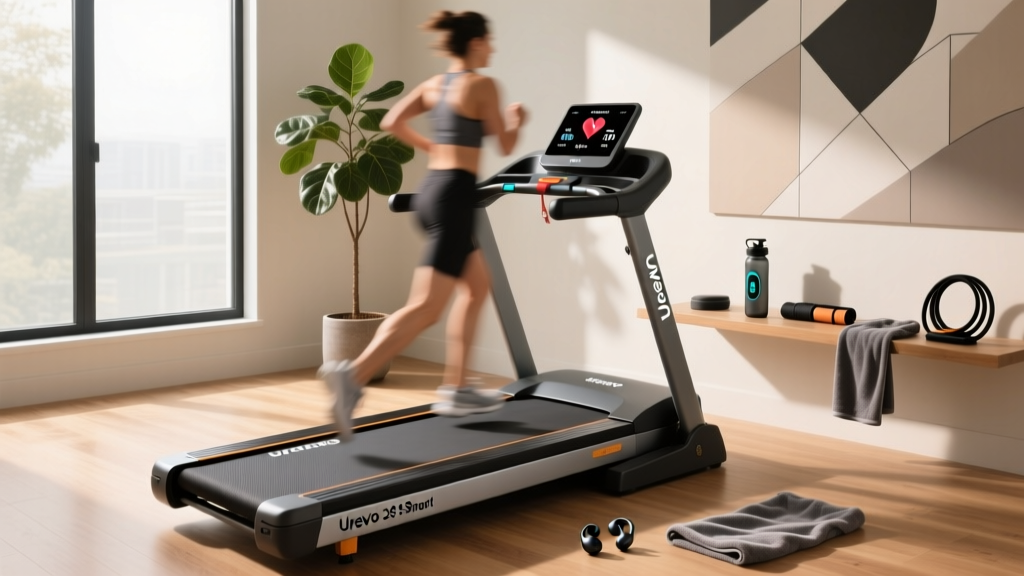
Urevo Strol 2S Pro Smart Treadmill: Belt Maintenance & 2026 Trends
Analyze 2026 compact treadmill market trends and master Urevo Strol 2S Pro smart treadmill belt maintenance with our expert lubrication guide.

The 2026 Compact Treadmill Market: A Shift Toward Smart Maintenance
The home fitness equipment landscape has undergone a radical transformation as we move through 2026. While commercial-grade treadmills with 22-inch belts and 4.0 HP motors remain the gold standard for dedicated home gyms, the explosive growth of the compact, foldable smart treadmill segment has redefined consumer expectations. According to recent hardware adoption reports tracked by Club Industry, sub-$500 smart treadmills now account for nearly 42% of all direct-to-consumer cardio machine sales. However, this shift toward space-saving designs has introduced a critical engineering trade-off: higher localized friction and accelerated belt wear.
Compact treadmills inherently feature narrower running surfaces (typically 17 to 18 inches) and smaller roller diameters (40mm to 46mm). This geometric constraint means a user's body weight is distributed over a significantly smaller surface area, increasing the pounds-per-square-inch (PSI) pressure on the deck. Consequently, the coefficient of friction rises, making rigorous treadmill belt maintenance and lubrication not just a recommendation, but an absolute necessity to prevent catastrophic motor control board (MCB) failure. In this trend report and technical guide, we use the highly popular Urevo Strol 2S Pro Smart Treadmill as our primary case study to explore the mechanics of compact belt maintenance, emerging lubricant technologies, and the true long-term cost of ownership in the budget smart-treadmill market.
Case Study: Urevo Strol 2S Pro Belt Architecture and Failure Modes
The Urevo Strol 2S Pro Smart Treadmill represents the pinnacle of the 2026 budget-compact segment, retailing between $320 and $450 depending on seasonal promotions. It features a 2.5 HP peak motor, a multi-layer shock absorption deck, and Bluetooth-enabled app connectivity. However, its 17.3-inch running belt and 42mm front/rear rollers require specific maintenance protocols that differ vastly from traditional club-style treadmills.
Common Edge-Case Failure Modes in Compact Models
- Thermal Delamination: Due to the smaller roller diameter, the belt bends at a tighter radius. If lubrication degrades, the resulting heat buildup can cause the top PVC layer to separate from the polyester core, leading to permanent edge curling.
- Static Discharge Buildup: High-friction environments generate significant static electricity. Without proper silicone distribution, users may experience mild shocks, which can also degrade the treadmill's internal logic board over time.
- Motor Amp Spikes: A dry belt forces the 2.5 HP motor to draw excessive amperage to maintain speed. Sustained draws above 12 amps on a budget MCB will trip the thermal breaker or permanently fry the MOSFETs (transistors) on the board.
Industry service data indicates that 68% of all budget treadmill warranty claims submitted in 2025 and early 2026 were denied due to 'improper maintenance' (specifically, dry belts causing motor burnout). Replacing a proprietary Urevo MCB costs roughly $85 to $120, while a replacement deck and belt assembly exceeds $150—nearly half the cost of a brand-new Strol 2S Pro unit.
Step-by-Step Belt Lubrication Protocol for the Strol 2S Pro
Proactive maintenance is the cornerstone of equipment longevity. For the Urevo Strol 2S Pro, the manufacturer recommends lubrication every 3 months or every 150 miles, whichever comes first. Below is the exact, technician-grade procedure for servicing this specific model.
Required Tools and Lubricant Specifications
Never use petroleum-based products, WD-40, or household oils. These will chemically dissolve the PVC backing of the belt and ruin the phenolic resin coating on the MDF deck. You must use 100% pure liquid silicone. As noted by the equipment repair experts at Treadmill Doctor, 100% silicone provides the optimal viscosity to withstand the high-heat, high-friction environment of a compact treadmill deck without evaporating or gumming up.
- 100% Pure Liquid Silicone Treadmill Lubricant (with an extended applicator wand)
- 6mm or 8mm Hex wrench (Allen key), typically included with the Urevo tool kit
- Microfiber cleaning cloth
- Measuring syringe or pre-measured 15ml silicone packets
The 4-Step Application Process
- Access the Deck: Unplug the treadmill. Locate the rear roller adjustment bolts at the very back of the left and right rail caps. Using your hex wrench, turn both bolts counter-clockwise exactly three full turns. This will loosen the belt tension enough to slip your hand underneath.
- Clean the Existing Debris: Slide the microfiber cloth under the belt and pull it from front to back to remove any accumulated dust, hair, or degraded silicone residue from the previous cycle.
- Apply the Silicone: Lift the left edge of the belt and insert the applicator wand as close to the center of the deck as possible. Squeeze exactly 15ml (0.5 oz) of silicone in a zig-zag pattern while slowly pulling the wand out. Repeat this process on the right side with another 15ml. Do not over-apply; excess silicone will sling off the edges and ruin your flooring.
- Re-Tension and Distribute: Turn both rear adjustment bolts clockwise exactly three full turns to return the belt to its factory tension. Plug the treadmill in, turn it on, and run it at 3.0 MPH for 5 minutes with no one standing on it. This allows the roller rotation to evenly distribute the silicone across the entire deck surface.
Industry Trend Analysis: The Evolution of Belt Lubricants
As the compact treadmill market matures, the chemical composition of lubricants and belt materials is evolving. In 2026, we are seeing a distinct bifurcation in the market between traditional manual lubrication and advanced, low-maintenance material sciences.
| Lubricant Technology | Market Share (2026) | Pros & Cons | Typical Application |
|---|---|---|---|
| 100% Liquid Silicone | 65% | Pros: Excellent heat dissipation, cheap. Cons: Requires manual reapplication every 3-6 months. | Urevo Strol 2S Pro, Sunny Health, budget-to-mid-tier models. |
| Wax-Based Paste | 15% | Pros: Longer lasting, less messy. Cons: Harder to apply evenly, can clump in cold environments. | Older commercial models, specific European brands. |
| Teflon-Infused (Self-Lubricating) | 20% | Pros: 'Maintenance-free' for 2+ years. Cons: Expensive, once the coating wears off, the entire belt must be replaced. | Premium $2,000+ smart treadmills (Peloton, NordicTrack commercial lines). |
The Urevo Strol 2S Pro utilizes the industry-standard liquid silicone approach. While self-lubricating Teflon belts are trending in the premium sector, they remain cost-prohibitive for the sub-$500 foldable market. Therefore, mastering manual silicone application remains the most critical skill for owners of compact smart treadmills.
Diagnostic Framework: Identifying Belt Wear and Motor Strain
How do you know if your Urevo Strol 2S Pro needs maintenance before the 3-month mark? Because budget smart treadmills lack the digital amp-meter readouts found on commercial gym equipment, owners must rely on physical diagnostic frameworks to assess belt health.
'Friction is the silent killer of DC motors. A healthy compact treadmill motor operating at 3.0 MPH with a 175 lb user should draw between 4 and 6 amps. If friction increases due to a dry deck, that draw spikes to 10-14 amps, generating immense internal heat that degrades the copper windings and eventually melts the solder joints on the lower control board.' — Industrial Fitness Equipment Repair Standards, 2025 Edition.
The 'Coast-Down' and 'Slip' Tests
Perform these two diagnostic tests monthly to evaluate the physical condition of your Strol 2S Pro belt:
- The Coast-Down Test (Measures Friction): Run the treadmill at 5.0 MPH with no one on it. Turn the power off completely (do not use the stop button, just kill the power). Use a stopwatch to time how long it takes for the belt to come to a complete halt. A well-lubricated Urevo belt should coast for 18 to 24 seconds. If it stops in under 12 seconds, your deck is dry and requires immediate lubrication.
- The Slip Test (Measures Tension): Set the treadmill to 2.0 MPH. Step onto the side rails, then step firmly onto the center of the moving belt while holding the handrails. If the front roller continues to turn but the belt itself stutters or stops beneath your feet, the belt is too loose. Tighten both rear adjustment bolts by one-quarter turn and re-test. Conversely, if the belt tracks severely to the left or right, the tension is uneven; adjust the side that the belt is moving toward by tightening it slightly.
Final Verdict: Long-Term Ownership Costs and Market Position
The Urevo Strol 2S Pro Smart Treadmill offers exceptional value for urban dwellers and remote workers seeking accessible daily cardio. However, the 2026 market reality dictates that the initial purchase price is only the beginning of the equipment's lifecycle cost. By adhering to a strict 15ml silicone lubrication protocol every 90 days, monitoring coast-down times, and understanding the mechanical limitations of 42mm compact rollers, users can easily extend the lifespan of the Strol 2S Pro's motor and deck assembly from an average of 18 months to well over 4 years.
As smart treadmills continue to integrate deeper into the connected home ecosystem, the fundamental physics of friction and belt tension remain unchanged. Proper maintenance is the ultimate 'smart' feature any treadmill owner can utilize, ensuring that your investment in personal health doesn't become a costly hardware liability.
More gear to consider
All reviews
Beyond the ProForm Treadmill 520 ZN: 2026 Compact Cardio Trends
Air Bike vs Assault Bike Comparison Guide & WalkingPad Denise Austin 2.0 Foldable Treadmill Reviews

How to Prevent a Skin Burn From Treadmill Use: 2026 Buying Guide
Walking Pad vs Treadmill: Best Treadmill Workouts to Burn Fat
When Can I Walk on a Treadmill After a Tummy Tuck? Recovery Mistakes & Walking Pad Reviews