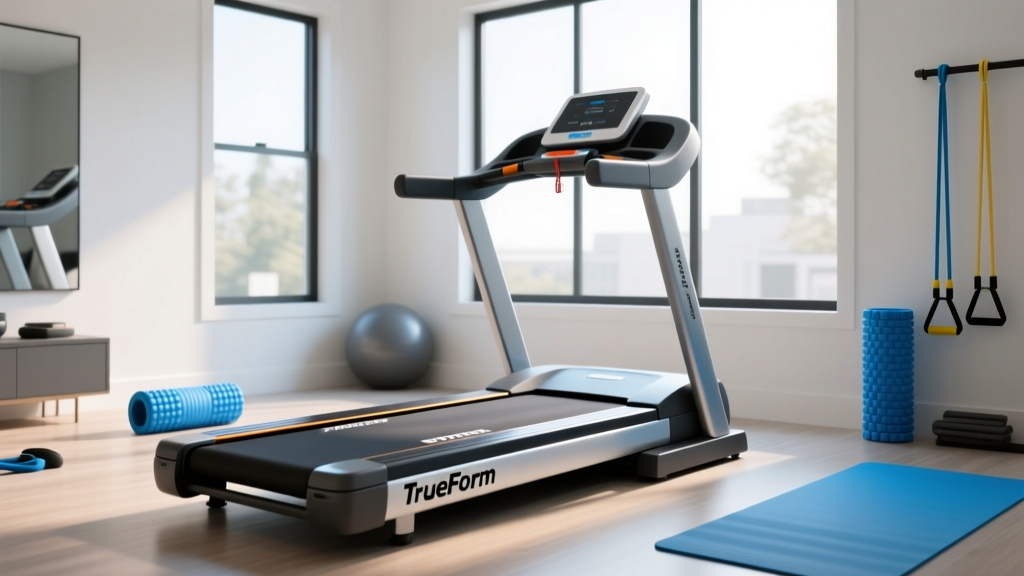
TrueForm Runner Treadmill: Belt Maintenance & Space Layout
Optimize your home gym layout with our guide to TrueForm Runner treadmill belt maintenance, spatial clearances, and curved treadmill placement.

The Intersection of Spatial Design and Curved Treadmill Maintenance
When designing a high-performance home gym in 2026, spatial optimization often takes precedence over equipment servicing requirements. Fitness enthusiasts meticulously measure floor plans to fit premium cardio machines into tight alcoves or basement corners, frequently overlooking the operational clearances required for long-term maintenance. This oversight is particularly costly when integrating a trueform runner treadmill into a compact layout. Unlike traditional flat-bed motorized treadmills, curved manual treadmills rely on complex mechanical tension and gravity-driven physics rather than electronic motors.
The TrueForm Runner (retailing around $6,499) is a masterpiece of biomechanical engineering, featuring a 350-pound footprint and a continuous vulcanized rubber slat belt. However, its unique belt system dictates a very specific approach to maintenance—one that is entirely dependent on how much physical space you allocate around the machine in your floor plan. Failing to design your gym layout with maintenance clearances in mind will render essential belt tensioning, alignment, and bearing care physically impossible, leading to premature wear and costly service calls.
CRITICAL MAINTENANCE MYTH: THE LUBRICATION FALLACYThe most common error new owners make is attempting to apply silicone-based treadmill lubricants to the TrueForm Runner’s slat belt. Never lubricate a curved manual treadmill belt. The TrueForm utilizes 56 sealed ball-bearing rollers and a high-friction rubber slat track. Introducing silicone spray or liquid lubricants will degrade the rubber, attract abrasive dust, and cause catastrophic belt slip. Maintenance for this machine is entirely mechanical (tension and alignment) and environmental (dust extraction), both of which require specific spatial access.
Spatial Clearances Required for Belt Maintenance
To properly maintain the belt tracking and tension on a trueform runner treadmill, you must treat the space immediately surrounding the machine as an active 'service zone.' According to facility design guidelines published by the National Strength and Conditioning Association (NSCA), commercial fitness floors mandate strict clearance perimeters for equipment servicing. Home gym layouts must adapt these principles to prevent equipment degradation.
Minimum Clearance Metrics for the TrueForm Runner
- Rear Axle Access (Minimum 24 Inches): The belt tensioning mechanism is located at the rear axle. You must have at least 24 inches of unobstructed space behind the treadmill to comfortably kneel, use a socket wrench on the tensioning bolts, and visually verify belt alignment while manually rotating the track.
- Lateral Wiping and Vacuuming (Minimum 18 Inches per side): Dust and skin cells accumulate in the side channels of the slat belt. You need 18 inches on both the left and right sides to maneuver a crevice-tool vacuum attachment and wipe down the lateral frame rails without contorting your body.
- Overhead Clearance (Minimum 80 Inches): While not directly related to the belt, the 62-inch height of the TrueForm Runner, combined with the vertical bounce of a runner’s stride, requires ample overhead space to prevent psychological gait alterations that can cause uneven belt wear.
Maintenance Clearance Matrix: Curved vs. Motorized
Understanding how the spatial needs of a manual curved treadmill differ from standard motorized models is vital for layout planning. Motorized treadmills primarily require side-access for deck lubrication, whereas curved treadmills demand rear-access for mechanical tensioning.
| Equipment Type | Primary Belt Maintenance | Rear Clearance Needed | Side Clearance Needed |
|---|---|---|---|
| TrueForm Runner (Curved Manual) | Rear-axle tensioning, bearing vacuuming | 24 - 30 inches | 18 inches |
| NordicTrack 1750 (Motorized) | Silicone deck lubrication, belt centering | 12 inches (plug access) | 24 inches |
| Peloton Tread (Motorized) | Belt tracking, motor hood dusting | 12 inches | 20 inches |
Step-by-Step Belt Tensioning: Why Space Matters
Over time, the Kevlar-reinforced continuous belt beneath the rubber slats of the TrueForm Runner will experience micro-stretching. When the belt slips under heavy sprinting loads, it requires mechanical tensioning. If your treadmill is pushed flush against a drywall partition, this essential maintenance cannot be performed. Here is the procedure that dictates your spatial layout:
- Access the Rear Axle: Move to the rear of the treadmill. This is why the 24-inch rear clearance is non-negotiable; you must be able to crouch and view the belt’s tracking path from behind.
- Locate the Tensioning Bolts: Identify the left and right rear axle adjustment bolts. These are typically accessed via the rear end-caps.
- Apply Quarter-Turn Adjustments: Using the appropriate metric wrench (refer to your specific model year’s manual, typically 13mm or 15mm), turn both the left and right bolts clockwise by exactly one-quarter turn. Never adjust one side independently unless correcting a lateral tracking issue.
- Test and Rotate: Manually rotate the slat belt with your hands to ensure the tension is even and the belt remains centered on the 56 sealed bearings. Repeat the quarter-turn process if slip persists under load.
The greatest enemy of the TrueForm’s sealed bearings is fine particulate dust, which works its way under the rubber slats and creates an abrasive paste. Once a month, you must use a shop-vac with a crevice tool to run along the entire lateral edge of the belt track. If your treadmill is wedged into a corner, you will miss the dust trap on the wall-side, leading to asymmetric bearing wear and a noisy, grinding operation within 18 months.
Flooring Transitions and Belt Tracking
Space optimization isn't just about the empty air around the machine; it is also about the floor footprint it occupies. The TrueForm Runner relies on absolute leveling to maintain proper belt tracking. If the belt consistently drifts to the left or right, it is rarely a belt issue—it is a flooring issue.
When designing your layout, avoid placing the treadmill where it bridges two different flooring densities (e.g., half on thick rubber stall mats, half on bare concrete). This creates a micro-incline that forces the slat belt to track aggressively toward the lower side, causing the rubber slats to scrape against the side rails. According to equipment manufacturers like TrueForm Fitness, the machine must be placed on a uniform, high-density surface. If space constraints force you to use interlocking gym tiles, ensure the tiles are high-density (Shore A hardness of 60 or above) and that the treadmill’s four leveling feet are entirely supported by a single, continuous surface plane.
Compact Gym Strategies for Curved Treadmills
If you are designing a small apartment gym or a tight garage fitness zone in 2026, accommodating a 74-inch long, non-folding manual treadmill requires strategic compromises. Since you cannot fold the TrueForm Runner vertically like a motorized NordicTrack, consider these spatial hacks to preserve your maintenance zones:
- Use Heavy-Duty Equipment Casters: While the TrueForm has transport wheels on the front, moving a 350-pound machine away from the wall for rear-axle maintenance is difficult on rubber flooring. Place the rear feet on low-profile, high-weight-capacity furniture sliders during your monthly maintenance routine, allowing you to easily pull the machine 2 feet away from the wall, perform your tensioning and vacuuming, and slide it back.
- Diagonal Placement: In square rooms, placing the treadmill diagonally in a corner naturally creates a triangular 'dead space' behind the rear axle. This corner pocket provides the perfect, unobtrusive 24-inch clearance wedge needed to kneel and access the tensioning bolts without dedicating an entire wall to empty space.
- Wall-Mounted Mirrors: Instead of leaving lateral space for visual form-checking, mount mirrors directly on the side walls. This allows you to utilize the 18-inch side clearance strictly for maintenance access and vacuuming, rather than leaving it open for a walking path.
Final Thoughts on Preventative Layout Design
Integrating a trueform runner treadmill into your home gym is an investment in elite, joint-friendly cardiovascular training. However, treating it like a standard motorized treadmill during the floor-planning phase is a critical error. By respecting the mechanical realities of the slat belt system—specifically the absolute ban on chemical lubricants and the strict requirement for rear-axle spatial access—you ensure the machine operates silently and smoothly for decades. Design your space not just for the workout, but for the maintenance that makes the workout possible.
For further reading on optimizing home fitness environments and managing indoor air quality to protect equipment bearings, consult the environmental guidelines provided by the American Council on Exercise (ACE). Proper spatial planning is the ultimate form of preventative equipment maintenance.
More gear to consider
All reviews
Stair Climber Home Guide & 30-Minute Treadmill Workout for Beginners

Air Bike vs Assault Bike Comparison Guide & WalkingPad Denise Austin 2.0 Foldable Treadmill Reviews

Assault Bike vs Air Bike: Maintenance & Inclined Treadmill Tips

Expert Treadmilling Belt Maintenance & Top Lubricant Picks
NordicTrack 2950 Treadmill Noise: Troubleshooting & Comparisons
