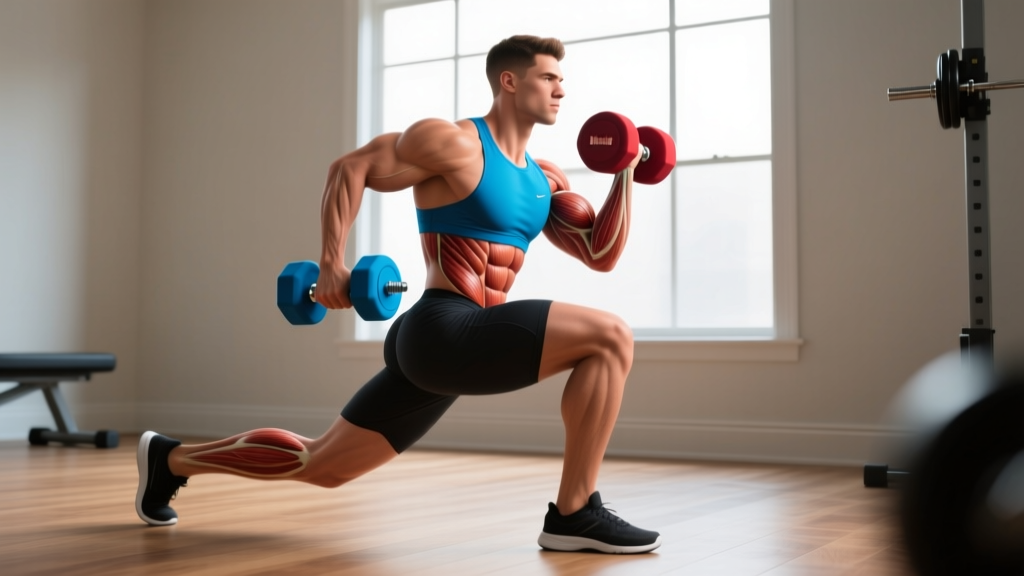
Dumbbell Lunges Muscles Worked: Troubleshooting Neoprene Form Errors
Discover which dumbbell lunges muscles worked are targeted. Troubleshoot common form mistakes and grip issues when using neoprene dumbbells at home.

The Home Gym Reality: Neoprene Dumbbells and Lunge Mechanics
As home gym setups continue to evolve in 2026, neoprene-coated dumbbells remain a staple for their floor-friendly, quiet, and rust-resistant properties. However, their unique physical characteristics—specifically their smooth grips, hexagonal edges, and fixed-weight increments—can inadvertently sabotage your lower body biomechanics. If you have ever finished a set of lunges with a burning lower back, aching knees, or exhausted forearms, your equipment and form are likely clashing.
Understanding exactly which dumbbell lunges muscles worked depends heavily on your torso angle, stride length, and how you grip the weight. This troubleshooting guide dissects the most common form failures associated with neoprene dumbbells and provides actionable fixes to ensure you are targeting the right muscle groups without risking joint injury.
Mapping the Movement: Dumbbell Lunges Muscles Worked
Before troubleshooting, we must establish the baseline anatomy of a standard forward or reverse lunge. According to biomechanical analyses published in the Journal of Sports Science & Medicine, the lunge is a highly adaptable, multi-joint exercise. The primary and secondary muscle activations shift dramatically based on minor kinematic adjustments.
- Primary Movers: Quadriceps (vastus lateralis, medialis, and rectus femoris) and Gluteus Maximus.
- Secondary Stabilizers: Hamstrings (biceps femoris), Adductor Magnus, and Gastrocnemius (calves).
- Core & Postural: Erector Spinae, Rectus Abdominis, and Quadratus Lumborum (which work isometrically to prevent torso rotation).
The Neoprene Factor: Equipment-Specific Troubleshooting
Why focus specifically on neoprene-coated dumbbells for home use? Unlike bare steel or chrome dumbbells with aggressive knurling, neoprene dumbbells (like the popular CAP Barbell Hex or BalanceFrom GoFit lines) feature a smooth, rubberized coating. This creates three distinct failure modes during lunges.
1. The Grip Fatigue Bottleneck
Neoprene handles lack texturing. To prevent the dumbbell from slipping, especially when sweating, lifters instinctively over-grip. This excessive isometric forearm contraction leads to grip failure long before the target leg muscles reach muscular failure.
The Fix: Use lifting straps or chalk. Alternatively, switch to a 'suitcase hold' where the dumbbell rests lightly against the outer thigh, using your latissimus dorsi to stabilize the weight rather than relying solely on finger flexors.
2. Hex-Edge IT Band Bruising
When performing walking lunges, lifters often slide the dumbbell down their leg to rest the weight. The hard, 90-degree edges of hex-shaped neoprene dumbbells can dig into the iliotibial (IT) band or the vastus lateralis, causing bruising and altering your stride to avoid pain.
The Fix: Maintain a 1-inch gap between the dumbbell and your leg. Engage your core and shoulder stabilizers to hold the weight slightly away from the body, which concurrently increases core activation.
3. The Fixed-Weight Trap
Neoprene sets usually jump in 5 lb or 10 lb increments. Lunges require significantly less weight than bilateral squats. Grabbing your 30 lb squat dumbbells for lunges often forces a biomechanical breakdown, leading to knee valgus (caving inward) and excessive forward lean.
Form Failure Matrix: Symptoms and Fixes
Use this diagnostic table to identify why your targeted dumbbell lunges muscles worked might not match what you actually feel after a workout.
| Symptom / Pain Point | Probable Muscle Imbalance | Neoprene Equipment Factor | Troubleshooting Fix |
|---|---|---|---|
| Sharp pain in the front of the knee (patellar tendon) | Quad dominance; weak glute activation | Weight too heavy (fixed 10lb jump); over-gripping pulls torso forward | Drop weight by 5 lbs per hand; increase stride length by 4-6 inches. |
| Lower back (lumbar) fatigue or spasms | Erector spinae overworking; weak core bracing | Thick neoprene grip (35mm+) forces arms wide, altering center of mass | Switch to reverse lunges; brace core using the Valsalva maneuver before descent. |
| Outer thigh / IT band bruising | Lateral pelvic tilt; asymmetrical loading | Hex edges resting against the leg during walking lunges | Hold dumbbells 2 inches away from the thigh; slow the eccentric phase to 3 seconds. |
| Forearm burn before leg fatigue | Grip strength bottleneck | Smooth neoprene coating lacks knurling | Use figure-8 lifting straps or apply liquid chalk to the handles. |
3 Biomechanical Mistakes Altering Muscle Activation
Mistake 1: The 'Tightrope' Stance
Many home gym users step directly in a straight line, one foot in front of the other. This narrow base of support forces the adductors and abductors to work overtime just to maintain balance, drastically reducing the load on the prime movers (quads and glutes).
"Your feet should remain hip-width apart during the entire lunge movement. Imagine you are walking on train tracks, not a single tightrope." — Cleveland Clinic Biomechanics Guidelines
Mistake 2: The Forward Knee Slide
If your heel lifts off the ground as you descend, you are shifting 80% of the load to the knee joint and the distal quadriceps tendon. This is often caused by ankle dorsiflexion restrictions or stepping too short. Ensure your front heel remains firmly planted, driving through the mid-foot to activate the posterior chain.
Mistake 3: Rushing the Eccentric Phase
Bouncing out of the bottom position uses the stretch reflex of the tendons rather than muscular contraction. When using neoprene dumbbells, the lack of audible 'clank' (unlike iron plates) often subconsciously encourages lifters to move faster. Enforce a strict 3-1-1 tempo: 3 seconds down, 1 second pause at the bottom (hovering the back knee 1 inch off the floor), and 1 second explosive drive up.
Selecting the Right Neoprene Weight for Home Lunges
In 2026, high-quality neoprene dumbbells average between $1.80 and $2.40 per pound. Because lunges are a unilateral movement, your weight requirements will be roughly 40% to 50% of what you use for bilateral goblet squats.
- Beginner (Focus on Stability): 10 lbs to 15 lbs per hand. (Recommended: Amazon Basics Neoprene Hex, ~$35 for a 15lb pair). Focus on the 90-degree knee flexion and hip-width track.
- Intermediate (Hypertrophy Focus): 20 lbs to 30 lbs per hand. (Recommended: CAP Barbell Coated Hex, ~$85 for a 25lb pair). Introduce walking lunges and 15-degree torso hinges for glute bias.
- Advanced (Strength/Overload): 35 lbs to 50+ lbs per hand. Warning: At this weight, the thick 40mm+ handles on heavy neoprene dumbbells will severely limit grip. Transition to urethane or knurled steel, or use heavy-duty lifting straps.
Expert Troubleshooting FAQ
Why do I only feel lunges in my quads and not my glutes?
This is the most common question regarding dumbbell lunges muscles worked. Quad dominance occurs when your stride is too short and your torso is perfectly vertical. To shift the tension to the glutes, take a 6-inch longer step forward and allow your torso to naturally hinge forward at a 20-degree angle, keeping your spine neutral.
Are reverse lunges better than forward lunges for home use?
For most home gym users working with fixed-weight neoprene dumbbells, reverse lunges are superior. Stepping backward keeps the center of mass stable over the front leg, reducing shear force on the patellar tendon and making it easier to maintain a hip-width base without losing balance on rubber flooring or carpet.
How do I clean sweat off neoprene handles to prevent slipping?
Neoprene degrades and becomes slick when exposed to the salts and oils in human sweat over time. Do not use harsh chemical cleaners like bleach, which will strip the coating. Instead, wipe the handles down after every session with a microfiber cloth dampened with a 50/50 mixture of white vinegar and water. Once a month, scrub the grips with a soft-bristle brush and mild dish soap to restore the original matte texture.
Final Thoughts on Unilateral Training
Mastering the lunge requires a deep understanding of your own biomechanics and the equipment in your hands. Neoprene dumbbells are excellent, low-maintenance tools for home gyms, but their smooth grips and rigid edges demand stricter form awareness. By diagnosing your specific failure points—whether it is grip fatigue, stride length, or torso angle—you can ensure that the dumbbell lunges muscles worked are exactly the ones you intend to build. Drop the ego, adjust your stride, and let the biomechanics do the heavy lifting.
More gear to consider
All reviews
The Best Dumbbell Only Back Workout & Top Adjustable Dumbbell Picks

Elevated Dumbbell Sumo Squats: Neoprene Weight Mistakes & Fixes

Bumper vs Iron Plates & Standing Ab Workout With Dumbbells Layouts

Bumper vs Iron Plates & the Seated Dumbbell Arnold Press Rack Guide

Optimizing Rack Storage for a Thigh Workout with Dumbbells
