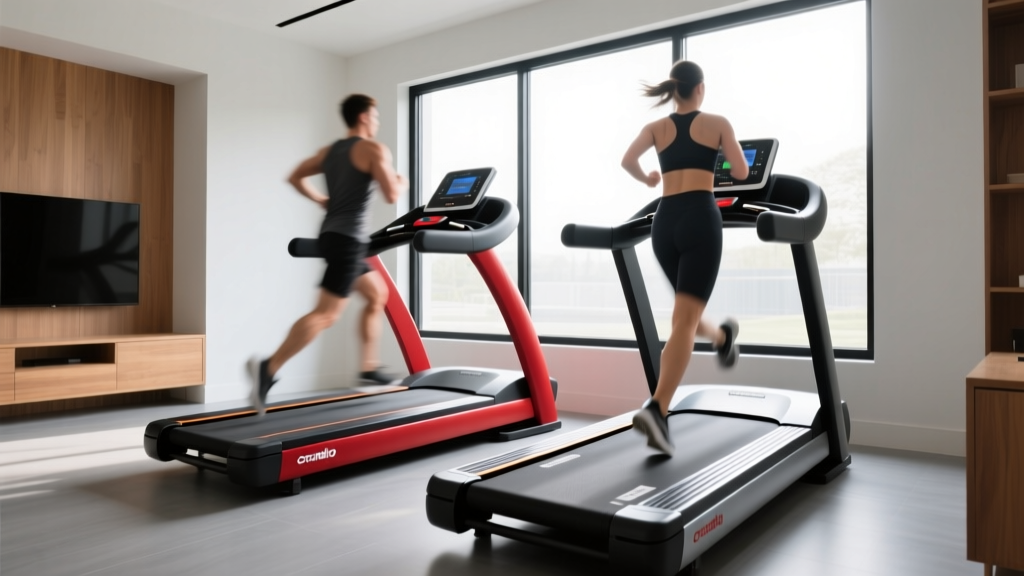
Troubleshooting Alternative Treadmill Classes: Curved vs Motorized
Fix common mistakes in alternative treadmill classes. Compare curved manual vs motorized treadmills, troubleshoot sprint lag, and optimize biomechanics.

The Shift to Alternative Treadmill Classes
As we navigate the 2026 home fitness landscape, the boutique studio experience has thoroughly infiltrated the garage gym. Alternative treadmill classes—ranging from dark-room sprint bootcamps and gamified virtual endurance rides to rhythm-based running sessions—have surged in popularity. However, transitioning from a studio environment to a home setup introduces a massive hardware dilemma: should you invest in a curved manual treadmill or stick with a traditional motorized model?
Making the wrong choice, or failing to troubleshoot the biomechanical and mechanical quirks of your chosen machine, is the fastest way to derail your training. This guide dissects the most common mistakes users make when replicating alternative treadmill classes at home, offering expert troubleshooting frameworks for both curved and motorized platforms.
Machine Match-Up: 2026 Market Realities
Before troubleshooting form and hardware, you must understand the mechanical baseline of your equipment. The demands of a high-intensity interval training (HIIT) class are vastly different from a steady-state Zone 2 endurance session.
| Machine Type | Top 2026 Benchmark Model | Avg. Price | Best Class Style | Primary Failure Point |
|---|---|---|---|---|
| Curved Manual | AssaultRunner Elite | $3,299 | Sprint intervals, HIIT, power pushes | Slat belt tension loss, rear axle wear |
| Curved Manual | TrueForm Trainer | $3,495 | Rhythm running, mid-foot strike drills | Rubber belt degradation under heavy friction |
| Motorized (Flat) | NordicTrack Commercial 1750 | $1,999 | Incline hikes, virtual scenic routes | Motor thermal limits, speed-change lag |
| Motorized (Flat) | Horizon 7.4 | $1,299 | Steady-state Zone 2, recovery jogs | Deck friction, budget FTMS Bluetooth drops |
Mistake #1: Ignoring Motorized "Sprint Lag" During HIIT
The most frequent complaint from users taking alternative treadmill classes like Sprint Social or Barry's Bootcamp at home is the "disconnect" during all-out sprint intervals. If you are using a motorized treadmill, you are fighting physics and software.
The Troubleshooting Framework: Overcoming the 1.2-Second Delay
Even premium motorized treadmills with a 4.0 Continuous Horsepower (CHP) motor, such as the NordicTrack Commercial 1750, experience a 0.8 to 1.5-second mechanical and software lag when you mash the quick-speed buttons. In a 20-second all-out sprint interval, a 1.5-second lag eats nearly 10% of your active work time, artificially lowering your heart rate peak and ruining the class's intended metabolic stimulus.
⚠️ WARNING: The "Manual Mode" DangerMany users attempt to bypass motorized lag by switching the console to "Manual" mode and physically running the belt up to speed with their feet while holding the handrails. Never do this. This places catastrophic lateral shear stress on the deck and voids the warranty. Instead, pre-program custom interval workouts via the manufacturer's app where the machine anticipates the speed change, or accept the lag and extend your sprint intervals by 2-3 seconds to compensate.
If your primary goal is to replicate studio-style sprint intervals with zero latency, a curved manual treadmill is non-negotiable. The Mayo Clinic notes that the efficacy of interval training relies heavily on the rapid transition between high-intensity output and recovery; manual treadmills allow instant speed changes dictated entirely by your leg turnover.
Mistake #2: Biomechanical Breakdown on Curved Treadmills
Curved treadmills are phenomenal for alternative treadmill classes focused on power and sprinting, but they are unforgiving of poor biomechanics. The most common mistake is treating a curved belt exactly like a motorized one.
Troubleshooting "Heavy Legs" and Shin Splints
On a motorized treadmill, the belt pulls your foot back, allowing for a heel-strike or mid-foot strike regardless of your position on the deck. On a curved treadmill (like the Woodway Curve or AssaultRunner), you are the motor.
- The Braking Effect: If you run too far back on the curve, your foot strikes the upward slope. This acts as a mechanical brake, forcing your quads to work 15-20% harder and frequently leading to patellar tendonitis and shin splints.
- The Over-Speed Effect: If you run too far forward, near the handrails, the steep downward slope pulls you into an uncontrollable sprint, compromising your pelvic tilt and straining your lower back.
Expert Fix: Locate the "sweet spot" on the apex of the curve. You should maintain a strict mid-foot strike directly under your center of mass. During rhythm-based alternative treadmill classes, focus on pulling your knee up and driving the ball of your foot down, rather than reaching forward with your heel.
Mistake #3: Neglecting Hardware Maintenance Under Class Loads
Alternative treadmill classes demand high volume and high torque. Residential machines are often pushed past their engineered limits when subjected to daily 45-minute boutique-style workouts.
Motorized Treadmills: The Thermal Shutdown
Classes heavily focused on incline work (like Orangetheory's "Hill" days) are notorious for frying residential motors. Running at a 12% to 15% incline at speeds above 4.0 MPH requires immense amperage. If your treadmill is plugged into a shared 15-amp household circuit via an extension cord, the voltage drop will cause the motor to overheat and trigger a thermal shutdown mid-class.
- Audit your power: Ensure the treadmill is plugged directly into a dedicated 20-amp wall outlet.
- Lubricate the deck: A dry deck increases friction, forcing the motor to draw more amps. Apply 100% silicone treadmill lubricant every 150 miles or every 3 months.
- Clear the hood: Use compressed air to blow dust out of the motor hood quarterly. Dust acts as an insulator, trapping heat inside the motor casing.
Curved Treadmills: Slat Belt Slippage
On slat-belt curved treadmills, the most common mid-class failure is belt slippage during a heavy power push. This is rarely a broken belt; it is almost always a tension issue. Over time, the rear axle shifts forward. Using the specific 10mm hex key provided by the manufacturer, you must tighten the rear tension bolts exactly one full clockwise turn on both the left and right sides to restore grip without over-tensioning the bearings.
Mistake #4: App and FTMS Bluetooth Sync Failures
Many alternative treadmill classes in 2026 are app-driven, utilizing platforms like Zwift, the Peloton App, or Apple Fitness+ to track metrics and control virtual avatars. The bridge between your treadmill and these apps is the FTMS (Fitness Machine Service) Bluetooth protocol.
Troubleshooting the "Rubber-Banding" Avatar
If your avatar in Zwift constantly rubber-bands (speeds up and slows down erratically) during a sprint class, your treadmill's internal Bluetooth board is struggling to broadcast speed data at the required 1Hz (once per second) frequency. Budget motorized treadmills often drop packets when the motor generates high electromagnetic interference (EMI) during high-speed intervals.
✅ The FTMS Troubleshooting Checklist:- Use a dedicated Bluetooth dongle: If your smart TV or laptop supports it, use a high-quality external Bluetooth 5.0 dongle rather than the device's internal antenna to reduce latency.
- Update firmware: Check the manufacturer's console menu for firmware updates. Brands like Horizon and NordicTrack frequently patch FTMS broadcast bugs.
- Footpod backup: For competitive virtual racing classes, bypass the treadmill's Bluetooth entirely. Pair a Garmin HRM-Pro Plus or Stryd footpod directly to your app for flawless, zero-latency speed and cadence data.
Expert Verdict: Matching the Machine to Your Class Style
Successfully executing alternative treadmill classes at home requires aligning your hardware with your programming. If your weekly schedule is dominated by HIIT, sprint intervals, and power pushes, the instant responsiveness and superior biomechanical feedback of a curved manual treadmill (budget $3,000 - $4,000) will yield vastly superior results and eliminate sprint-lag frustration.
Conversely, if your preferred alternative classes focus on long endurance rides, heavy incline hiking, or scenic virtual routing, a high-quality motorized treadmill with a minimum 4.0 CHP motor and a robust cooling system (budget $1,800 - $2,500) is the correct tool. According to the American Heart Association's guidelines on physical activity, consistency in your cardiovascular routine is the ultimate driver of heart health. Choose the machine that minimizes friction—both mechanical and motivational—so you can show up for every class.
By understanding the mechanical realities, maintaining your hardware, and correcting your biomechanics, you can transform your garage into a world-class studio environment, free from the interruptions of poorly troubleshooted equipment.
More gear to consider
All reviews
Folding Treadmill Small Space Review & Treadmill Burn Treatment

Who Makes Horizon Treadmills? Stair Climber Home Setup Guide

Cardio Machine Noise: Treadmill Heels Impact & Troubleshooting

How Many Miles is 10k Steps on Treadmill? Curved vs Motorized Guide
Home Gym Layouts: Bike Types and Your Precor Treadmill Serial Number
