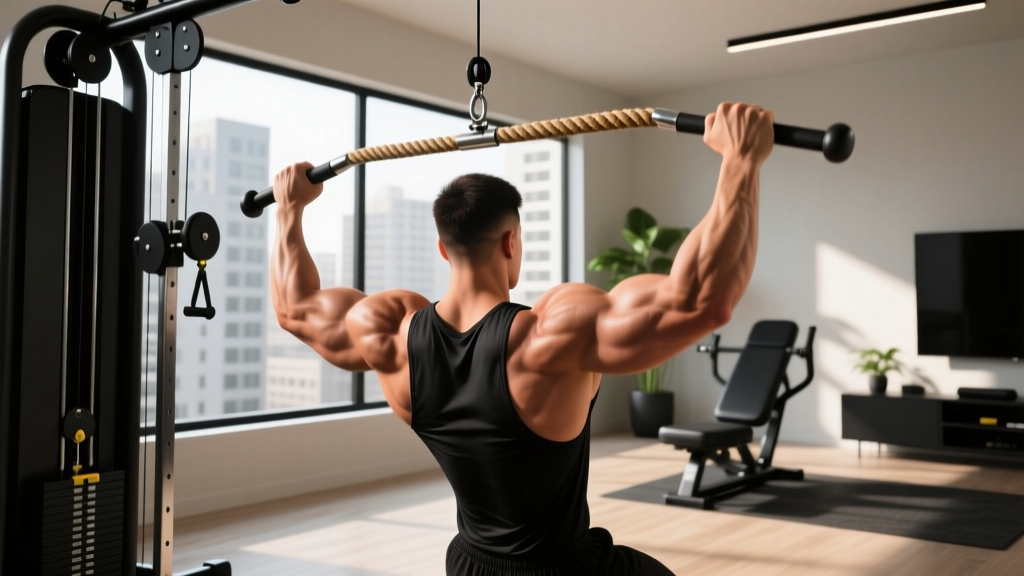
Tricep Rope vs Bar: Cable Arms Beyond Nautilus Bicep Curl Machines
Compare tricep rope and bar attachments for cable pushdowns, and learn how to pair them with a Nautilus bicep curl machine for ultimate arm growth.

The Architecture of Arm Hypertrophy: Cable Versatility vs. Fixed Isolation
Building a complete, proportionate arm stack requires more than just mindless reps; it demands a strategic understanding of biomechanics, equipment leverage, and joint health. In modern commercial and high-end home gyms, the triceps are primarily targeted via high-pulley cable systems using various attachments. However, the biceps often require a different approach to achieve maximum isolation. This is where the contrast between versatile cable attachments and dedicated fixed-path equipment—like a nautilus bicep curl machine—becomes the cornerstone of elite arm programming.
In this head-to-head comparison, we are breaking down the biomechanical differences between the tricep rope and metal bar attachments (straight and V-bar). We will also explore how these variable-resistance cable tools perfectly complement the fixed-cam isolation of a Nautilus bicep curl machine to create the ultimate arm hypertrophy ecosystem in 2026.
Biomechanics of the Pushdown: Rope vs. Metal Bar
The triceps brachii consists of three heads: the long, lateral, and medial. While all three heads contribute to elbow extension, the angle of your wrist and shoulder dictates the bias and the amount of mechanical tension you can safely apply. According to electromyography (EMG) data published in the Journal of Strength and Conditioning Research, the choice of attachment significantly alters muscle activation patterns and joint stress.
The Tricep Rope: Peak Contraction and Joint Freedom
The nylon tricep rope (typically 24 to 28 inches in length) is the gold standard for maximizing the shortened position of the triceps. Because the rope is not a fixed solid bar, it allows the lifter to pull the attachment past the hips, splitting the hands outward at the bottom of the movement.
- Wrist Ergonomics: The rope permits a neutral grip (palms facing each other), which aligns the radius and ulna bones, drastically reducing the risk of medial epicondylitis (golfer's elbow).
- Peak Contraction: By splitting the rope at the bottom, you introduce shoulder extension and wrist supination/pronation, allowing for an extra 10 to 15 degrees of range of motion (ROM) compared to a solid bar.
- The Drawback: The flexible nature of the rope limits absolute load. Attempting to push past 80-90 lbs on a standard rope often results in grip failure or the rope bunching up, reducing mechanical tension on the triceps.
The Straight and V-Bar: Overload and Lateral Head Bias
Metal attachments, such as the standard straight bar or the angled V-bar, are designed for progressive overload. The solid structure allows lifters to move significantly heavier loads, making them ideal for the mechanical tension required to trigger myofibrillar hypertrophy.
- The V-Bar Advantage: An angled V-bar (typically pitched at 30 degrees) offers a semi-neutral grip. It bridges the gap between the heavy overload of a straight bar and the wrist comfort of a rope. It heavily biases the lateral head, giving the arm that coveted 'sweep' from the front.
- The Straight Bar Trap: While it allows for the heaviest loads, a straight bar forces the wrists into full extension and supination. Under heavy loads (120+ lbs), this can compress the carpal tunnel and strain the wrist flexors, making it a high-risk option for lifters with pre-existing joint issues.
Head-to-Head Attachment Comparison Matrix
| Attachment Type | Max Load Capacity | Wrist Ergonomics | Peak Contraction | Primary Tricep Head Targeted |
|---|---|---|---|---|
| Nylon Tricep Rope | Moderate (60-90 lbs) | Excellent (Neutral) | Maximum (Split ROM) | Long & Medial Heads |
| Angled V-Bar | High (100-150+ lbs) | Good (Semi-Neutral) | Moderate (Hip Block) | Lateral Head |
| Straight Metal Bar | Maximum (150+ lbs) | Poor (Full Extension) | Low (Hip Block) | Lateral & Medial Heads |
Completing the Arm Stack: The Role of the Nautilus Bicep Curl Machine
While cable attachments offer incredible versatility for the triceps, the biceps often suffer from 'momentum cheating' when trained with free weights or standard cables. This is exactly why premier fitness facilities and serious home gym owners pair their functional cable towers with a dedicated nautilus bicep curl machine.
Unlike cables, which provide linear vector resistance, a modern Nautilus bicep curl machine (such as the selectorized models engineered by Core Health & Fitness) utilizes a precision cam system. This cam is mathematically designed to match the natural ascending-descending strength curve of the human bicep.
The Synergy of Variable vs. Fixed Resistance
Triceps (Cable Attachments): Require multi-planar freedom to navigate around the hips and maximize the shortened position. Ropes and V-bars provide this necessary variable path.
Biceps (Nautilus Machine): Require strict, fixed-path isolation to eliminate shoulder sway and momentum. The Nautilus cam ensures that the bicep is under maximum tension at the exact point of peak contraction (90 degrees of elbow flexion), a feat that is nearly impossible to replicate perfectly with a free-standing cable bar.
By utilizing a V-bar or rope for heavy, joint-friendly tricep overload, and then transitioning to the Nautilus bicep curl machine for strict, cam-driven bicep isolation, lifters can achieve a level of localized hypertrophy that free weights alone cannot provide.
Edge Cases, Failure Modes, and Equipment Maintenance
When outfitting your arm station in 2026, understanding the failure points of your equipment is just as important as the exercise selection. Here are the real-world maintenance issues we see with these attachments:
Rope Fraying and Carabiner Wear
The most common failure mode for nylon tricep ropes is fraying at the metal crimp where the rope loops into the carabiner. After 12 to 18 months of heavy commercial use, the nylon sheath splits, exposing the inner core. Pro-Tip: Wrap the connection point in heavy-duty athletic tape or invest in ropes with reinforced rubber collars (like the Rogue Fitness Heavy-Duty series, retailing around $35) to extend lifespan.
Knurling Degradation on Metal Bars
Cheap, hollow-core straight bars often feature aggressive, machine-cut knurling that tears calluses and degrades quickly. When pairing high-end cable stacks with a premium nautilus bicep curl machine, do not bottleneck your setup with a $15 hollow bar. Invest in a solid steel, chrome-finished V-bar with moderate mountain-style knurling (typically $45-$60) to ensure grip security without skin tearing.
The 2026 Programming Framework: When to Use What
To maximize arm growth while preserving joint longevity, the National Strength and Conditioning Association (NSCA) recommends varying joint angles and resistance profiles. Here is a practical decision framework for your next arm day:
- Phase 1: Heavy Mechanical Tension (Triceps)
Use the V-Bar Attachment for 4 sets of 6-8 reps. Focus on controlling the eccentric (negative) phase for 3 seconds. The semi-neutral grip protects the wrists while allowing heavy overload. - Phase 2: Metabolic Stress & Peak Contraction (Triceps)
Switch to the Nylon Tricep Rope for 3 sets of 12-15 reps. Emphasize the split at the bottom, holding the peak contraction for a full second to maximize cellular swelling (the 'pump'). - Phase 3: Fixed-Path Isolation (Biceps)
Move to the Nautilus Bicep Curl Machine for 4 sets of 10-12 reps. Because the machine eliminates the need for stabilization, push to absolute muscular failure, utilizing drop-sets on the selectorized weight stack to fully exhaust the short and long heads of the bicep.
Frequently Asked Questions (FAQ)
Can I use a straight bar for bicep curls on a cable machine instead of a Nautilus machine?
While you can perform cable curls with a straight bar, the resistance vector is linear (pulling straight down toward the stack). A Nautilus bicep curl machine uses a cam to alter the resistance curve, making the exercise harder at the top of the movement where the bicep is fully contracted. Cable curls tend to be easiest at the top, which is suboptimal for hypertrophy.
Which tricep attachment is best for avoiding elbow tendonitis?
The nylon tricep rope is universally considered the safest option for lifters dealing with lateral or medial epicondylitis. The neutral grip and the ability to rotate the wrists freely at the bottom of the movement prevent the connective tissues from being locked into a high-stress, fixed angle.
How much should I budget for a complete arm station?
A high-quality functional trainer with a robust cable ratio will cost between $2,500 and $4,000. Adding premium attachments (V-bar and Rope) will add roughly $80. A commercial-grade Nautilus bicep curl machine is a significant investment, typically ranging from $3,800 to $4,500 on the secondary or direct market, but it provides unmatched isolation that justifies the cost for serious enthusiasts and facility owners.
Final Verdict
The debate between the tricep rope and the metal bar is not about which is universally 'better,' but rather which tool serves the specific biomechanical need of the moment. The V-bar provides the structural integrity for heavy lateral head overload, while the rope unlocks the joint-friendly, peak-contraction ROM necessary for complete development. When you pair this cable versatility with the uncompromising, cam-driven isolation of a nautilus bicep curl machine, you eliminate the weak links in your arm training, setting the stage for unprecedented growth in 2026 and beyond.
More gear to consider
All reviews
Best Home Gym Machines for Buyers: Expert Recommendations Based on Space, Budget, and Fitness Goals

Router Sports Maintenance Essentials: Proven Practices for Longevity, Precision, and Safety

Unilateral Bicep Curl Machine & Preacher Bench Setup Guide

12 Practical DIY Beginner Ideas for Body Arms Enthusiasts

Tricep Rope vs Bar: Cable Gear Beyond the Bicep Curls Machine
