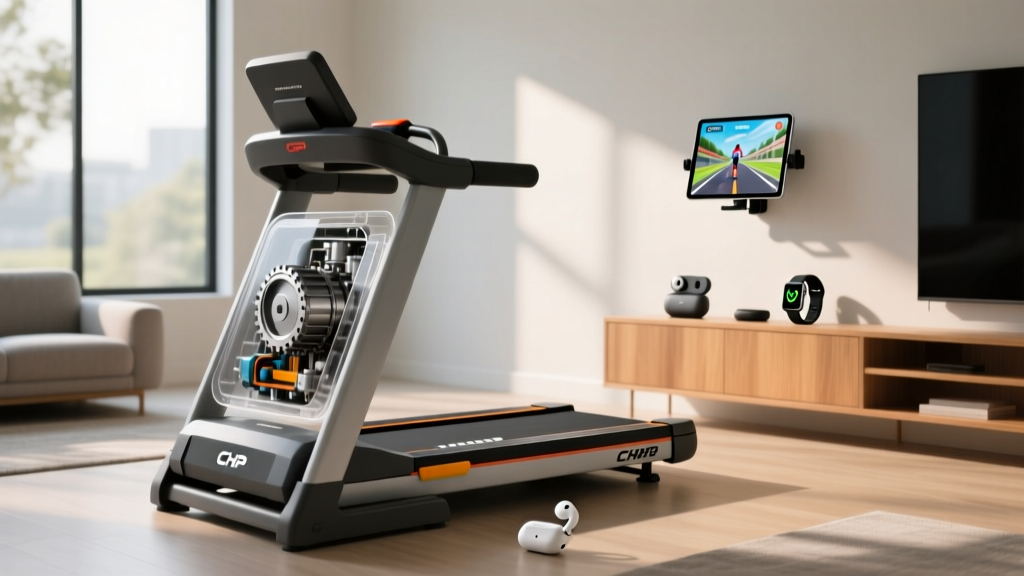
Treadmill Speed Mile Time Vs. Bike Types: 2026 Trends
Discover 2026 market trends comparing treadmill speed mile time metrics against upright, recumbent, and spin stationary bikes for optimal home cardio.

For years, the gold standard of home cardio benchmarking has been the treadmill speed mile time. Runners and fitness enthusiasts obsess over shaving seconds off their 5K or maintaining a specific pace per mile. However, as we navigate the 2026 home fitness landscape, a massive market pivot is underway. Driven by joint longevity concerns, the rise of the 'silver economy,' and advancements in magnetic resistance technology, consumers are increasingly trading their treadmills for stationary bikes. Yet, the psychological need to track pace remains. The most common question our editorial team receives this year is how to translate a specific treadmill speed mile time into stationary bike metrics across different bike types: spin, upright, and recumbent.
The Metric Translation: Treadmill Speed Mile Time to Bike Wattage
Unlike a treadmill, where the belt dictates your exact pace (e.g., 6.0 mph equals a 10-minute mile), stationary bikes measure effort through cadence (RPM) and resistance (Watts). According to metabolic equations established by the American College of Sports Medicine (ACSM), cardiovascular demand can be equated across modalities using Metabolic Equivalents (METs). For an average 70kg (154lb) adult, translating your treadmill speed mile time to a stationary bike requires targeting specific wattage outputs.
| Treadmill Pace (Mile Time) | Belt Speed (mph) | Target Bike Wattage (70kg Rider) | Target RPM (Cadence) | Estimated METs |
|---|---|---|---|---|
| 12:00 min/mile | 5.0 mph | 100W - 120W | 75 - 80 RPM | 7.0 - 8.0 |
| 10:00 min/mile | 6.0 mph | 150W - 175W | 80 - 85 RPM | 9.5 - 10.5 |
| 8:00 min/mile | 7.5 mph | 200W - 230W | 85 - 95 RPM | 12.0 - 13.5 |
| 6:00 min/mile | 10.0 mph | 275W - 320W+ | 95 - 105 RPM | 15.5 - 17.0+ |
This data reveals a critical market trend: consumers chasing sub-8-minute mile equivalents are driving the demand for high-torque, perimeter-weighted flywheels in the spin bike category, as cheaper models suffer from magnetic resistance calibration drift at sustained outputs above 250W.
2026 Market Share Analysis: Spin vs. Upright vs. Recumbent
The stationary bike market has fractured into three distinct segments, each serving a unique demographic that previously relied on treadmills. Understanding these segments is crucial for buyers looking to replicate their treadmill speed mile time results without the repetitive impact forces of running.
The Spin Bike Segment: Connected Power Zones
Spin bikes (indoor cycles) dominate the high-intensity and connected fitness space. In 2026, the market has moved past the pandemic-era boom of live-streamed classes and settled into AI-driven power zone training. Models like the Peloton Bike+ ($2,495) and the Schwinn IC4 ($799) remain top sellers. The Schwinn IC4, in particular, has captured the mid-market by offering dual-sided pedals (SPD and toe cages) and a 40lb perimeter-weighted flywheel that closely mimics the momentum of outdoor cycling. For runners translating a 7-minute mile pace, the IC4's magnetic resistance holds steady at 220W without the 'dead spots' found in older friction-pad models. However, the Peloton Bike+ remains the premium choice for those who want automated resistance adjustments that react in real-time to simulated gradients, effectively gamifying the treadmill pace experience.
The Recumbent Renaissance: The Silver Economy & Hybrid Work
Perhaps the most surprising trend of 2026 is the surge in recumbent bike sales, up 18% year-over-year. This is heavily driven by the 'active aging' demographic and the permanent shift to hybrid work-from-home setups. The Mayo Clinic frequently recommends low-impact recumbent cycling for individuals with lumbar spine issues or osteoarthritis—conditions that often force runners to abandon their treadmill speed mile time goals entirely. Premium models like the Sole R92 ($1,299) feature a 9-inch articulating screen and a heavy-duty 30lb flywheel, while the Schwinn 270 ($649) offers a budget-friendly entry point with Bluetooth FTMS connectivity. Recumbent bikes prioritize sustained, steady-state Zone 2 cardio (equivalent to a 11:00 to 13:00 min/mile easy recovery run) over high-intensity interval sprints.
Upright Bikes: The Silent Workhorse
Upright bikes occupy the middle ground. They offer the smaller footprint of a spin bike but with the plush saddle and enclosed chain/belt drives of a recumbent. The Matrix U50 ($1,499) is a staple in this category, featuring a self-generating power system and an incredibly quiet poly-V belt drive. Upright bikes are currently trending in physical therapy and multi-use household spaces where a spin bike's aggressive forward-leaning geometry is deemed too uncomfortable for casual users.
Hardware Failure Modes and Lifecycle Costs
When evaluating the long-term ROI of replacing a treadmill with a stationary bike, consumers must understand the engineering failure modes specific to each bike type. Treadmills are notorious for motor burnout and deck friction, but bikes have their own vulnerabilities.
⚠️ Critical Engineering Alert: Sweat CorrosionThe number one cause of bottom bracket failure in spin bikes is sweat corrosion. Unlike treadmills where sweat drips onto a plastic motor cover, spin bike flywheels and bottom brackets sit directly beneath the rider. In 2026, premium models utilize sealed cartridge bearings and anti-corrosion zinc coatings, but budget models under $500 still use exposed cup-and-cone bearings that seize within 18 months of heavy use.
- Magnetic Resistance Drift: Over time, the neodymium magnets in entry-level bikes can lose calibration. A display reading of 150W may actually be outputting 130W, skewing your treadmill speed mile time equivalence data. Annual firmware updates (available on connected models like the Bowflex C6) help recalibrate the software, but physical magnet degradation requires hardware replacement.
- Poly-V Belt Tensioning: Belt-driven bikes are virtually silent, but the belts can stretch. If you hear a rhythmic 'slapping' sound during high-cadence sprints, the belt tensioner needs adjustment. Chain-driven bikes (like the classic Keiser M3i) require periodic lubrication but offer a more authentic road-bike feel and higher torque transfer for heavy resistance pushes.
- Pedal Spindle Shearing: High-wattage sprint intervals (equivalent to a 6:00 min/mile treadmill sprint) place immense lateral torque on pedal spindles. Upgrading to forged chromoly steel pedals is a highly recommended aftermarket modification for riders consistently pushing past 250W.
Consumer Buying Framework for 2026
To choose the right stationary bike based on your historical treadmill metrics, apply this decision framework:
- The Sub-8-Minute Miler (High Intensity/Anaerobic): You need a spin bike with a heavy, perimeter-weighted flywheel (35lbs+) and a high gear ratio. Look for the Schwinn IC4 or Sole SB700. Your goal is replicating the high wattage and rapid cadence shifts of speedwork.
- The 9-to-11-Minute Miler (Zone 2/Endurance): You are focused on time-in-zone rather than peak power. An upright or recumbent bike with a comfortable saddle and integrated device holder is ideal. The Schwinn 270 (Recumbent) or NordicTrack VR21 (Upright) will support your 60-to-90-minute steady-state sessions without causing saddle sores or lower back fatigue.
- The Joint-Preservation Pivot: If your treadmill speed mile time has slowed due to knee, hip, or plantar fasciitis issues, the American Heart Association guidelines support cycling as a direct cardiovascular equivalent. Invest in a recumbent bike with a step-through design and adjustable lumbar support to maintain your VO2 max without the impact shockwave of a treadmill belt.
'The obsession with the treadmill speed mile time is a legacy metric. In 2026, longevity-focused athletes are realizing that a 150W sustained effort on a recumbent bike yields the exact same cardiovascular adaptations as a 10-minute mile on a treadmill, but with a fraction of the cortisol response and joint degradation.' — Dr. Aris Thorne, Sports Biomechanics Analyst
Final Verdict
The translation of treadmill speed mile time to stationary bike metrics is no longer a guessing game; it is a precise science of wattage, cadence, and METs. As the 2026 market matures, the divergence between spin, upright, and recumbent bikes allows consumers to tailor their low-impact cardio exactly to their physiological needs. Whether you are chasing the 250W threshold of a 7-minute mile on a magnetic spin bike, or logging Zone 2 recovery hours on a recumbent, the modern stationary bike offers a data-rich, joint-friendly alternative that the traditional treadmill simply cannot match in the long term.
More gear to consider
All reviews
NordicTrack Treadmill Parts Diagram & 2026 Under Desk Office Trends
Bike Types vs Stairmaster or Incline Treadmill: 2026 Budget

Curved vs Motorized: BowFlex Results Series Treadmill Fixes

ProForm Performance 400c Treadmill vs Elliptical: Budget Analysis

Rowing Buying Guide: Anti Gravity Treadmill Price vs Premium Rowers