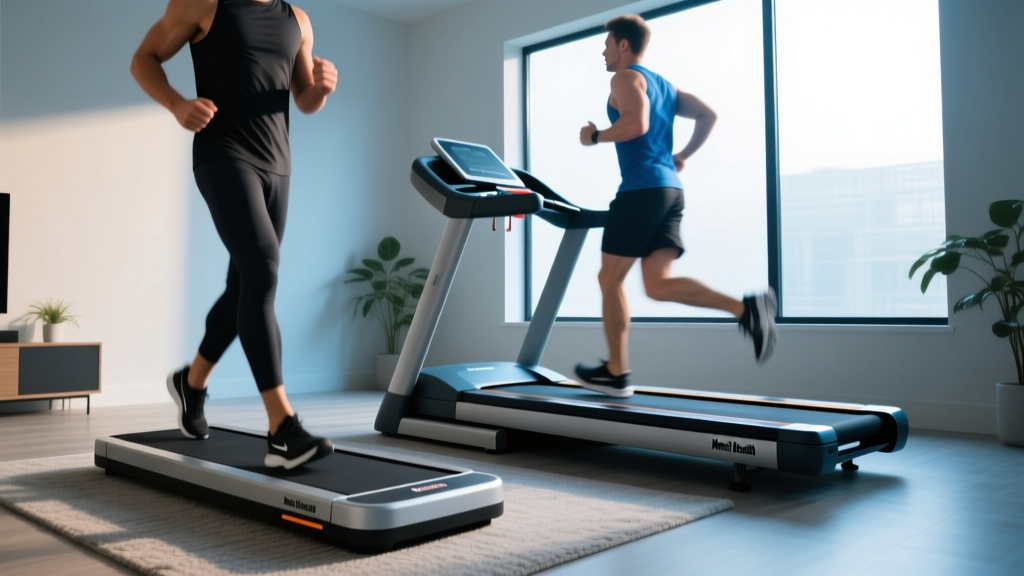
Walking Pad vs Treadmill: Using a Treadmill Distance Calculator
Use our treadmill distance calculator framework to choose between a walking pad and traditional treadmill. Step-by-step 2026 guide with model reviews.

The Ultimate Beginner's Guide to Choosing Your Cardio Machine
Choosing between a compact walking pad and a full-sized traditional treadmill is one of the most common dilemmas for home gym beginners. While social media makes walking pads look like the perfect effortless fitness hack, the reality of your daily biomechanics and distance goals tells a different story. To make a data-driven decision, you need to look past the marketing and use a treadmill distance calculator framework to map your actual daily mileage against the hardware limitations of each machine type.
This step-by-step guide will walk you through calculating your exact distance needs, comparing the mechanical realities of walking pads versus treadmills, and reviewing the top-performing 2026 models that fit your specific footprint and budget.
💡 Pro Tip: According to the Centers for Disease Control and Prevention (CDC), adults need at least 150 minutes of moderate-intensity aerobic activity per week. For a brisk walker, this translates to roughly 7 to 10 miles per week. Knowing your exact weekly mileage is the first step to avoiding motor burnout on underpowered machines.Step 1: Use the Treadmill Distance Calculator Framework
Most generic online calculators assume an average stride length of 2.5 feet, which leads to massive inaccuracies for taller or shorter individuals. To get a precise baseline for your equipment needs, you must calculate your personalized distance.
The Custom Stride Formula
- Measure your stride: Place a piece of tape on the floor. Take 10 normal walking steps starting with your heel on the tape. Measure the distance to the heel of your 10th step in inches, then divide by 10. This is your exact stride length.
- Track your daily steps: Use your smartwatch or phone pedometer to find your average daily step count over a 5-day period.
- Calculate total miles: Multiply your daily steps by your stride length (in inches), divide by 12 to get feet, and divide by 5,280 to get miles.
| Daily Steps | Short Stride (28 inches) | Average Stride (30 inches) | Long Stride (34 inches) |
|---|---|---|---|
| 5,000 | 2.21 miles | 2.36 miles | 2.68 miles |
| 8,000 | 3.53 miles | 3.78 miles | 4.29 miles |
| 10,000 | 4.41 miles | 4.73 miles | 5.36 miles |
| 12,000 | 5.30 miles | 5.68 miles | 6.43 miles |
Step 2: Match Your Calculated Distance to the Right Machine
Once your treadmill distance calculator outputs your daily and weekly mileage, you can objectively choose your machine category. The dividing line isn't just about space; it is about thermal limits and belt geometry.
When to Choose a Walking Pad (Under 3 Miles/Day)
Walking pads are engineered for low-impact, low-speed cruising. If your calculated distance is consistently under 3 miles per day (roughly 60 to 90 minutes of walking), a walking pad is ideal. They excel in small apartments and can slide under a bed or sofa. However, their small DC motors lack the cooling fans and heavy flywheels required for prolonged use.
When to Choose a Traditional Treadmill (Over 3 Miles/Day or Running)
If your distance calculator shows you are logging 4+ miles daily, or if you plan to incorporate jogging intervals (6.0+ mph), a traditional treadmill is non-negotiable. The Harvard Health Publishing notes that transitioning from walking to jogging significantly increases caloric expenditure and cardiovascular demand, which requires a wider belt and a continuous-duty motor to safely accommodate your changing biomechanics.
Step 3: Evaluate the Hardware Constraints
Before pulling out your credit card, you must understand the physical limitations of the hardware you are about to buy. Here is a direct comparison of the mechanical specs you need to scrutinize.
| Feature | Standard Walking Pad | Traditional Home Treadmill |
|---|---|---|
| Belt Width | 15.0" - 17.5" (Restrictive) | 20.0" - 22.0" (Accommodating) |
| Belt Length | 40.0" - 45.0" (Short stride only) | 55.0" - 60.0" (Full stride/running) |
| Motor Type | 1.0 - 1.5 HP Peak (DC) | 2.5 - 3.5 CHP (Continuous Duty) |
| Max Speed | 3.5 - 4.0 mph | 10.0 - 12.0 mph |
| Weight Capacity | 220 - 265 lbs | 300 - 350 lbs |
| Incline | 0% (Flat only) | 10% - 15% (Motorized) |
Expert Insight on Motor Failure: The most common failure mode for walking pads is thermal overload. A 1.25 HP peak motor on a walking pad will overheat and trigger an automatic safety shutoff if a 200 lb user walks at 3.5 mph for more than 45 continuous minutes. Traditional treadmills use Continuous Horsepower (CHP) ratings, meaning a 2.5 CHP motor can sustain that output indefinitely without overheating.
Step 4: 2026 Model Reviews Based on Distance Profiles
Based on the distance calculator profiles, here are the top-tier machines dominating the 2026 market for both categories.
The Walking Pad Pick: KingSmith WalkingPad X21
Best for: Calculated distances of 1.5 to 2.5 miles per day; strict space constraints.
- Price: ~$399
- Belt Dimensions: 15.7" W x 47.2" L
- Motor: 1.25 HP Peak
- Pros: Innovative dual-fold design reduces storage footprint to roughly 22 x 28 inches. The 47-inch belt is slightly longer than competitors, accommodating taller users up to 6'2".
- Cons: The handlebar is somewhat flimsy at max speed (3.7 mph). No incline capability.
The Traditional Treadmill Pick: Horizon Fitness T101
Best for: Calculated distances of 3 to 6+ miles per day; walkers and light joggers.
- Price: ~$599
- Belt Dimensions: 20" W x 55" L
- Motor: 2.5 CHP
- Pros: Unbeatable durability in the sub-$700 bracket. Features a 3-zone cushioning system that reduces joint impact by up to 30% compared to outdoor asphalt. Includes a 10% motorized incline to increase caloric burn without increasing speed.
- Cons: Weighs 148 lbs; while it folds, it is not easily moved by a single person.
Step 5: Factor in Long-Term Maintenance
Regardless of whether your treadmill distance calculator points you toward a pad or a full-sized rig, friction is the enemy of your machine's lifespan. Follow this exact maintenance schedule to protect your investment:
- Monthly Belt Alignment Check: Walk at 2.0 mph and observe the belt. If it drifts more than 1/4 inch to the left or right, use the included Allen wrench to adjust the rear roller bolts (turn clockwise to pull the belt right, counter-clockwise to pull left).
- Quarterly Lubrication (Walking Pads): Because walking pads have smaller decks and higher friction-to-surface-area ratios, they require 100% silicone treadmill oil every 3 months or every 100 miles. Lift the belt, apply an S-pattern of oil, and run the machine at 1.0 mph for 3 minutes to distribute it.
- Bi-Annual Lubrication (Traditional Treadmills): Full-sized treadmills with larger decks and better airflow typically only require lubrication every 6 months or 150 miles. Check your owner's manual, as some premium 2026 models feature self-lubricating wax decks.
Final Verdict: Let the Math Decide
Don't buy a walking pad just because it looks aesthetically pleasing on social media, and don't buy a massive treadmill if you only have the time or desire to walk 1.5 miles a day in your living room. By utilizing a personalized treadmill distance calculator framework, you strip away the guesswork. If your math points to high mileage, incline training, or jogging, invest the $599 in a Horizon T101. If your math confirms you are a casual, low-mileage walker looking to hit the American Heart Association's baseline movement guidelines while working from home, the KingSmith X21 is your perfect 2026 companion.
More gear to consider
All reviews
Elliptical vs Treadmill: Is a Treadmill With Hand Weights Better?

What Does Treadmill Do to Your Body? Noise & Impact Guide

Caroma Treadmill vs. Elliptical: 2026 Home Cardio Market Trends

Stair Climber Guide: Adapting a Holder for iPad on Treadmill

ProGear Manual Treadmill Belt Maintenance: 2026 Market Trends
