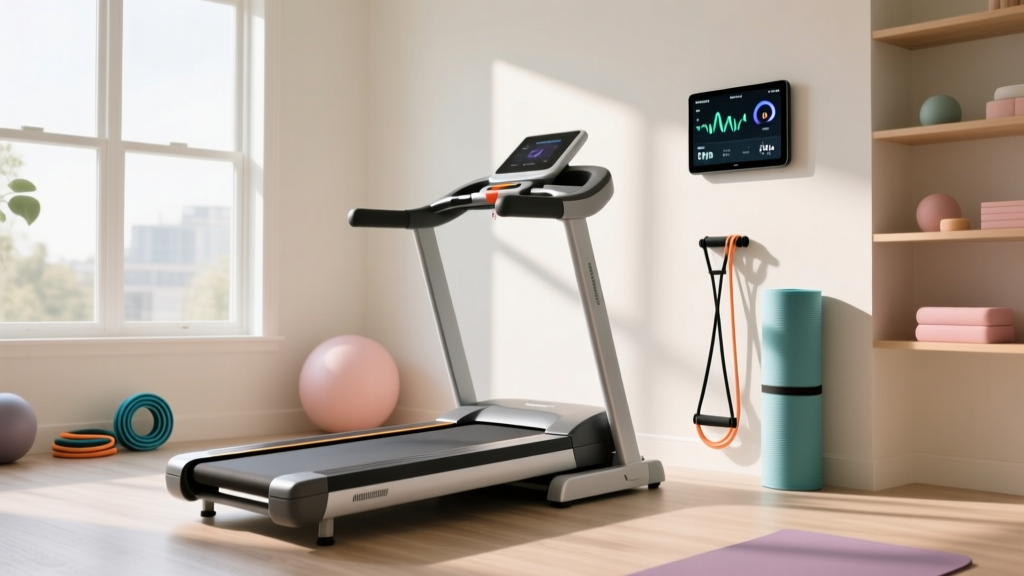
When Can I Use a Treadmill After C-Section? Compact Cardio Layouts
Discover when you can use a treadmill after C-section recovery and explore space-saving compact cardio equipment layouts for your postpartum room.

Navigating postpartum recovery in a small living space presents a unique architectural and physiological challenge. For new mothers healing from major abdominal surgery, the desire to return to a fitness routine often clashes with the reality of nursery clutter, limited square footage, and strict medical timelines. While full-sized fitness machines are out of the question during early recovery, compact portable cardio equipment offers a vital bridge back to health. This guide merges medical recovery timelines with spatial design principles, helping you integrate space-optimized cardio into your postpartum environment without compromising safety or room aesthetics.
The Medical Timeline: Healing Before Stepping
Before discussing room layouts, we must establish the physiological boundaries of postpartum recovery. The American College of Obstetricians and Gynecologists (ACOG) emphasizes a gradual return to physical activity, but the mechanics of a treadmill introduce specific variables that differ from standard over-ground walking.
The Biomechanical Difference: A motorized treadmill belt pulls your leg back, altering your natural gait cycle and requiring increased engagement of the deep core stabilizers and pelvic floor to maintain balance. This micro-stress on the healing abdominal fascia is why treadmill use requires stricter clearance than casual indoor walking.
Phase 1: Weeks 1 to 6 (The Rest and Gentle Movement Phase)
During the first six weeks, the primary focus is incision healing and preventing blood clots. According to the Mayo Clinic, light walking around the house is encouraged within hours of surgery to promote circulation. However, structured cardio machines are strictly prohibited. Your spatial focus during this phase should be on clearing wide, unobstructed pathways in your home for safe, unassisted walking.
Phase 2: Weeks 6 to 12 (The Transitional Phase)
At the 6-week postpartum checkup, your OBGYN will assess the superficial incision. However, the deeper fascial layers take up to 12 weeks to regain significant tensile strength. During this window, low-impact, seated, or ultra-slow portable cardio equipment becomes your primary tool, allowing you to elevate your heart rate without subjecting the healing abdominal wall to the repetitive impact or belt-driven gait alterations of a treadmill.
Phase 3: Week 12 and Beyond (Return to Treadmill)
This brings us to the most common search query among new mothers: when can I use treadmill after C-section recovery protocols? For most women with uncomplicated recoveries, a return to treadmill walking (starting at 0% incline and speeds under 3.0 mph) is cleared between 8 to 12 weeks. Running or high-incline treadmill walking should generally be delayed until 4 to 6 months postpartum, following a clearance from a pelvic floor physical therapist.
Bridging the Gap: Compact Portable Cardio Options
While waiting for treadmill clearance, maintaining cardiovascular health is crucial for postpartum mood regulation and energy levels. In 2026, the market for compact portable cardio equipment has evolved significantly, offering ultra-quiet, low-profile machines that fit seamlessly into multi-use postpartum rooms.
Spatial Callout: The Noise-to-Sleep Ratio
When selecting portable cardio for a nursery or shared bedroom, acoustic output is just as critical as physical footprint. A machine operating above 55 decibels (dB) can disrupt infant sleep cycles. The compact options below prioritize brushless motors and magnetic resistance to keep noise pollution below the ambient hum of a white noise machine.
1. Seated Under-Desk Ellipticals
Seated ellipticals are the ultimate spatial hack for postpartum recovery. They allow you to maintain cardiovascular output while seated in a glider or nursing chair, eliminating the gravitational load on the pelvic floor. Top Spatial Pick: The Cubii JR2. With a footprint of just 23 x 17 inches and a height of 10 inches, it slides entirely beneath a standard nursery glider. Weighing only 12.5 lbs, it can be easily moved with one hand while holding an infant. The magnetic resistance operates at roughly 45 dB, making it completely silent during use.
2. Foldable Walking Pads
For mothers cleared for light walking (Weeks 8+) who lack the 60-square-foot footprint required for a standard treadmill, folding walking pads are the ideal transitional tool. Top Spatial Pick: The WalkingPad R2. When folded, it measures a mere 38.2 x 20.3 x 5.1 inches. This ultra-slim profile allows it to slide under standard bed frames (requiring only 5.5 inches of vertical clearance) or stand vertically in a 2-inch gap between a dresser and the wall. Its brushless motor operates at 50 dB, and the handrail folds flat to eliminate visual clutter.
3. Hydraulic Mini Steppers
Mini steppers provide a higher heart-rate yield in a fraction of the space, though they require more core stabilization. They are best suited for mothers past the 10-week mark who are rebuilding core endurance. Top Spatial Pick: Sunny Health & Fitness SF-S0912. The base occupies a tiny 16 x 12 inch square. Because it relies on hydraulic cylinders rather than a heavy flywheel, it weighs under 15 lbs and can be stored on a high closet shelf when not in use.
Comparison Matrix: Compact Cardio for Postpartum Spaces
Use this data table to evaluate which machine aligns with your room dimensions, storage capabilities, and current stage of medical recovery.
| Equipment Type | Active Footprint | Storage Clearance | Noise Output | Recovery Phase |
|---|---|---|---|---|
| Seated Elliptical | 23 x 17 in | Under-chair / 10in H | ~45 dB | Weeks 4-8 |
| Folding Walking Pad | 56 x 22 in | Under-bed / 5.5in H | ~50 dB | Weeks 8-12 |
| Hydraulic Mini Stepper | 16 x 12 in | Closet shelf / 14in H | ~55 dB | Weeks 10+ |
| Standard Motorized Treadmill | 70 x 30 in | Dedicated zone / 65in H | 65-80 dB | Weeks 12+ |
Layout Design: Integrating Cardio into a Multi-Use Postpartum Room
Space optimization is not merely about buying small equipment; it is about intentional layout design. A postpartum room serves as a nursery, a recovery suite, and often a temporary home office. Introducing fitness equipment requires a strategic approach to visual weight and traffic flow.
The Postpartum Zoning Strategy
- Zone 1: The Recovery & Feeding Nexus. This area centers around the glider and side table. This is where seated ellipticals belong. Position the elliptical directly in front of the glider so it can be used during feeding sessions or while holding the baby. Keep the power cable routed along the baseboard using adhesive cord channels to prevent tripping hazards during midnight wake-ups.
- Zone 2: The Active Pathway. Walking pads require a dedicated safety clearance. You must maintain a minimum of 24 inches of clearance on both sides and 36 inches behind the machine. Position the walking pad parallel to the longest unbroken wall in the room, facing a window or a mounted mirror. Avoid placing the pad in the 'crib sightline'—you should not have to look over or around the machine to see the baby from the doorway.
- Zone 3: Visual Concealment. When not in use, fitness equipment can contribute to cognitive overload and stress in a recovery space. Utilize 'dead zones' for storage. The 6-inch gap between the bottom of a standard crib and the floor is perfect for sliding in a folded WalkingPad. Alternatively, use a tension-mounted curtain rod inside a closet alcove to hide a mini stepper behind a linen drape.
Frequently Asked Questions
Can I use a walking pad before I am cleared for a treadmill?
Walking pads operate at much lower maximum speeds (usually capping at 3.5 to 4.0 mph) and lack the aggressive belt-pull of a heavy-duty treadmill. However, the gait mechanics remain similar. You should still wait for your 6-to-8-week medical clearance before using a walking pad, utilizing a seated elliptical in the interim.
How do I protect hardwood floors in a nursery from compact cardio machines?
Compact machines concentrate their weight into a smaller surface area, increasing point-load pressure. Always use a high-density EVA foam interlocking mat (at least 0.5 inches thick) cut precisely to the machine's footprint. This protects the floor, dampens acoustic vibration transfer to rooms below, and provides a defined 'fitness zone' that visually separates the workout space from the nursery area.
Will the electromagnetic interference (EMI) from a walking pad motor affect baby monitors?
Modern 2026 brushless DC motors in premium walking pads are heavily shielded and comply with FCC Part 15 regulations regarding electromagnetic interference. However, to be absolutely safe, maintain a minimum distance of 4 feet between the motor housing of any cardio machine and your baby monitor base station or Wi-Fi router.
More gear to consider
All reviews
2026 Cardio Trends: Air Bike vs Assault Bike & Weslo Cadence G 40

Sole Treadmill F80 vs F85 Setup: Curved vs Motorized Installation

Commercial 1750 Treadmill Noise Level vs Top Cardio Machines
Spirit Fitness XT685 Treadmill Noise & Cardio Machine Sound Guide
Maintaining Your Gold's Gym Treadmill 450 & Stationary Bike Types
