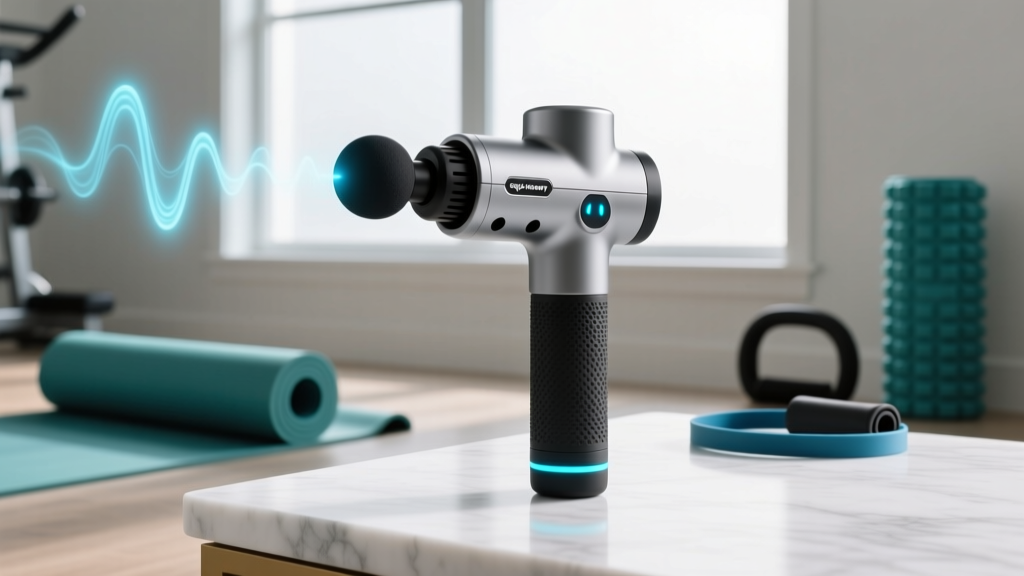
Massage Gun for Trapezius: Percussion vs Vibration Therapy Picks
Discover the best massage gun for trapezius relief. Our expert hands-on review compares percussion vs vibration therapy to melt upper back tension.

Upper trapezius hypertonicity is the defining postural epidemic of the modern era. Whether you are a powerlifter dealing with heavy yoke tension or a desk worker suffering from 'tech neck,' the descending fibers of the upper traps bear the brunt of the load. When searching for the most effective massage gun for trapezius relief, consumers are immediately confronted with a modality split: high-amplitude percussion versus targeted vibration therapy. As we move through 2026, recovery technology has bifurcated into these two distinct camps, each offering unique neurological and mechanical benefits.
Expert Summary: Percussion therapy (14-16mm amplitude) is superior for breaking up fascial cross-links and addressing deep, chronic muscle knots in thick trapezius tissue. Vibration therapy (30-120Hz, low amplitude) excels at neurological down-regulation, utilizing the Gate Control Theory of pain to provide immediate, acute relief for surface-level tension and postural fatigue.The Biomechanics of Trapezius Hypertonicity
To understand why certain recovery tools fail on the traps, we must look at the anatomy. The upper trapezius originates at the external occipital protuberance and the nuchal ligament, inserting on the lateral third of the clavicle. According to CDC Ergonomics guidelines, for every inch your head shifts forward past the midline, the effective weight of your head on the cervical spine and upper traps increases by roughly 10 pounds. This constant eccentric overload leads to localized ischemia (restricted blood flow) and the formation of myofascial trigger points.
Because the traps overlay the cervical spine and the scapula, applying aggressive percussive force blindly can result in bruising on the C7 spinous process or aggravate the thoracic outlet. This is where the percussion versus vibration debate becomes critical for safe, effective recovery.
Percussion vs. Vibration: A Clinical Comparison
While marketing materials often use the terms interchangeably, percussion and vibration operate on entirely different biomechanical principles. Below is a structural comparison of how each modality interacts with trapezius tissue.
| Feature | Percussion Therapy | Vibration Therapy |
|---|---|---|
| Amplitude (Depth) | 14mm – 16mm | 2mm – 5mm |
| Frequency (Speed) | 30 – 60 Hz (1800-3600 PPM) | 30 – 120 Hz |
| Primary Mechanism | Mechanical tissue deformation, fluid dynamics | Neuromuscular oscillation, Gate Control Theory |
| Best Trap Condition | Deep, chronic knots; thick muscular yokes | Acute spasms, nerve-related tension, stiffness |
As noted by Mayo Clinic's research on massage therapy, mechanical manipulation increases localized circulation and reduces muscle stiffness. However, the type of manipulation dictates the neurological response. Percussion forces fluid exchange in deep fascia, while high-frequency vibration overwhelms local nociceptors (pain receptors), effectively 'closing the gate' on pain signals traveling to the brain.
Hands-On Review: Top Percussion Devices for the Traps
When evaluating percussion massage guns for the trapezius, handle ergonomics and stall force are vastly more important than raw speed. Reaching your own contralateral trap requires significant shoulder internal rotation; a poorly designed handle will cause shoulder impingement before you even reach the target tissue.
1. Theragun PRO Plus ($599)
The 2026 flagship Theragun PRO Plus remains the gold standard for self-administered trap release. Its defining feature is the patented multi-grip ergonomic handle, which allows you to grip the device in four distinct ways. By using the 'standard' or 'underhand' grip, you can easily reach the upper trap fibers of the opposite side without straining the rotator cuff.
- Amplitude: 16mm (Deepest in class, essential for penetrating the thick upper trap belly).
- Stall Force: 60 lbs (Prevents the motor from dying when you press into stubborn levator scapulae knots).
- Trap-Specific Attachment: The Dampener attachment is mandatory here. It reduces the perceived impact by 30%, allowing you to safely work near the cervical spine without jarring the vertebrae.
2. Ekrin Athletics B37S ($229)
For athletes with highly developed trapezius muscles (e.g., Olympic weightlifters, wrestlers), the Ekrin B37S is a superior mid-tier choice. It features a fixed 15-degree ergonomic handle angle that naturally aligns the wrist when reaching over the shoulder.
- Amplitude: 14mm.
- Stall Force: 56 lbs.
- Real-World Insight: The B37S operates at a slightly lower decibel level than older Theragun models, which is crucial when treating the upper traps. Because the device is so close to your ears, high-pitched motor whine can induce secondary tension headaches.
Hands-On Review: Top Vibration Devices for the Traps
If your trap tension is driven by postural fatigue, stress, or cervical nerve irritation, percussion can sometimes be too aggressive, causing the muscle to 'guard' (involuntarily contract to protect itself). In these scenarios, targeted vibration is the superior modality.
1. Theragun Relief ($179)
While technically categorized as a targeted massager rather than a traditional 'gun,' the Theragun Relief is purpose-built for the neck, jaw, and upper traps. It abandons the pistoning action of percussion for pure, high-frequency vibration.
- Design: A unique 3-point ergonomic grip that cradles the neck and traps simultaneously.
- Frequency: Up to 3,200 PPM of pure oscillation.
- Application: Ideal for the 'neck-to-shoulder' sweep. The vibration penetrates the superficial fascia, down-regulating the sympathetic nervous system and providing immediate relief from tension headaches originating at the base of the skull.
2. Hyperice Vyper 3 ($199)
Though it is a vibrating roller rather than a handheld gun, the Hyperice Vyper 3 must be included in any comprehensive trap recovery stack. The traps respond exceptionally well to broad, sweeping pressure combined with vibration.
- Zones: 3 distinct vibration zones allow you to target the exact width of your upper back.
- Frequency: 68 Hz to 122 Hz.
- Protocol: Laying the Vyper horizontally across the upper traps while a partner applies downward pressure, or positioning it against a wall for self-myofascial release, provides a broader shear force that a percussive gun head simply cannot replicate.
The 4-Minute 'Trap Melt' Protocol
Do not simply jam a massage gun into your shoulder and hope for the best. Follow this clinical step-by-step protocol to maximize tissue compliance and avoid injury.
- Anchor the Scapula (0:00 - 0:30): Reach the arm of the affected side behind your back. This depresses the scapula and stretches the upper trap fibers, making them more accessible.
- Vibration Priming (0:30 - 1:30): Use a vibration device (or the lowest speed setting on a percussion gun with the Dampener head). Glide at 1 inch per second from the base of the skull (occipital ridge) down to the acromioclavicular (AC) joint. This prepares the nervous system for deeper work.
- Percussive Ischemic Compression (1:30 - 3:00): Switch to the Thumb or Cone attachment on your percussion gun. Locate the most tender nodule (trigger point). Apply moderate pressure and hold completely still for 15 to 20 seconds. Do not sweep. This mimics manual ischemic compression, forcing a rush of oxygenated blood into the tissue upon release.
- Flush and Glide (3:00 - 4:00): Switch back to the large Ball attachment. Perform long, sweeping strokes from the neck outward toward the shoulder joint to encourage lymphatic drainage and flush metabolic waste.
Edge Cases and Failure Modes: When to Stop
Recovery tools are not without risk. According to the Arthritis Foundation, while soft tissue manipulation is generally safe, localized inflammation requires caution. Avoid using percussion or vibration on the trapezius under the following conditions:
- Cervical Radiculopathy: If your trap pain is accompanied by tingling, numbness, or shooting pain down the arm, you likely have a compressed cervical nerve root (e.g., C5 or C6). Applying vibration or percussion near the nerve root can severely exacerbate the impingement.
- The C7 Spinous Process: The prominent bone at the base of your neck is highly susceptible to periosteal bruising. Never use a hard plastic or carbon fiber attachment directly on the midline of the spine. Always stay lateral (to the side) on the muscle belly.
- Thoracic Outlet Syndrome (TOS): If you experience vascular symptoms (cold hands, blue tint to fingers) alongside trap tightness, the scalenes and upper traps may be compressing the brachial plexus. Aggressive percussion can cause reactive swelling, worsening the compression.
- Carotid Sinus Proximity: Never wrap the massage gun around the lateral or anterior neck. The carotid sinus regulates blood pressure, and mechanical vibration here can trigger a dangerous drop in heart rate and blood pressure (syncope).
Final Verdict: Building Your Recovery Stack
The search for the ultimate massage gun for trapezius relief does not end with a single device; it ends with understanding your specific pathology. If you are a strength athlete dealing with dense, fibrotic tissue and deep trigger points, the Theragun PRO Plus or Ekrin B37S provides the necessary amplitude and stall force to mechanically alter the tissue. However, if your trap tension is a byproduct of chronic postural stress, desk work, or nervous system up-regulation, the Theragun Relief or Hyperice Vyper 3 will yield vastly superior results by leveraging neurological pain-gating mechanisms.
For the ultimate 2026 recovery setup, pair a high-amplitude percussive gun for post-workout deep tissue work with a dedicated vibration tool for evening neurological down-regulation. By respecting the biomechanics of the cervical spine and adhering to targeted protocols, you can effectively dismantle upper trap tension without risking structural injury.
More gear to consider
All reviews
Sauna Blanket & Panel Guide: Renpho Massage Gun Won't Turn On

Infinity Massage Gun vs. Infrared Sauna Blankets & Panels Guide

Infrared Sauna Blanket & Panel Setup: No Flash Disk Recovery Tool

Space-Saving Home Ice Bath Setups & Leercon Massage Gun Integration

Beyond the Iconic Massage Gun: Heat Therapy Pad and Wrap Comparison
