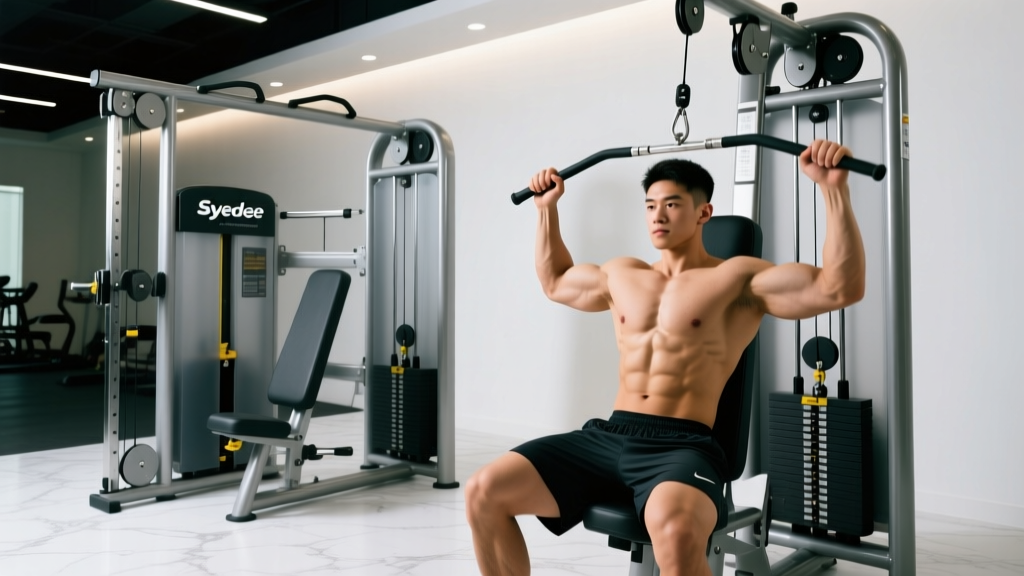
Syedee Chest Press Machine vs Cable Crossover: Chest Training Guide
Compare the Syedee chest press machine and cable crossovers for chest training. Dive into biomechanics, pricing, and 2026 home gym buying advice.

The Biomechanics of Pectoral Hypertrophy: Fixed Path vs. Variable Cables
Building a comprehensive chest training setup in 2026 requires a nuanced understanding of pectoral biomechanics and equipment engineering. When outfitting a home or boutique commercial gym, buyers frequently face a critical crossroads: investing in a dedicated fixed-path press or a versatile cable crossover system. The pectoralis major consists of the clavicular (upper) and sternocostal (mid/lower) heads, which require distinct angles and tension profiles for optimal hypertrophy. According to the ExRx exercise directory, achieving full muscular recruitment necessitates both heavy compound overloading and continuous-tension isolation movements. This guide provides an in-depth comparison between the highly rated Syedee chest press machine configurations and traditional dual adjustable pulley (DAP) cable crossovers to help you make an evidence-based purchasing decision.
Expert Insight: Fixed-path machines excel at central nervous system (CNS) overload and safe failure training, while cable crossovers provide constant tension through the entire range of motion (ROM), maximizing metabolic stress and sarcoplasmic hypertrophy.Deep Dive: The Syedee Chest Press Machine Ecosystem
Syedee has carved out a massive footprint in the budget-to-mid-tier home gym market by offering high-value, multi-functional equipment. When consumers search for a 'Syedee chest press machine,' they are typically referring to the chest press mechanisms integrated into Syedee's All-in-One Smith Machine and Functional Trainer combos, or their standalone plate-loaded leverage presses. In 2026, the Syedee functional trainer bundles (typically priced between $899 and $1,299) remain a top seller due to their space-saving footprint and robust 11-gauge steel construction.
Specifications and Real-World Performance
- Frame Construction: 11-gauge (approx. 3mm thick) commercial-grade steel with a powder-coated finish.
- Pulley Ratio: Most Syedee functional trainer attachments utilize a 1:2 pulley ratio. This means loading 200 lbs of plates yields 100 lbs of resistance at the handle, allowing for smoother micro-loading and reduced carriage friction.
- Bearing System: The Smith/press bar components utilize 12mm linear bearings, providing a frictionless, strictly vertical or slightly angled pressing path.
- Cable Durability: Standard 2,000 lb test aircraft cables. While durable, budget-tier pulleys can develop a slight lateral wobble after 18-24 months of heavy, un-lubricated use.
Pros and Cons of the Syedee Setup
Pros: Exceptional cost-to-feature ratio; allows for safe, unassisted heavy pressing to failure; integrates seamlessly into a single power rack footprint; ideal for solo lifters.
Cons: Fixed pressing path may not accommodate all anthropometrics (specifically lifters with extreme shoulder mobility restrictions); the 1:2 ratio limits absolute max-load capacity for elite powerlifters.
Cable Crossover Machines for Chest Training
A dedicated cable crossover machine—featuring two independent weight stacks and adjustable pulley heights—represents the gold standard for chest isolation. Unlike free weights, where tension drops off at the top of a dumbbell flye due to gravity vectors, cables provide continuous horizontal adduction resistance. The American Council on Exercise (ACE) frequently highlights cable flyes in their muscle activation studies, noting that the continuous tension profile leads to higher time-under-tension (TUT) metrics compared to traditional free-weight alternatives.
Why Dual Adjustable Pulleys (DAP) Rule Hypertrophy
The primary advantage of a standalone cable crossover (such as the Body-Solid SCC-1200G or Rogue Monster DAP) is the infinite adjustability of the resistance vector. By altering the pulley height, you can precisely target different regions of the chest:
- High-to-Low Crossovers: Pulleys set at the highest notch with a downward pulling motion emphasize the sternocostal (lower) head.
- Low-to-High Crossovers: Pulleys set near the floor, pulling upward and inward, target the clavicular (upper) head, mimicking an incline press.
- Mid-Level Flyes: Pulleys at shoulder height provide uniform tension across the entire pectoral slab, maximizing the stretch-mediated hypertrophy response at the bottom of the movement.
Head-to-Head Comparison Matrix
To help you allocate your 2026 fitness budget, we have mapped the Syedee chest press ecosystem against a standard commercial-grade cable crossover.
| Feature | Syedee Chest Press (Combo Unit) | Dedicated Cable Crossover |
|---|---|---|
| Average Price (2026) | $899 - $1,299 | $1,800 - $3,500+ |
| Footprint (L x W) | ~55 x 65 inches | ~105 x 35 inches |
| Tension Profile | Variable (Cam/Lever based) | Constant (Linear Cable) |
| Max Load Capacity | ~300 lbs (Plate Loaded) | 2 x 200 lbs (Selectorized) |
| Primary Use Case | Heavy Compound Overload | Isolation, Stretch, Hypertrophy |
| Maintenance Needs | Moderate (Linear bearing lube) | Low (Guide rod wiping) |
Space, Budget, and Footprint Analysis
Space is often the ultimate limiting factor in home gym design. A dedicated cable crossover requires a wide, unobstructed wingspan—typically spanning 8 to 9 feet across the front, plus an additional 4 feet of depth for the user to step forward and execute flyes safely. If your training space is a standard two-car garage or a spare bedroom, a massive crossover might dominate the room.
Conversely, the Syedee All-in-One units consolidate a squat rack, Smith machine, and cable pulley system into a single 55x65 inch footprint. For lifters prioritizing heavy pressing (bench, incline, military press) who only need occasional cable work for triceps and lat pulldowns, the Syedee is a masterclass in spatial efficiency. However, if your primary goal is bodybuilding-style chest isolation, the narrow pulley spread on budget combo units can cause the cables to rub against the frame during wide-grip flyes, a failure mode frequently noted in long-term user reviews.
"If your training philosophy aligns with the National Strength and Conditioning Association (NSCA) principles of periodization, you need both heavy mechanical tension and metabolic stress. If budget allows, pairing a basic flat bench with a dedicated DAP crossover yields superior chest hypertrophy compared to a fixed-path machine alone."
Final Verdict: Which Should You Buy?
The decision ultimately hinges on your training age, anthropometrics, and available square footage.
Choose the Syedee Chest Press / Functional Trainer if: You are outfitting a compact home gym, you train solo and need the safety of a fixed Smith/press path to train to failure, and your budget is strictly capped under $1,500. It is an outstanding value for general strength and conditioning.
Choose a Dedicated Cable Crossover if: You are a hypertrophy-focused lifter, physical therapy/rehab is a consideration (cables are vastly superior for joint-friendly, multi-planar rehab), and you have a dedicated room or wide garage bay to accommodate the 9-foot wingspan. The continuous tension provided by dual 200lb stacks is irreplaceable for elite chest development.
Frequently Asked Questions
Can I perform chest flyes on the Syedee machine?
Yes, but with limitations. You can use the functional trainer cable attachments on the Syedee unit for flyes. However, because the pulleys are mounted closer together than on a dedicated crossover, you will experience a 'dead zone' at the peak contraction where the cables lose lateral tension. Using D-ring handles and stepping well in front of the machine can mitigate this.
What is the ideal pulley height for cable crossovers?
For general mid-chest development, set the pulleys slightly above shoulder height. Take a step forward, maintain a 15-degree forward torso lean, and keep a slight bend in the elbows. This aligns the cable vector perfectly with the transverse adduction function of the sternocostal pectoral fibers.
Are budget cables safe for heavy chest pressing?
Modern budget equipment, including Syedee, uses 2,000 lb test aircraft cables, which are more than safe for human-generated forces on chest presses. The actual point of failure in budget machines is rarely the cable itself, but rather the plastic pulley wheels or the retaining clips. Inspect your pulley wheels for grooving every 6 months and replace them with aluminum alternatives if necessary.
More gear to consider
All reviews
Push-Up Bars vs Sitting Chest Press Machine: Fixing Form Mistakes

Hammer Chest Press Machine Types: Mistakes & Troubleshooting

Cable Crossover vs Chest Press Bench Machine: 2026 Guide
Incline, Decline, Flat Bench vs Chest Press Machine Maintenance

Equip Bands Tools Checklist: A Field-Tested, Precision-Driven Inventory for Fitness Professionals
