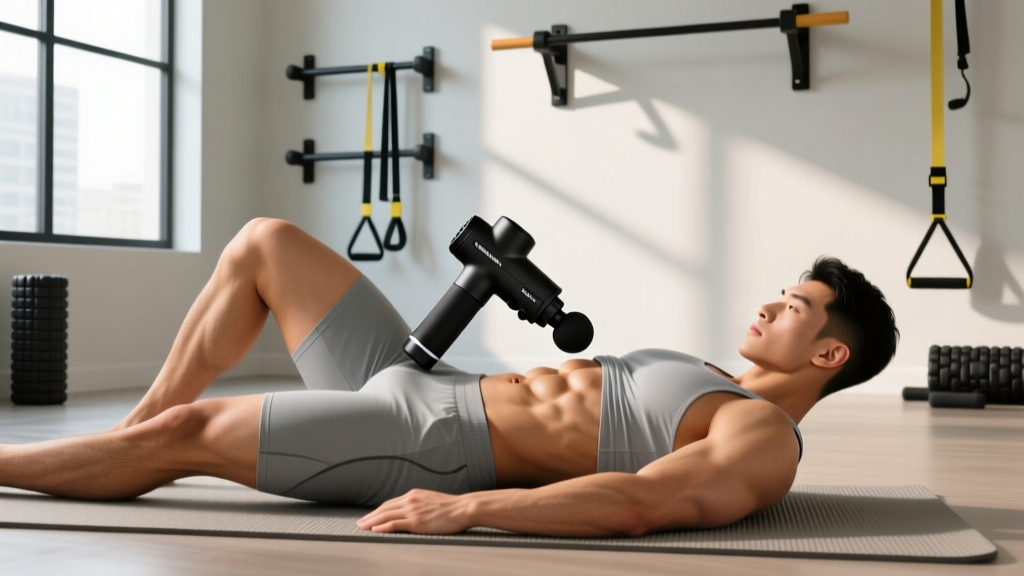
Benefits of Massage Gun on Stomach & Stretching Tools
Discover the real benefits of massage gun on stomach tissue and explore our 2026 buying guide to the best stretching equipment for core flexibility.

The Truth About Percussive Therapy on the Core
Core recovery is often the most neglected aspect of a comprehensive fitness routine. While athletes routinely use percussive therapy on their hamstrings, quads, and lats, the anterior core is frequently overlooked. When evaluating the benefits of massage gun on stomach tissue, it is vital to separate evidence-based fascial release from pervasive internet myths.
Percussive therapy devices, such as the Theragun PRO or Hyperice Hypervolt 2, deliver rapid bursts of pressure into the muscle tissue. On the abdominal wall—specifically targeting the rectus abdominis and external obliques—this mechanical stimulation yields several distinct physiological advantages:
- Fascial Adhesion Release: Heavy core training (like weighted cable crunches or dragon flags) can cause the fascia surrounding the abdominal muscles to become stiff. A massage gun helps glide these fascial layers, reducing localized stiffness.
- Neuromuscular Down-Regulation: The rapid frequency (typically 1,200 to 1,750 RPM) stimulates the Golgi tendon organs and muscle spindles, signaling the nervous system to relax hypertonic abdominal muscles post-workout.
- Enhanced Localized Perfusion: Increased blood flow to the obliques and transverse abdominis accelerates the clearance of metabolic waste products accumulated during high-volume core circuits.
Never apply a massage gun directly to the umbilical region, the lower pelvic bowl, or directly over the spinal column. The National Strength and Conditioning Association (NSCA) advises avoiding areas where vital organs are close to the surface without heavy skeletal protection. Always use the dampener or flat head attachment, keep the device moving, and limit the speed to a maximum of 1,500 RPM to prevent visceral trauma.
Why Stretching Equipment is the Missing Link
While percussive therapy excels at preparing the tissue and reducing delayed onset muscle soreness (DOMS), it does not actively elongate the muscle fibers or improve joint range of motion. To achieve true core flexibility and spinal mobility, you must pair recovery tools with dedicated stretching equipment and flexibility tools.
According to the Mayo Clinic, consistent, structured stretching improves joint range of motion, enhances circulation, and helps your joints move through their full range. For the core, this means utilizing tools that promote thoracic extension, oblique rotation, and hip-flexor elongation—all of which directly impact anterior core flexibility.
2026 Stretching Equipment Comparison Matrix
Below is our curated comparison of the most effective flexibility tools on the market, specifically analyzed for their utility in core recovery and full-body mobility.
| Equipment | Primary Use | Core Flexibility Benefit | Est. Price (2026) |
|---|---|---|---|
| Chirp Wheel+ | Spinal Extension | Stretches rectus abdominis via backbending | $109 - $139 |
| Hyperice Vyper 3 | Vibratory Rolling | Core fascia release & stabilization | $249 |
| TheraBand Stretch Strap | Assisted PNF | Oblique & rotational flexibility | $15 - $20 |
| Teeter FitSpine X3 | Inversion Therapy | Spinal decompression & core elongation | $399 |
In-Depth Reviews: Top Flexibility Tools for Core & Full-Body
1. Chirp Wheel+ (Best for Anterior Core Extension)
The Chirp Wheel+ is a specialized yoga wheel designed with a patented center channel that cradles the spine while forcing the surrounding musculature into deep extension. When you lie back over the 12-inch wheel, the rectus abdominis is placed under a deep, sustained stretch. This is the exact opposite of the flexion-heavy movements (like sit-ups) that dominate most core routines.
- Material: Polycarbonate core with sweat-resistant EVA foam.
- Best Practice: Perform 3 sets of 45-second holds, focusing on deep diaphragmatic breathing to allow the abdominal fascia to yield.
2. Hyperice Vyper 3 (Best for Vibratory Fascia Release)
The Vyper 3 is not just a foam roller; it is a high-intensity vibrating cylinder. By incorporating vibration (up to 90 Hz), the Vyper 3 overrides the stretch reflex, allowing you to sink deeper into the tissue without the central nervous system guarding the muscle.
"Vibration therapy has been shown to significantly improve acute range of motion without the performance decrements sometimes associated with prolonged static stretching." — Insights synthesized from ACE Fitness recovery research reviews.
Core Application: Assume a plank position with your forearms on the Vyper 3. Turn it to speed 2 and slowly roll from the lower ribs to the pelvis. This engages the core stabilizers while simultaneously vibrating the fascial layers of the abdomen.
3. TheraBand Stretch Strap (Best for Assisted PNF)
Proprioceptive Neuromuscular Facilitation (PNF) is the gold standard for flexibility. The TheraBand Stretch Strap features 10 numbered loops, allowing you to lock your limbs into place and safely contract-relax your core and hip flexors without straining your lower back.
- Pros: Extremely portable, virtually indestructible, allows for precise tension measurement via numbered loops.
- Cons: Requires foundational knowledge of PNF stretching techniques to be fully effective.
The 15-Minute Core Recovery & Flexibility Protocol
To maximize the benefits of massage gun on stomach tissue and seamlessly transition into deep flexibility work, follow this sequential 15-minute protocol designed by sports physical therapists.
- Minute 0-3: Percussive Down-Regulation. Using a dampener head on your massage gun at 1,200 RPM, lightly glide over the external obliques and the upper rectus abdominis. Avoid the centerline and lower organs.
- Minute 3-6: Vibratory Planks. Use the Hyperice Vyper 3. Hold a forearm plank over the vibrating roller for 3 sets of 45 seconds to activate the transverse abdominis while releasing fascial tension.
- Minute 6-10: Thoracic & Core Extension. Position the Chirp Wheel+ under your mid-back. Slowly extend backward, opening the chest and stretching the entire anterior chain. Hold for 60 seconds, repeating 3 times.
- Minute 10-15: Assisted PNF Twists. Lie supine. Loop the TheraBand Stretch Strap around your right foot. Extend the left leg, and use the strap to gently pull the right leg across your body into a supine twist, deeply stretching the left oblique and hip flexor. Hold for 45 seconds per side.
Expert FAQs
Can using a massage gun on my stomach burn belly fat?
No. This is a pervasive myth. Percussive therapy increases localized blood flow and aids in muscle recovery, but it does not induce lipolysis (fat breakdown) or spot-reduce visceral or subcutaneous adipose tissue. Fat loss is strictly dictated by a sustained caloric deficit and hormonal balance.
How often should I use stretching equipment for my core?
For optimal flexibility gains without overstretching the abdominal ligaments, utilize tools like the Chirp Wheel+ and stretching straps 3 to 4 times per week. The Mayo Clinic recommends holding stretches for about 30 seconds per repetition to safely lengthen the tissue.
Is it safe to use a vibrating foam roller directly on my abs?
Yes, but with strict parameters. Never place a vibrating roller directly on a relaxed, supine stomach, as the downward pressure and vibration can cause discomfort to the digestive organs. Always use the roller against the abdominal wall while the core is actively engaged (e.g., in a plank or quadruped position) to create a muscular shield over your internal organs.
More gear to consider
All reviews
Foam Roller Density Guide: Market Trends & Massage Gun for Lipedema

Normatec vs Hyperice Boots & Revive Ultra Massage Gun Guide

Theragun vs Hyperice vs Wahl Massage Gun Space Guide

Beyond the Massage Gun Chart: 2026 Smart Cupping Trends

Heat Pad vs Wrap Setup & Massage Gun for Achilles Tendonitis
