
Bike Types vs Treadmill Fat Burning Walking Workouts: Value Breakdown
Compare upright, recumbent, and spin bike costs against treadmill fat burning walking workouts. Discover the best cardio value for your home gym budget.

Choosing between a spin bike and treadmill walking depends entirely on your biomechanical limits and metabolic goals. A spin bike offers higher calorie burn per minute and lower joint impact, making it ideal for high-intensity interval training and injury recovery. Conversely, walking on a treadmill provides superior weight-bearing benefits for bone density and mimics natural daily movement. This guide is designed for home gym buyers, physical therapy patients, and fitness beginners evaluating which cardio machine aligns with their specific needs.
Key Takeaways
- Spin bikes burn approximately 65 percent more calories per hour than moderate treadmill walking.
- Treadmill walking provides essential weight-bearing stimulus for bone mineral density maintenance.
- Cycling reduces compressive knee joint forces by up to 85 percent compared to walking.
- Spin bikes require roughly 40 percent less floor space than standard motorized treadmills.
Core Definitions and Differences
Spin Bike: A specialized stationary bicycle featuring a heavy front flywheel, direct-drive pedal mechanism, and micro-adjustable magnetic resistance. It is engineered to simulate the biomechanics and high-intensity demands of outdoor road cycling.
Treadmill Walking: A form of weight-bearing cardiovascular exercise performed on a motorized continuous belt. It allows users to precisely control incline angles and belt speed to replicate outdoor terrain variations.
Calorie Burn and Weight Loss Comparison
When evaluating a stationary bike vs treadmill for weight loss, energy expenditure varies significantly based on intensity. According to metabolic data from Harvard Health Publishing, a 155-pound individual burns approximately 280 kilocalories per hour walking at a moderate pace of 3.5 miles per hour.
In contrast, the same 155-pound individual performing vigorous stationary cycling burns roughly 466 kilocalories per hour. This massive discrepancy occurs because spinning recruits the quadriceps, glutes, and hamstrings simultaneously against heavy magnetic resistance. Treadmill walking primarily utilizes the lower leg and hip flexors with minimal external resistance.
Energy Expenditure Metrics
High-intensity interval training (HIIT) on a spin bike can elevate excess post-exercise oxygen consumption (EPOC). This metabolic afterburn effect causes the body to continue consuming oxygen and burning calories for up to 24 hours post-workout. Treadmill walking rarely reaches the anaerobic threshold required to trigger significant EPOC.
Joint Impact and Biomechanics
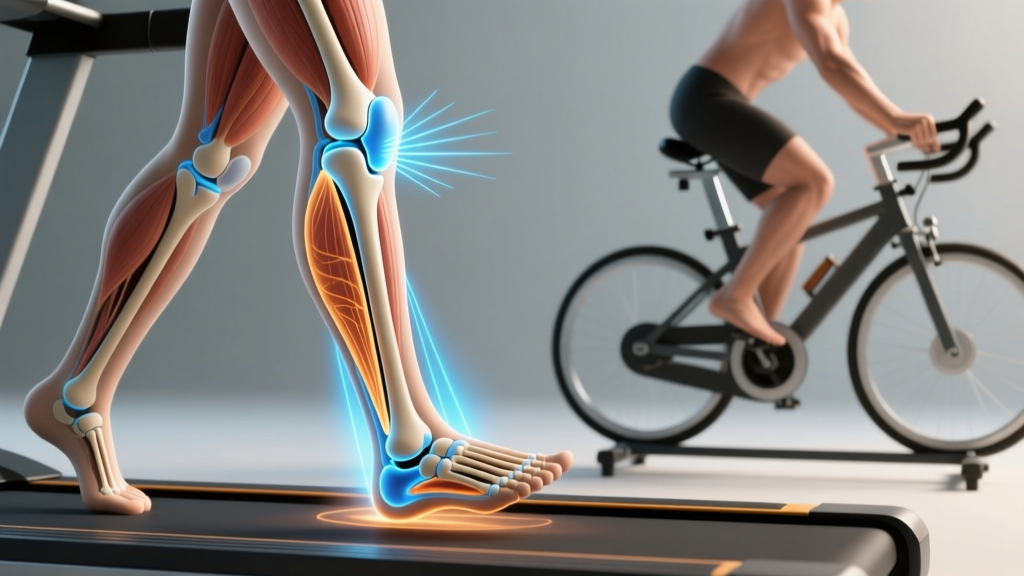
For users researching cycling vs walking for bad knees, the biomechanical differences are critical. The American Council on Exercise notes that cycling is a closed-chain kinetic exercise, meaning the feet remain fixed to the pedals. This closed-loop system drastically reduces shear forces on the anterior cruciate ligament and patellofemoral joint.
Treadmill walking is an open-chain, weight-bearing activity. Every footstrike generates a ground reaction force equivalent to 1.2 to 1.5 times the user's body weight. While this impact is necessary for stimulating osteoblast activity and maintaining bone mineral density, it can exacerbate osteoarthritis in the knees and hips.
Knee and Hip Stress Analysis
Physical therapists frequently prescribe stationary cycling for post-operative rehabilitation. The smooth rotational movement promotes synovial fluid circulation without the compressive trauma of footstrikes. Users with acute plantar fasciitis or lumbar spine issues will find immediate relief on a recumbent or upright spin bike compared to an inclined treadmill.
Space, Cost, and Smart Tech Integration
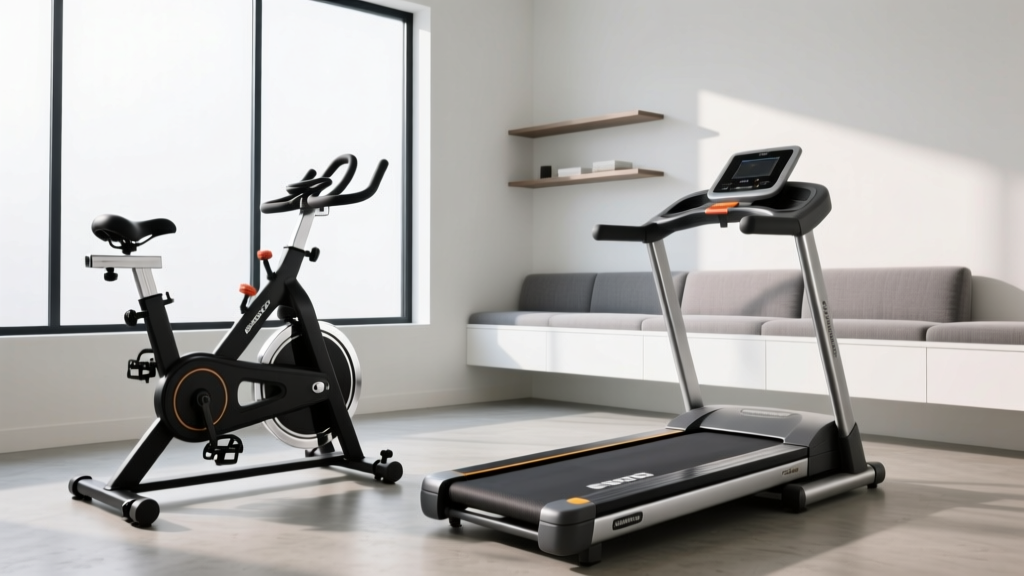
Home gym spatial constraints heavily influence equipment selection. A standard motorized treadmill requires a footprint of approximately 17 square feet, plus an additional 3 feet of clearance behind the deck for safety. A typical spin bike occupies only 10 square feet and can be easily rolled into a corner.
The 2026 smart fitness landscape has blurred the lines between these machines. Premium spin bikes now feature automated magnetic resistance that adjusts synchronously with virtual terrain mapping. Motorized treadmills have integrated auto-incline capabilities that simulate alpine hiking routes based on global GPS data.
Decision Framework: Which Should You Choose?
Use this practical decision matrix to align your physiological needs with the correct cardiovascular equipment.
| Primary Goal or Constraint | Recommended Equipment | Key Rationale |
|---|---|---|
| Maximum Caloric Expenditure | Spin Bike | Enables high-resistance intervals and full lower-body muscle recruitment. |
| Osteoporosis Prevention | Treadmill Walking | Weight-bearing impact stimulates bone remodeling and density retention. |
| Joint Pain or Rehabilitation | Spin Bike | Zero-impact closed-chain motion protects cartilage and ligaments. |
| Small Apartment or Condo | Spin Bike | Compact 10 square foot footprint with vertical storage options. |
| Posture and Gait Correction | Treadmill Walking | Reinforces natural spinal alignment and functional daily movement patterns. |
Frequently Asked Questions
Is walking on a treadmill better than a spin bike for seniors?
For seniors without severe joint degradation, treadmill walking is superior for maintaining balance, core stability, and bone density. However, seniors managing rheumatoid arthritis or recovering from hip replacements should utilize a spin bike to preserve joint cartilage while maintaining cardiovascular health.
Can I build muscle using a treadmill or spin bike?
A spin bike can induce mild muscular hypertrophy in the quadriceps and glutes when utilizing heavy resistance and low cadences. Treadmill walking will not build significant muscle mass, though walking at maximum incline (15 percent) can improve muscular endurance in the calves and hamstrings.
Final Verdict and Next Steps
Selecting the right equipment requires matching your physical capabilities with your spatial reality. If joint preservation and high caloric expenditure are your priorities, purchase a magnetic resistance spin bike. If bone density maintenance and natural gait training are essential, invest in a motorized treadmill. Your immediate next step is to measure your available floor space and schedule a trial session at a local fitness center to test both modalities before committing to a purchase.
More gear to consider
All reviews
Virtual Reality Treadmills: 2026 Motor & HP Comparison Guide

ProForm Pro 4500 Treadmill Setup & Motor Horsepower Guide

Folding Treadmill Review: Budget & Treadmill Oil Lubricant Costs

Cadence 70E Treadmill Noise: Beginner's Comparison Guide

Best Walking Pads for a Beginner on Treadmill Workouts (2026)
