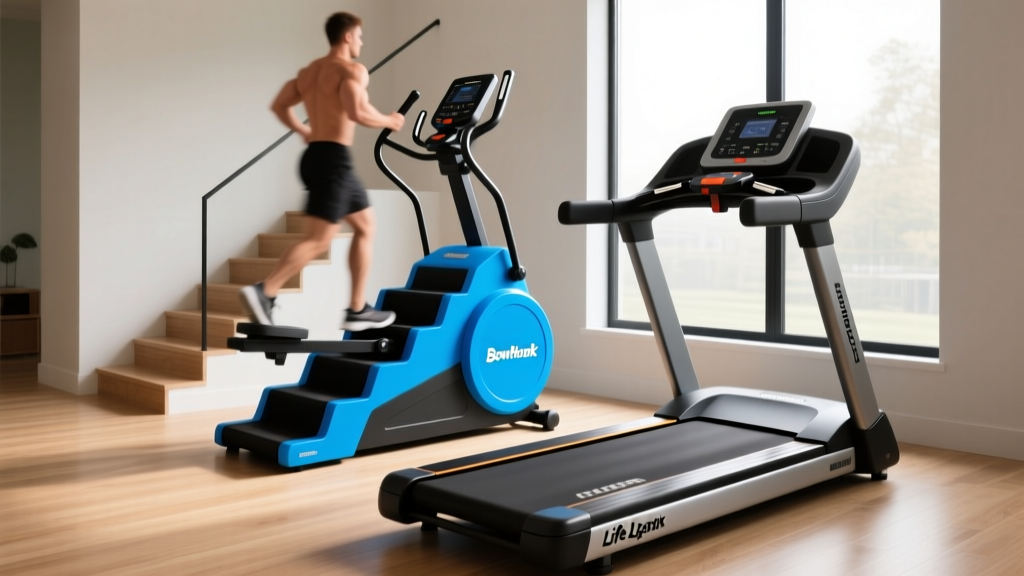
Stair Climber vs TR1200i Treadmill: Home Use Guide 2026
Compare the Bowflex stair climber and LifeSpan TR1200i treadmill. Our 2026 home use guide breaks down specs, space, and cardio benefits.

The 2026 Home Cardio Dilemma: Vertical vs. Horizontal
As home gym layouts evolve in 2026, the battle for floor space has forced fitness enthusiasts to make critical decisions about their primary cardio anchor. For years, the folding treadmill has been the default choice, but the surge in high-intensity, low-impact vertical training has brought the stair climber machine for home use into the spotlight. This guide serves as a comprehensive head-to-head comparison between a staple horizontal machine—the LifeSpan TR1200i treadmill—and the modern home stair climber category, specifically analyzing the Bowflex Max M9 and traditional step-mills.
Choosing between a stair climber and the TR1200i treadmill is not just about picking a brand; it is a fundamental choice between vertical load-bearing mechanics and horizontal incline walking. Below, we break down the exact specifications, spatial requirements, and biomechanical realities to help you determine which machine actually belongs in your home.
Contender Profiles: Defining the Matchup
The Horizontal Anchor: LifeSpan TR1200i Treadmill
The LifeSpan TR1200i treadmill remains a benchmark for mid-tier home folding treadmills. It is engineered for users who prioritize steady-state cardio, incline walking, and joint-friendly rehabilitation. Current 2026 pricing places the TR1200i treadmill between $899 and $1,099, making it a highly accessible entry point for dedicated home cardio.
- Motor: 2.5 HP Continuous Duty (quiet, efficient for walking/jogging)
- Running Surface: 20-inch width by 56-inch length (accommodates strides up to 6'2')
- Incline: 15% maximum incline via automated hydraulic lift
- Weight Capacity: 300 lbs
- Folded Footprint: 30" W x 10" D x 72" H
The Vertical Challengers: Home Stair Climbers
When discussing a stair climber machine for home use, the market splits into two distinct categories: compact stair-steppers (like the Bowflex Max M9, priced around $1,999) and traditional step-mills (like the StairMaster FreeClimber 1400, priced upwards of $3,500). For this comparison, we will focus on the Bowflex Max M9 as the primary residential contender, as its footprint is designed specifically to compete with folding treadmills in apartments and spare bedrooms.
- Resistance: 20 levels of magnetic eddy-current resistance
- Step Height: 20-inch vertical pedal travel
- Weight Capacity: 300 lbs
- Active Footprint: 30.5" L x 22" W x 65.5" H
Head-to-Head Specification Matrix
The following table contrasts the core engineering metrics of the TR1200i treadmill against the Bowflex Max M9 stair climber, highlighting the distinct mechanical approaches to cardiovascular conditioning.
| Feature | LifeSpan TR1200i Treadmill | Bowflex Max M9 Stair Climber |
|---|---|---|
| Primary Motion | Horizontal / Incline Walking | Vertical Stepping / Elliptical Hybrid |
| Drive System | 2.5 HP Electric Motor & Belt | Magnetic Resistance & Drive Belt |
| Active Floor Space | 70" L x 30" W | 30.5" L x 22" W |
| Noise Output | Moderate (Motor + Footstrike) | Very Low (Magnetic Flywheel) |
| Power Requirement | Standard 120V Wall Outlet | Standard 120V Wall Outlet |
| 2026 Avg. Price | $999 | $1,999 |
Spatial Realities: Footprint and the Ceiling Height Trap
The most common failure point when purchasing a stair climber machine for home use is ignoring ceiling clearance. While the TR1200i treadmill only requires standard 8-foot ceilings (the deck sits roughly 8 inches off the ground, and the console peaks at 55 inches), stair climbers elevate the user significantly.
⚠️ The Ceiling Height Trap:When using a machine like the Bowflex Max M9 or a traditional StepMill, the pedals elevate the user by 12 to 15 inches at their highest point. To avoid head trauma or drywall damage, you must calculate: User Height + 15 inches + Pedal Base Height. If you are 6'0" tall, your maximum vertical reach on a stair climber is roughly 7'3". You must have a minimum ceiling height of 8 feet to use a home stair climber safely. The TR1200i treadmill completely bypasses this spatial restriction.
However, when it comes to pure floor space, the stair climber dominates. The Bowflex Max M9 occupies just 4.6 square feet of active floor space. Even when the TR1200i treadmill is folded upright, its base still consumes roughly 2.5 square feet, and it requires a 72-inch vertical clearance against a wall, making it incompatible with rooms featuring sloped ceilings or low window sills.
Biomechanics, Impact, and Caloric Expenditure
The physiological demands of these two machines are vastly different. According to data from Harvard Health Publishing, a 155-pound individual using a general stair stepper burns approximately 223 calories in 30 minutes. In contrast, walking at a moderate 3.5 mph on a flat treadmill burns roughly 149 calories in the same timeframe.
However, the TR1200i treadmill features a 15% maximum incline. When you maximize the incline and walk at 3.0 mph, the caloric expenditure skyrockets, rivaling or exceeding the stair climber while maintaining a closed-chain kinetic environment. According to the Mayo Clinic, low-impact, closed-chain exercises are vastly superior for individuals managing osteoarthritis or recovering from lower-limb injuries. The stair climber requires the user to independently stabilize their center of gravity and bear full unilateral body weight on each pedal stroke, which can exacerbate patellofemoral pain syndrome (runner's knee) if form degrades during high-intensity intervals.
"The TR1200i treadmill at a 15% incline provides a highly controlled, predictable load on the Achilles tendon and plantar fascia, whereas a stair climber demands dynamic ankle dorsiflexion and deep knee flexion with every single step."
Maintenance Protocols: Belt Lubrication vs. Drive Tension
Long-term ownership costs are a critical factor in any home gym investment. The maintenance requirements for horizontal vs. vertical machines diverge sharply after the first 90 days of ownership.
TR1200i Treadmill Maintenance
- Belt Lubrication: The 20" x 56" running deck requires 100% silicone lubricant every 150 miles or every 3 months to prevent motor strain.
- Belt Alignment: Horizontal tracking must be checked monthly. A misaligned belt will fray the edges and void the deck warranty.
- Motor Dusting: The 2.5 HP motor hood must be vacuumed bi-annually to prevent overheating and control board failure.
Stair Climber Maintenance
- Drive Belt Tension: Vertical climbers rely on internal drive belts connected to the flywheel. These rarely need lubrication but may require tension adjustments after 500 hours of use to prevent pedal slipping.
- Pedal Arm Bearings: The pivot points bearing the user's unilateral weight are subject to high shear forces. Listen for metallic clicking, which indicates bearing wear.
- Console Sweat Damage: Because the user is positioned vertically and leaning forward over the console, sweat corrosion on the membrane keypad is a leading cause of failure in home stair climbers.
Final Verdict: Choosing Your Home Cardio Anchor
The decision between a stair climber and the TR1200i treadmill ultimately hinges on your spatial constraints, joint health, and training preferences. If you live in an apartment with strict noise ordinances, limited square footage, and possess healthy knees and hips, a compact stair climber like the Bowflex Max M9 delivers unparalleled high-intensity cardiovascular conditioning in a tiny footprint.
Conversely, the LifeSpan TR1200i treadmill is the undisputed champion for users prioritizing joint longevity, steady-state incline walking, and budget-friendly reliability. Its 15% incline capability bridges the caloric gap of vertical climbing while providing the biomechanical safety of a moving horizontal belt. For comprehensive home use in 2026, the TR1200i remains the most versatile and forgiving investment for the general population, while the stair climber remains a specialized tool for the space-starved, high-intensity athlete. For more insights on optimizing your cardio routines, refer to the American Council on Exercise (ACE) guidelines on cardiovascular programming.
More gear to consider
All reviews
Compact Cardio 2026: What is 12 Speed on Treadmill & Top Picks

Stair Climber Fix & WalkingPad Denise Austin 2.0 Double-Fold Treadmill

True Cost of a Treadmill That Connects to Apple Watch: Belt Care

Stair Climber Machine for Home Use vs Urevo Foldi Mini Treadmill

Under Desk Treadmill Review: Budget & Non Treadmill Stress Test Value
