Stair Climber vs Gold's Gym Trainer 430i Treadmill: 2026 Guide
Compare the stair climber machine for home use against the Gold's Gym Trainer 430i treadmill. Expert analysis on space, joint impact, and 2026 pricing.

The Home Cardio Dilemma: Vertical vs. Horizontal Training
When outfitting a home gym in 2026, the battle for floor space is real. Fitness enthusiasts are constantly weighing the biomechanical benefits of vertical climbing against the familiar, steady-state pacing of horizontal walking and running. This comprehensive guide breaks down the stair climber machine for home use, using a classic budget benchmark—the Gold's Gym Trainer 430i treadmill—as our horizontal baseline to help you decide which modality deserves your hard-earned square footage.
Editor's Note on Legacy Equipment: The Gold's Gym Trainer 430i treadmill is a legacy entry-level model. While largely discontinued in primary retail channels by 2026, it remains a staple on the secondary market and serves as the perfect archetype for budget-friendly, compact horizontal cardio machines. We use its specifications to represent the standard 1.5 CHP home treadmill category.Stair Climber Machines: A 2026 Home Use Guide
Stair climbers are not a monolith. The term encompasses three distinct categories of equipment, each with vastly different footprints, price points, and mechanical realities. Understanding these differences is critical before making a purchase.
1. Traditional StepMills (The Gold Standard)
True StepMills, like the StairMaster StepMill 3 (SM3) or the commercial-grade SM5, feature a continuously revolving staircase. They demand the most from the user and the room.
- Footprint: Approximately 49" L x 30" W.
- Ceiling Clearance: This is the most common installation failure. You must add the machine's step-up height (usually 8 to 10 inches) to the user's height, plus an additional 6 inches for headroom. An 8'6" ceiling is the absolute minimum for a 6-foot user.
- Pricing: $2,200 to $3,500 for new home models.
2. Hybrid Climbers (The Space-Savers)
Hybrid machines, such as the Bowflex Max Trainer M9, combine the stepping motion of a stair climber with the upper-body engagement of an elliptical. They utilize a fixed pedal track rather than a revolving staircase, drastically reducing the vertical clearance required.
- Footprint: 49" L x 30" W (similar length, but much lower profile).
- Ceiling Clearance: Standard 8-foot ceilings are perfectly adequate.
- Pricing: $1,500 to $2,000.
3. Mini-Steppers (The Budget Entry)
Models like the Sunny Health & Fitness SF-S902 offer a hydraulic-resistance stepping motion. While they lack the kinetic momentum of a StepMill, they are unbeatable for small apartments.
- Footprint: A mere 13" x 16".
- Pricing: $60 to $150.
Evaluating the Baseline: Gold's Gym Trainer 430i Treadmill
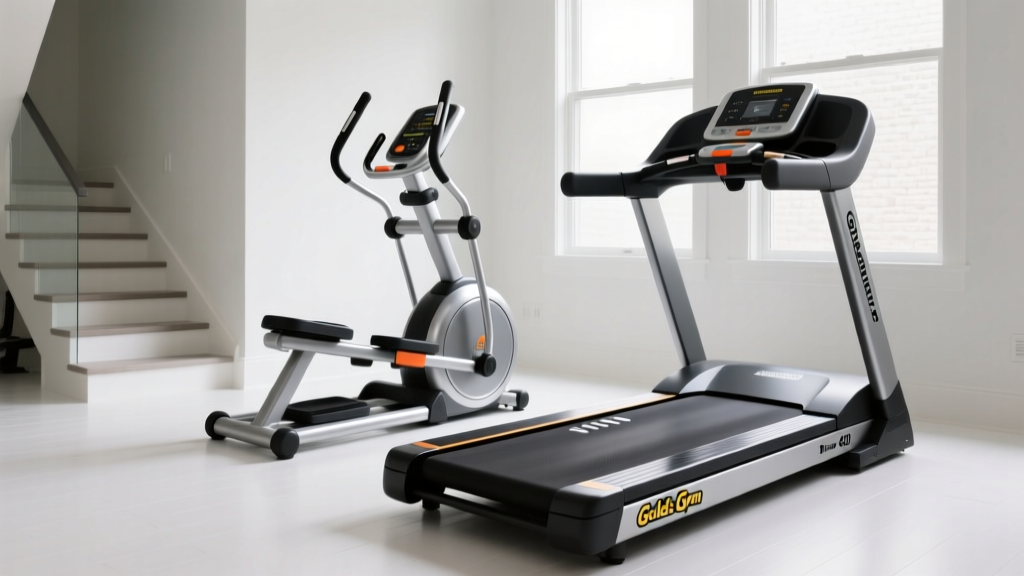
To properly evaluate the ROI of a stair climber, we must compare it against traditional horizontal cardio. The Gold's Gym Trainer 430i treadmill represents the quintessential budget home treadmill. Originally retailing around $399, it features a 1.5 Continuous Horsepower (CHP) motor, a 16" x 50" running belt, and a maximum speed of 10 MPH with a 10% motorized incline.
While the 430i is excellent for walking, light jogging, and steady-state Zone 2 cardio, its limitations become apparent when compared to vertical climbers. The 1.5 CHP motor is prone to overheating during high-incline, low-speed power walking (a popular 2026 fitness trend), and the 280 lb weight capacity restricts its use in multi-user households. Furthermore, the 65" length of the deck requires significant dedicated floor space, making it a permanent fixture in any room it occupies.
Head-to-Head Comparison Matrix
| Feature | StairMaster StepMill 3 | Bowflex Max M9 (Hybrid) | Gold's Gym 430i Treadmill |
|---|---|---|---|
| Primary Motion | Vertical Revolving | Vertical Elliptical | Horizontal Belt |
| Motor / Resistance | 4.0 HP Drive | Magnetic / Eddy Current | 1.5 CHP Drive |
| Max User Weight | 280 lbs | 300 lbs | 280 lbs |
| Min. Ceiling Req. | 8' 6" | 8' 0" | 8' 0" |
| 2026 Market Price | ~$2,499 | ~$1,799 | ~$250 (Refurbished) |
Biomechanics, Joint Impact, and Caloric ROI
The decision between a stair climber and a treadmill like the Gold's Gym Trainer 430i ultimately comes down to your physiological goals and joint health. According to data published by Harvard Health Publishing, a 155-pound individual utilizing a stair step machine will burn approximately 216 calories in 30 minutes, compared to 133 calories walking at a moderate 3.5 MPH pace on a flat treadmill. To match the caloric expenditure of a stair climber on a budget treadmill, you must either run at high speeds (which the 1.5 CHP motor of the 430i struggles to sustain quietly) or utilize maximum incline settings.
However, caloric burn is only half the equation. Joint preservation is paramount for long-term consistency. The Mayo Clinic emphasizes that low-impact aerobic exercises are crucial for individuals managing osteoarthritis or recovering from lower-extremity injuries. While treadmills offer shock absorption, the repetitive heel-strike of running or the awkward biomechanics of power-walking on a short 50-inch belt can exacerbate knee and hip issues. Stair climbers eliminate the downward impact force entirely, relying on concentric and eccentric muscle contractions of the glutes, quadriceps, and calves.
"Vertical climbing recruits the posterior chain and gluteus maximus at a significantly higher rate than horizontal walking. For users seeking hypertrophy and metabolic conditioning simultaneously, the stair climber offers a dual-threat advantage that standard treadmills cannot replicate without extreme incline modifications." — American Council on Exercise (ACE) Biomechanics Insights.
Space, Power, and Installation Realities
Before finalizing your purchase, conduct a rigorous audit of your home environment. The physical footprint is misleading; it is the volumetric space that dictates usability.
- Power Requirements: The Gold's Gym 430i treadmill requires a dedicated 120V, 15-amp circuit to prevent tripping breakers during motor surges. Traditional StepMills have similar requirements. Hybrid climbers and mini-steppers often draw significantly less amperage, making them safer for older homes with shared circuits.
- Acoustic Footprint: Budget treadmills with 1.5 CHP motors generate noticeable whining and belt friction noise, especially as the lubrication degrades over time. Magnetic resistance hybrid climbers operate in near silence, a massive advantage for early-morning or late-night apartment dwellers.
- Maintenance: Treadmill belts require periodic silicone lubrication and tensioning. Stair climbers require chain or belt tension checks, but lack the continuous friction surface that degrades treadmill decks.
Final Verdict: Which Machine Earns Your Floor Space?
If your primary goal is casual, low-intensity walking while consuming media, and you are shopping on a strict secondary-market budget, a refurbished Gold's Gym Trainer 430i treadmill remains a viable, space-efficient horizontal option. It provides a familiar interface and adequate pacing for Zone 1 recovery days.
However, if you are investing in new equipment for 2026 and seek maximum caloric expenditure, lower-body muscular endurance, and joint-friendly biomechanics, the stair climber machine is the undisputed champion. For homes with standard 8-foot ceilings, hybrid climbers like the Bowflex Max series offer the perfect bridge between vertical intensity and spatial efficiency. For those with the ceiling clearance and the budget, a true StepMill remains the ultimate home cardio centerpiece, delivering commercial-grade results that no budget treadmill can replicate.
More gear to consider
All reviews
Cursor Treadmill Alternatives: Air Bike vs Assault Bike 2026 Guide

Allie Bennett Treadmill Strut: Best Under Desk Office Treadmills
Folding Treadmill, Scooter, Bike: Small Space Review & Care

What Treadmill MPH Do You Need? Under Desk Office Budget Breakdown

Rowing Machine Guide & Technique vs Treadmill with Weighted Vest