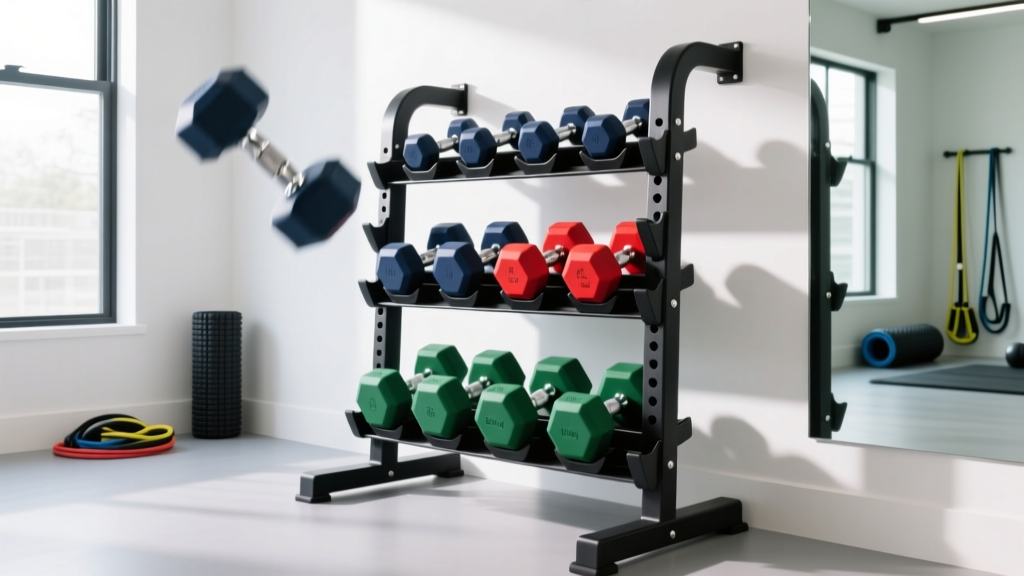
Space-Saving Dumbbell Racks for Your Lat Row Dumbbell Setup
Discover space-saving dumbbell racks and layout tips to optimize your home gym for heavy lat row dumbbell workouts and efficient equipment storage.

The Spatial Demands of the Lat Row Dumbbell Exercise
When optimizing a compact home gym, most lifters focus on the footprint of their power rack or cardio machines, completely overlooking the spatial requirements of free weight movements. The lat row dumbbell exercise—a unilateral staple for building latissimus dorsi thickness and correcting muscular imbalances—is a prime example of a movement that demands specific layout considerations. According to Cleveland Clinic's guide to back exercises, maintaining a neutral spine and proper hip hinge during bent-over rows is critical for preventing lumbar strain. However, you cannot maintain proper biomechanics if your equipment layout forces you into a cramped, compromised position.
A standard flat utility bench measures approximately 17.5 inches in height and 48 inches in length. To execute a single-arm lat row dumbbell variation safely, you need a minimum of 24 inches of lateral clearance on the working side. This allows the dumbbell to hang fully at the bottom of the eccentric phase without striking a wall, rack, or adjacent equipment. Furthermore, retrieving heavy dumbbells (e.g., 80+ lbs) from a poorly positioned rack and walking them over to your bench is a primary cause of lower back injuries in home gyms. Space optimization is not just about fitting equipment into a room; it is about engineering a safe, fluid staging area for heavy lifts.
Comparing Space-Saving Dumbbell Racks for Tight Layouts
Selecting the right storage solution dictates your gym's traffic flow. Below is a comparison of the top rack configurations for small spaces, evaluating their footprint, capacity, and suitability for row-heavy routines.
| Rack Model | Footprint & Dimensions | Capacity | Est. Price | Best Layout Application |
|---|---|---|---|---|
| Rogue 3-Tier Dumbbell Rack | 47" L x 23" W x 38" H | 10 Pairs (up to 100 lbs) | $395.00 | Open-wall staging; allows seated retrieval from the top tier. |
| Rep Fitness A-Frame Rack | 28" L x 28" W x 36" H | 10 Pairs (up to 50 lbs) | $299.00 | Corner placements; minimizes linear wall space usage. |
| Titan Fitness Wall-Mounted | 0 sq ft (48" W x 30" H wall space) | 6-8 Pairs (varies by tier) | $149.00 | Ultra-compact gyms; keeps floor entirely clear for bench movement. |
For a dedicated lat row dumbbell setup, the Rogue 3-Tier Dumbbell Rack is often the superior choice. The top tier sits at roughly 32 inches high. If positioned correctly next to your bench, you can sit down, hinge forward, and lift the dumbbells directly into the starting position without walking with a loaded spine.
The 'Triangle of Efficiency' Layout Framework
To maximize a room under 200 square feet, implement the 'Triangle of Efficiency' framework. This concept maps the three critical zones of any free-weight exercise: Storage, Staging, and Execution.
- Storage Zone (The Rack): Place your rack against the longest uninterrupted wall. If using a freestanding unit like the Rep Fitness A-Frame, tuck it into a corner at a 45-degree angle to the bench to save linear wall space.
- Staging Zone (The Retrieval Path): Maintain a 36-inch clear path between the rack and the bench. This is the 'loading zone' where you pick up the weights. Ensure your 3/4-inch vulcanized rubber flooring extends fully through this zone to protect the subfloor from dropped dumbbells during fatigued sets.
- Execution Zone (The Bench): Position the bench parallel to the rack, exactly 24 inches away from the edge of the rack's footprint. This specific measurement allows you to reach out and grab the dumbbells from a seated position, eliminating the need to deadlift the weights off the rack and carry them backward.
Wall-Mounted vs. Freestanding: Edge Cases and Failure Modes
Wall-mounted racks are the ultimate space-savers, but they introduce structural edge cases that freestanding racks do not. When mounting a 3-tier wall rack to hold pairs of 50 lb or 70 lb dumbbells, the total dynamic load can easily exceed 400 lbs.
Critical Installation Requirements
- Stud Verification: You must anchor the rack into wooden wall studs spaced 16 inches on-center, or use toggle bolts rated for 250+ lbs per anchor if mounting to commercial-grade concrete.
- Hardware Specs: Use 3/8-inch x 3-inch structural lag screws. Standard drywall anchors will catastrophically fail under the lateral pull of removing heavy dumbbells.
- The 'Snag' Failure Mode: If mounted too high, the user must reach upward to grab a heavy dumbbell, creating shoulder impingement risks. The bottom tier should be no lower than 18 inches from the floor, and the top tier no higher than 42 inches.
Expert Insight: Never mount a dumbbell rack directly behind the head of your bench. If you miss a rep on a dumbbell pullover or lose balance during a heavy lat row dumbbell set, falling backward into a steel rack loaded with iron is a severe hazard. Always offset the rack to the side or behind the foot of the bench.
Pro-Tip: The 'Seated Scoop' Retrieval Method
When utilizing a horizontal 3-tier rack for your lat row dumbbell routine, adopt the 'Seated Scoop'. Sit sideways on the bench facing the rack. Grab the dumbbells from the top tier, rest them on your thighs, and then use your legs to kick them up into position as you hinge forward. This layout-dependent technique completely bypasses the lower back during the pickup phase, allowing you to save your energy for the actual working set.
Frequently Asked Questions (FAQ)
Can I use a kettlebell rack for my lat row dumbbell setup?
While kettlebell racks save space, their angled shelves are designed for round-bottomed bells. Storing hex-head rubber dumbbells on a steeply angled kettlebell rack can cause the handles to sit awkwardly, making one-handed retrieval difficult. For dumbbells, a flat-shelved horizontal or A-frame rack is vastly superior for ergonomic grip alignment.
How much weight can a standard home gym wall hold?
A standard interior residential wall (1/2-inch drywall over 2x4 wooden studs) can support roughly 100 lbs per lag screw driven directly into the center of a stud. For a 3-tier rack holding 10 pairs of dumbbells totaling 300+ lbs, you must ensure the mounting brackets span across at least three distinct wall studs to distribute the shear force safely.
What is the best dumbbell shape for tight rack clearances?
Hex-head dumbbells are mandatory for tight spaces and tiered racks. Round urethane or neoprene dumbbells can roll if placed slightly off-center on a flat rack tier, creating a dangerous drop hazard. Hex heads lock into place on the steel rails, ensuring your gym layout remains safe even when you are fatigued after a heavy set of rows.
More gear to consider
All reviews
What Do Bent Over Dumbbell Rows Work? Gear Stress & Care

2026 Dumbbell Rack Trends: Storing Your Trap Raises Dumbbell Sets
EZ Curl Bar vs Straight Bar Longevity: Care Tips & Single Dumbbell Good Morning Alternatives
Olympic vs Standard Plates for a Dumbbell Chest Press Without Bench
Bumper vs Iron Plates: Gym Layouts and Dumbbell Chest Presses
