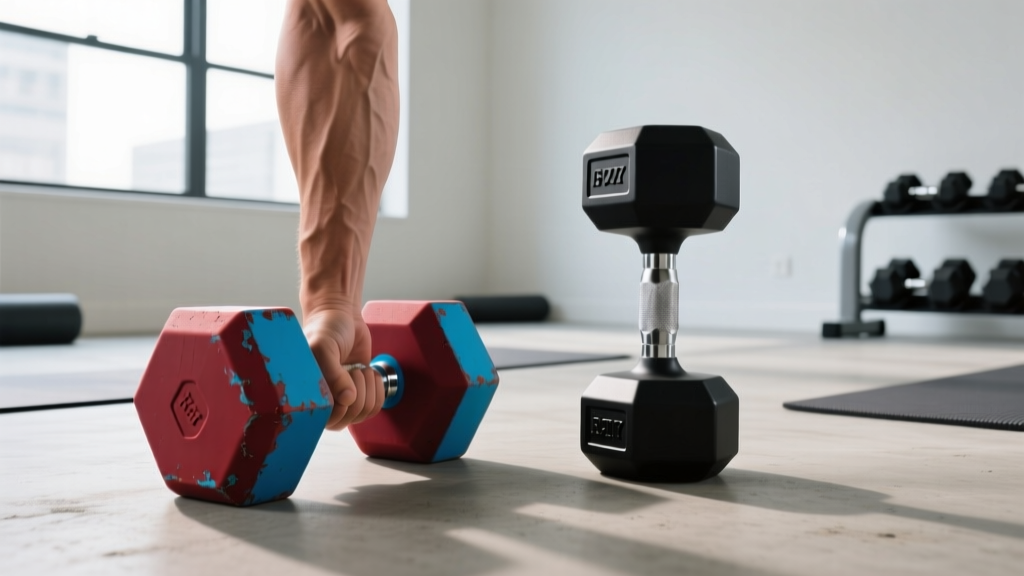
Side Dumbbell Raise Equipment Trends: Rubber Hex vs Urethane
Analyzing 2026 market trends for the side dumbbell raise: why commercial and home gyms are shifting from rubber hex to urethane dumbbells for isolation.

The Biomechanical Demands of the Side Dumbbell Raise
When analyzing free weight equipment through the lens of specific isolation movements, few exercises expose design flaws as ruthlessly as the side dumbbell raise. Often referred to as the lateral raise, this movement targets the medial deltoid through shoulder abduction. According to ExRx.net's biomechanical breakdown of the dumbbell lateral raise, the exercise relies on a long moment arm, meaning even minor deviations in equipment design, weight distribution, or grip ergonomics are magnified at the point of muscular failure.
In 2026, the fitness equipment market is undergoing a significant correction. For the past decade, rubber hex dumbbells dominated both commercial and home gym floors due to their low cost and anti-roll design. However, a growing contingent of sports scientists, physical therapists, and serious lifters are scrutinizing how these budget-friendly tools interact with high-rep isolation work. The result? A massive market pivot toward premium urethane dumbbells. This trend report breaks down the material science, ergonomic realities, and procurement economics driving the shift from rubber hex to urethane for the side dumbbell raise and similar isolation movements.
Moment Arms, Head Profiles, and Movement Interference
The primary mechanical failure of the traditional rubber hex dumbbell during a side dumbbell raise lies in its head profile. Recycled rubber hex molds are inherently bulky. To achieve the necessary weight, the hexagonal heads must be thick and wide. For lifters performing the movement with a neutral grip at the bottom of the range of motion, these oversized heads frequently collide with the lateral thigh or hip, artificially truncating the stretch position.
2026 Trend Alert: The Compact Head RevolutionModern urethane dumbbells, such as those utilizing virgin polyurethane, boast a density that allows for a 20-30% reduction in head volume compared to rubber hex equivalents. This sleeker profile completely eliminates thigh interference during the side dumbbell raise, allowing for a full, unobstructed range of motion and optimal medial deltoid stretch.
Furthermore, the center of mass in cheaper rubber molds can occasionally be off-center by a few millimeters due to inconsistent pouring and cooling processes. While unnoticeable during a heavy dumbbell bench press, a 3mm shift in the center of mass during a strict 15-pound side dumbbell raise creates an asymmetric torque that forces the rotator cuff and forearm stabilizers to overcompensate, leading to premature fatigue.
Grip Ergonomics: The Hidden Limiting Factor
Ask any hypertrophy coach what limits the side dumbbell raise, and they will rarely say "deltoid strength." The limiting factor is almost always grip endurance and forearm fatigue. This is where the handle specifications of rubber hex versus urethane dumbbells diverge drastically.
Handle Diameter and Knurling Depth
Most commercial-grade rubber hex dumbbells feature a handle diameter ranging from 35mm to 38mm, often encased in a thick, unknurled chrome or rubberized sleeve. The lack of aggressive knurling means the lifter must squeeze the dumbbell with excessive force to prevent it from slipping during the concentric phase of the raise. This intense grip demand rapidly fatigues the brachioradialis and flexor digitorum, ending the set before the medial deltoid reaches true mechanical failure.
Conversely, premium urethane dumbbells prioritize the handle. As detailed in Rogue Fitness Urethane Dumbbell specifications, high-end urethane sets typically feature a 34mm handle with a refined, medium-depth "volcano" knurl pattern. This specific diameter and knurling combination provides maximum friction with minimal grip crushing force, effectively removing the forearm as the bottleneck during high-rep side dumbbell raise protocols.
Material Science & Market Realities: Rubber vs. Urethane
The 2026 fitness equipment market is heavily influenced by evolving environmental regulations and a demand for longevity. The traditional rubber hex dumbbell is manufactured using recycled rubber tires and synthetic binders. While cost-effective, this process releases Volatile Organic Compounds (VOCs), resulting in the notorious "gym smell" that off-gasses for months. In 2026, stricter indoor air quality standards in commercial facilities have accelerated the phase-out of low-grade rubber.
Urethane (specifically virgin polyurethane) is a completely different polymer class. It is odorless, highly resistant to UV degradation, and impervious to sweat and cleaning chemicals. To understand the practical differences, review the comparison matrix below.
| Feature | Rubber Hex Dumbbells | Virgin Urethane Dumbbells |
|---|---|---|
| Material Base | Recycled rubber & synthetic binders | Virgin polyurethane elastomer |
| Durometer (Hardness) | 70-80 Shore A (Softer, prone to gouging) | 85-90 Shore A (Dense, highly impact-resistant) |
| Odor / Off-Gassing | High VOCs, strong odor for 3-6 months | Zero VOCs, completely odorless |
| Head Profile | Bulky, high interference risk | Compact, streamlined for isolation |
| Handle Ergonomics | 35-38mm, often unknurled or poorly knurled | 32-34mm, precision CNC knurling |
| Average Lifespan | 3-5 years (edges degrade, chunking) | 10-15+ years (commercial grade) |
Cost-Per-Pound and Procurement Economics in 2026
The primary argument for rubber hex has always been price. However, the economic gap is narrowing. In the early 2020s, rubber hex dumbbells averaged $1.50 to $2.00 per pound, while urethane commanded a massive premium of $6.00 to $8.00 per pound.
As of 2026, global supply chain stabilization and improved polyurethane injection molding efficiencies have brought the cost of premium urethane down to the $3.50 to $4.50 per pound range for commercial sets. Meanwhile, the cost of raw rubber and shipping heavy, low-density products has pushed budget rubber hex prices up to $2.25 to $2.85 per pound.
"When you factor in the replacement cycle—commercial gyms are replacing chipped and degrading rubber hex sets every 36 months—the 10-year total cost of ownership for urethane is actually lower. For the home gym user buying a set once, the ergonomic benefits for movements like the side dumbbell raise make urethane the undisputed choice."
Industry analyses, such as those highlighted in Rep Fitness's material comparison guides, consistently point out that urethane's resistance to edge-chunking and dropping damage makes it a superior long-term capital expenditure, even if the initial outlay is 40% higher.
The FitGearPulse Decision Framework
Should you outfit your facility or home gym with rubber hex or urethane? Use this 2026 decision framework based on your specific training modalities and budget constraints.
- Choose Urethane If: Your programming heavily features strict isolation movements (side dumbbell raises, tricep extensions, skull crushers) where grip fatigue and movement path obstruction are limiting factors. Urethane is also mandatory for indoor, climate-controlled home gyms where off-gassing odors are unacceptable, and for commercial spaces demanding a 10-year lifecycle.
- Choose Rubber Hex If: You are outfitting a high-abuse outdoor functional fitness rig, a garage gym with extreme temperature fluctuations (urethane can stiffen in freezing temps, though modern blends handle this better), or if your budget strictly caps at $2.50/lb and your programming focuses primarily on heavy, low-rep compound movements where handle ergonomics are secondary to sheer mass.
Final Thoughts on Isolation Optimization
The side dumbbell raise is an exercise of precision, not brute force. It requires a seamless connection between the lifter's grip and the implement's center of mass. As the 2026 market data clearly illustrates, the industry is moving away from the compromised ergonomics and bulky profiles of rubber hex dumbbells. By investing in virgin urethane dumbbells, lifters eliminate artificial friction points, reduce grip-induced premature failure, and secure a piece of equipment that will outlast the trends of the decade.
More gear to consider
All reviews
EZ Curl Bar vs Straight Bar Longevity: Care Tips & Single Dumbbell Good Morning Alternatives
Beyond Upward Row Dumbbells: Barbell Collar Clamp Setup

EZ Bar vs Straight Bar: Upgrading Your Whole Body Dumbbell Workout
Bowflex SelectTech 552 Dumbbells Pair vs Rubber & Urethane Care

Beyond Dumbbell RDLs for Glutes: Olympic Barbell Weight & Knurl Guide
