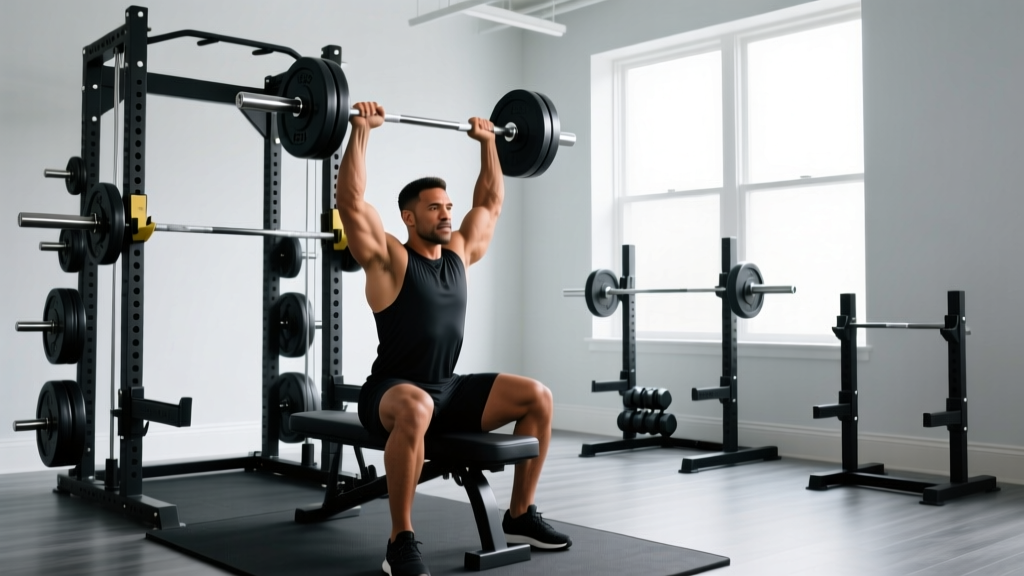
Seated Overhead Dumbbell Press: Power Rack vs Squat Stand Guide
Master the seated overhead dumbbell press. Compare power racks, squat racks, and squat stands to build the safest beginner home gym setup.

The Beginner’s Dilemma: Matching Your Rack to the Lift
When building a home gym in 2026, most beginners obsess over barbell squats and bench presses, leading them to blindly purchase the first power rack they find. However, if your programming includes the seated overhead dumbbell press—a foundational movement for anterior deltoid hypertrophy and shoulder stability—your rack choice becomes a critical, often overlooked variable.
Unlike a barbell military press, the seated overhead dumbbell press requires significant lateral clearance, specific bench angles, and unique safety spotter placements. Choosing between a full power rack, a half squat rack, or independent squat stands will dictate whether your shoulder workouts are safe, effective, or endlessly frustrating. This step-by-step guide breaks down the exact spatial geometry, equipment specifications, and biomechanical setups you need to master this lift safely.
⚠️ Beginner Warning: The Upright Clearance TrapStandard power racks feature a 49-inch inner width between uprights. A pair of 100lb Rogue Rubber Hex dumbbells measures roughly 14.5 inches in length each. When seated inside the rack, your total wingspan with dumbbells can easily exceed 55 inches. This causes the weights to slam into the steel uprights before your elbows reach full extension, ruining the range of motion and potentially damaging your equipment. Always measure your specific dumbbells before committing to an in-rack bench setup.
Step 1: Evaluating Power Racks (Full Cages)
Full power racks, such as the Rep Fitness PR-4000 (averaging $799–$899 in 2026) or the Rogue R-3 ($1,100+), are the gold standard for home gym safety. They feature four main uprights, crossmembers, and a pull-up bar.
Pros for the Seated Overhead Press
- Ultimate Safety: You can position safety spotter arms on all four sides, creating a catch-net if you fail a heavy rep and drop a dumbbell backward.
- Attachment Ecosystem: Access to lat pulldowns and cable crossovers, which pair well with shoulder routines.
Cons & Failure Modes
The primary failure mode for the seated overhead dumbbell press inside a full cage is spatial restriction. To avoid hitting the uprights with heavy, wide dumbbells, you must position your adjustable bench perpendicular to the front uprights, essentially sitting outside or halfway out of the cage. This negates the safety benefits of the rear spotter arms. Furthermore, dragging a heavy 80lb FID (Flat/Incline/Decline) bench in and out of a fully enclosed cage is cumbersome for daily workflow.
Step 2: Evaluating Squat Racks (Half Racks)
Half racks, like the Rogue SML-2 Monster Lite Squat Stand ($625), feature two main front uprights and two shorter rear stabilizing uprights with weight storage horns.
The 'Open-Front' Advantage
Half racks solve the clearance issue. You can pull your adjustable bench up to the front uprights, facing outward. This gives your elbows infinite lateral clearance for the seated overhead dumbbell press. If you fail a rep, you simply let the dumbbells drop to the floor (assuming you have rubber flooring) or guide them down to the front spotter arms set just below shoulder height.
Footprint Considerations
While better for dumbbell pressing than full cages, half racks still have a fixed depth (usually 48 to 53 inches). If you are pressing with a steep 85-degree bench incline, your head may still be close to the crossmembers, requiring careful bench alignment.
Step 3: Evaluating Squat Stands (Independent Uprights)
Squat stands, such as the Titan Fitness T-2 Series ($249–$299), consist of two independent, heavy-duty steel uprights with a base footprint.
Why Stands Excel for Dumbbell Work
For the dedicated seated overhead dumbbell press, squat stands are arguably the superior choice for beginners and intermediates. Because there are no rear crossmembers or side cages, you can place your adjustable bench at any angle, anywhere relative to the uprights.
"For strict dumbbell shoulder work, independent squat stands offer unmatched freedom. You aren't fighting the geometry of a cage; you are simply using the stands to set your spotter arms at the exact height needed to catch a failed dumbbell kick-up." — Home Gym Engineering Principles
The Stability Caveat
Squat stands lack the sheer mass and bolted-in stability of a power rack. When performing heavy dumbbell kick-ups (using your thighs to heave the weights into position), you might accidentally bump the stands. In 2026, it is highly recommended to either bolt squat stands to a wooden platform or load the rear weight storage horns with at least 150 lbs of bumper plates to anchor the center of gravity.
Comparison Matrix: Which Setup Fits Your Home Gym?
| Equipment Type | Avg 2026 Price | Dumbbell Clearance | Spotter Arm Utility | Best For... |
|---|---|---|---|---|
| Power Rack | $750 - $1,200 | Poor (Restricted to 49") | Excellent (360° catch) | Heavy Barbell Work |
| Half Rack | $550 - $800 | Good (Open Front) | Good (Front/Side catch) | Mixed Barbell & Dumbbell |
| Squat Stands | $200 - $350 | Excellent (Infinite) | Moderate (Front only) | Dumbbell Focus & Small Spaces |
Step 4: Biomechanics and Bench Setup
According to kinesiology data from ExRx, the seated dumbbell shoulder press primarily targets the anterior deltoid, with synergistic help from the lateral deltoid and upper pectoralis major. However, the angle of your bench drastically alters joint stress.
The 75-to-85 Degree Rule
Beginners often set their adjustable bench to a perfectly vertical 90 degrees. This forces the humerus into extreme external rotation at the bottom of the movement, significantly increasing the risk of shoulder impingement. Mayo Clinic strength training guidelines emphasize maintaining neutral spinal alignment and avoiding hyperextension. Setting your FID bench to a 75 or 85-degree incline allows the scapula to retract slightly and provides a safer, more natural pressing groove that aligns with the scapular plane (roughly 30 degrees forward of the frontal plane).
Step 5: Executing the Press Safely (Step-by-Step)
Once you have selected your rack (we recommend Squat Stands or a Half Rack for this specific movement) and set your bench to 80 degrees, follow this execution protocol:
- Set the Spotter Arms: Place the safety spotter arms on your uprights at roughly shoulder-height when seated. If you fail, you only need to drop the dumbbells 4–6 inches to hit the steel safeties, protecting your rotator cuffs from a sudden, deep stretch under load.
- The Thigh Kick-Up: Sit on the bench with the dumbbells resting on your knees, near the hip crease. Kick one knee up sharply to launch the right dumbbell to your shoulder, immediately followed by the left knee. Do not attempt to curl the weights up from a dead hang at your sides.
- Scapular Anchoring: Before pressing, pinch your shoulder blades together and down (depression and retraction). This creates a stable shelf on the bench and protects the AC joint.
- The Pressing Arc: Press the weights up and slightly inward. The dumbbells should not touch at the top; stopping just an inch apart maintains constant tension on the deltoids.
- The Descent: Lower the weights under a strict 2-second eccentric tempo until the handles are roughly level with your collarbone, or your elbows break 90 degrees. Do not bounce out of the hole.
Frequently Asked Questions
Can I use a power rack if I already own one?
Yes. If you already own a full power rack, simply pull your adjustable bench completely out of the cage, or position it sideways so you are pressing parallel to the front uprights. Use a pair of standalone squat stands or specialized dumbbell spotter platforms placed just outside the rack to catch failed reps.
What is the best dumbbell style for this lift?
Urethane or rubber hex dumbbells are ideal because their flat edges prevent them from rolling off your thighs during the kick-up phase, and they won't chip your flooring if you have to bail a rep. Avoid round chrome dumbbells for heavy overhead work.
Final Verdict for the Beginner
If your primary goal is heavy, safe barbell squatting and benching, invest in a Power Rack. But if your programming heavily features the seated overhead dumbbell press, lateral raises, and unilateral movements, a heavy-duty pair of Squat Stands or an open-front Half Rack will provide the spatial freedom necessary to train your shoulders effectively without fighting your equipment. Measure your space, respect the geometry of your dumbbells, and press safely.
More gear to consider
All reviews
2026 Trends: Loadable Dumbbells for a 5 Day Dumbbell Workout Plan

Cable Flyes vs Dumbbell Flys: Adjustable Dumbbell Guide

Reverse Pec Deck with Dumbbells Setup & Adjustable Dumbbell Comparison

Curl Bar vs Dumbbells: Bicep Gains & Olympic Knurling Guide

Power vs Squat Stand: What Weight Dumbbells Should I Use Female
