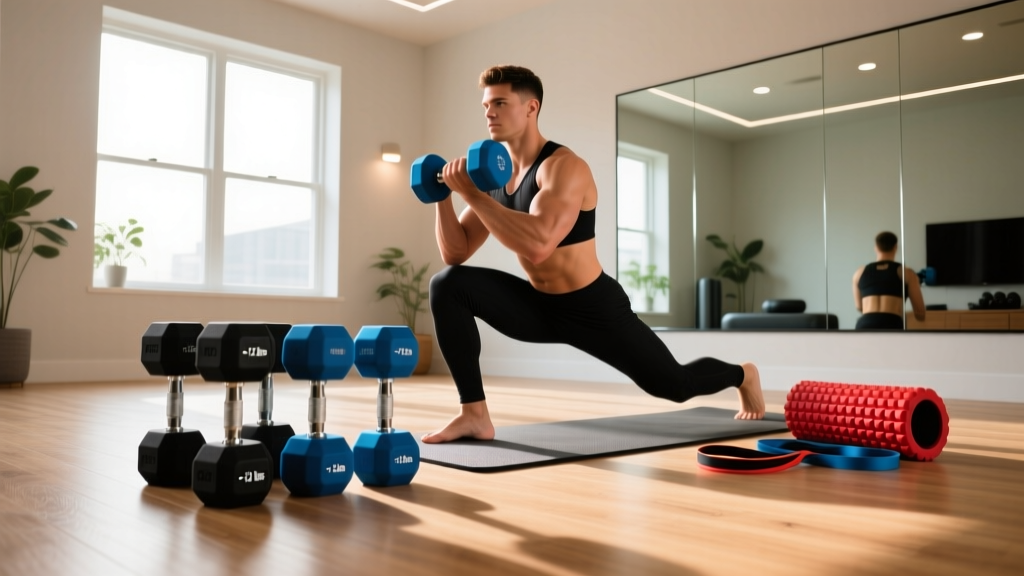
Rubber Hex vs Urethane: Space & Dumbbell Overhead Press GIF Guide
Optimize your home gym layout by comparing rubber hex vs urethane dumbbells. Learn space-saving storage, drop zones, and overhead press clearance tips.

The Spatial Footprint: Material Density and Gym Layouts
Designing a high-functioning home gym in 2026 requires more than just measuring floor space; it demands a meticulous understanding of equipment micro-geometry. When optimizing compact layouts—such as a 60-square-foot garage corner or a low-ceiling basement—the physical density of your free weights dictates your storage footprint and movement envelopes. The debate between rubber hex dumbbells and urethane dumbbells is fundamentally a spatial optimization challenge.
Urethane is a significantly denser polymer than standard recycled rubber. Consequently, a 50-pound urethane dumbbell possesses a noticeably smaller physical volume than a 50-pound rubber hex dumbbell. According to manufacturing specifications from premium brands like Rogue Fitness, virgin urethane allows for a more compact head profile. This density advantage means a full 5-to-50-pound urethane set can fit onto a 28-inch, 3-tier vertical rack, whereas the bulkier rubber hex equivalents often require a 36-inch or even 42-inch rack. In tight layouts, reclaiming those 8 to 14 inches of linear wall space is critical for integrating functional trainers or folding squat racks.
Rack Layouts and Stacking Geometry Matrix
Beyond the rack itself, the shape of the dumbbell head dictates how it interacts with your storage system. Hexagonal heads are designed to stack vertically on flat shelves and resist rolling, making them ideal for shallow, open-concept shelving units. Urethane dumbbells, however, are frequently manufactured in round profiles (though hex urethane exists) and require specialized cradled trays to prevent structural damage to the rack.
| Feature | CAP Barbell Rubber Hex | Rep Fitness Urethane (Round) | Rogue Urethane Hex |
|---|---|---|---|
| Avg. Cost per lb (2026) | $1.30 - $1.80 | $3.50 - $4.20 | $4.80 - $5.50 |
| Relative Volume (50lb pair) | High (Bulky) | Low (Compact) | Medium |
| Rack Compatibility | Flat Shelves / Floor | Tray Racks Only | Flat Shelves / Tray |
| Odor Outgassing | High (Months) | None | None |
| Drop Durability | Low (Handle cracking) | Very High | High |
Movement Envelopes and Form Analysis in Confined Spaces
Space optimization is not solely about where equipment rests; it is about the dynamic volume a lifter occupies during a set. In restricted floor plans, your walls, mirrors, and ceilings become active constraints. When analyzing biomechanics in tight layouts, reviewing a looped dumbbell overhead press gif helps lifters visualize the exact lateral elbow flare and vertical clearance required to avoid striking low-hanging garage door tracks, basement ductwork, or nearby walls.
The overhead press demands the most aggressive vertical envelope of any dumbbell movement. A standard 8-foot ceiling leaves roughly 24 to 30 inches of clearance above a 6-foot lifter's crown. If your layout forces you to press near a wall, the natural arc of the dumbbell—as clearly visible when studying a dumbbell overhead press gif for form checks—requires at least 18 inches of lateral buffer space to prevent the plates from scraping the drywall at the lockout position.
Clearance Calculation Framework
To safely map your pressing zone, use this formula:
- Measure Lifter Height: Stand flat-footed and measure to the top of your wrist when your arm is fully extended overhead.
- Add Dumbbell Radius: Add the vertical height of your dumbbell head (approx. 4.5 inches for rubber hex, 3.8 inches for compact urethane).
- Calculate Buffer: Subtract this total from your ceiling height. You need a minimum of 6 inches of negative space to account for spinal extension and momentum.
If your clearance is under 4 inches, you must relocate your pressing station or switch to seated variations.
Durability, Drop Zones, and Floor Protection
In a space-optimized gym, your drop zones are severely limited. You do not have the luxury of a dedicated 4x8-foot rubber platform surrounded by open space. When a set of heavy dumbbells is dropped in a confined layout, they often hit the edges of your flooring mats or strike adjacent equipment.
This is where the material failure modes of rubber hex versus urethane become glaringly apparent. Experts at BarBend frequently note that cheap rubber hex dumbbells suffer from catastrophic handle junction failures. The cast iron head is encased in rubber, but the chrome handle is pressed in. When dropped at an angle in a tight space where you cannot guide the weight down safely, the torque snaps the handle free from the rubber shell.
Urethane, conversely, is poured and bonded directly to a knurled steel handle with industrial adhesives and mechanical locking pins. It absorbs high-impact kinetic energy without deforming or cracking. Furthermore, recycled rubber hex dumbbells emit volatile organic compounds (VOCs) that can make small, unventilated spaces like basement gyms virtually unusable for the first six months. Urethane is completely odorless, a non-negotiable factor for indoor spatial layouts lacking industrial HVAC systems.
Designing the Layout: Pros and Cons by Space Type
Choosing between these materials should be dictated by your specific architectural constraints.
The Narrow Garage Gym (Width under 10 feet)
- Recommendation: Urethane (Round or Hex)
- Why: The compact density of urethane allows for a narrower 2-tier rack, preserving precious lateral width for a folding squat rack. The superior drop-durability protects your car or nearby workbenches from rogue bouncing weights.
The Finished Basement (Low Ceilings, Climate Controlled)
- Recommendation: Urethane Hex
- Why: Outgassing from rubber hex will permeate the home's upper floors. Urethane eliminates this risk. The hex shape prevents rolling into drywall or sump pump enclosures, while the smaller head size accommodates the tighter vertical clearances discussed in our overhead press analysis.
The Open Spare Bedroom / Multi-Use Room
- Recommendation: Rubber Hex (Budget Permitting)
- Why: If space is abundant and the room is well-ventilated, rubber hex offers a budget-friendly entry point. The flat edges allow them to be stored neatly under a bed or in a standard closet shelving unit without requiring an expensive, dedicated dumbbell rack.
Final Verdict: Optimizing Your 2026 Investment
Space optimization is an exercise in compromise, but your dumbbell material should not be where you cut corners. While rubber hex dumbbells offer an attractive entry price of around $1.50 per pound, their bulky footprint, vulnerability to handle snapping, and noxious outgassing make them a liability in truly optimized, compact layouts.
Investing in urethane—despite the $4.00+ per pound premium—pays dividends in reclaimed floor space, rack efficiency, and structural longevity. By carefully mapping your movement envelopes, utilizing visual form tools like a dumbbell overhead press gif to verify ceiling clearances, and selecting high-density equipment, you can engineer a commercial-grade training environment in less than 80 square feet.
For further insights on facility spacing and biomechanical safety zones, refer to the guidelines published by the National Strength and Conditioning Association (NSCA), which emphasize that equipment density must always be balanced against the athlete's dynamic range of motion.
More gear to consider
All reviews
Loadable Dumbbell Market 2026: Chasing ToughFit Decagon PEV Dumbbells

Bumper vs Iron Plates: Value for Spin Lock Dumbbell & Bar Rigs

Best Dumbbell Racks for a Safe Dumbbell Single Leg RDL Setup (2026)

Best 50 Pound Dumbbells Set of 2: 2026 Setup & Comparison Guide
Power Rack vs Squat Rack vs Stand for Overhead Dumbbell Tricep Press