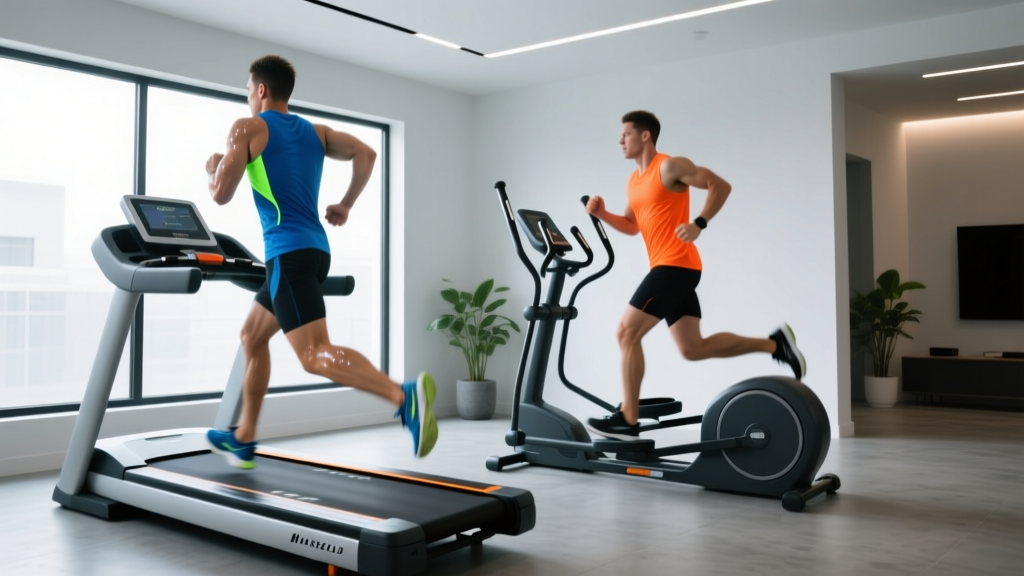
Rowing Machine vs Incline Exercise Treadmill: 2026 Showdown
Compare top 2026 rowing machines and incline exercise treadmills. Dive into our head-to-head buying guide, biomechanical technique, and joint impact data.

The Ultimate Cardio Showdown: Rowing vs. Incline Walking
Building a home gym in 2026 often comes down to a battle for floor space and maximum physiological return. Two modalities currently dominate the premium cardio market: the traditional rowing machine and the modern incline exercise treadmill. While both offer exceptional cardiovascular conditioning, they target the body in fundamentally different ways. This head-to-head product comparison and comprehensive rowing machine buying guide will dissect the biomechanics, hardware specifications, and real-world utility of both machines to help you make an informed investment.
Quick Verdict: Which Modality Wins?
Choose a Rowing Machine if: You need a space-efficient, full-body (86% muscle engagement) workout with zero impact on your joints, and you want to avoid recurring subscription fees for basic functionality.
Choose an Incline Exercise Treadmill if: You prefer passive, low-coordination movement, want to simulate outdoor hiking or hill sprints, and prioritize bone-density loading through weight-bearing exercise.
Head-to-Head Product Comparison: 2026 Flagship Models
To understand the hardware differences, we must look at the current market leaders. Below is a specification matrix comparing the gold-standard rowers against the top-tier incline exercise treadmill models available this year.
| Feature | Concept2 RowErg | Hydrow Apex | NordicTrack X22i | Peloton Tread+ |
|---|---|---|---|---|
| Type | Air Rower | Magnetic Rower | Incline Treadmill | Incline Treadmill |
| 2026 Price | $995 | $2,995 | $2,999 | $3,995 |
| Resistance / Incline | Dynamic Air (Damper 1-10) | Electromagnetic (100 levels) | -6% to 40% Incline | 0% to 12.5% Incline |
| Footprint (L x W) | 95" x 24" (Separable) | 80" x 25" (Separable) | 70" x 35" (Fixed) | 72" x 34" (Fixed) |
| Max User Weight | 500 lbs | 375 lbs | 300 lbs | 300 lbs |
Rowing Machine Buying Guide: What Actually Matters
When shopping for a rower, consumers are often distracted by touchscreens and aesthetic designs. However, the true value of a rowing machine lies in its ergonomics, resistance curve, and data accuracy. Here is your essential 2026 buying checklist.
1. Understanding Drag Factor vs. Damper Setting
The most common beginner mistake is setting the damper lever to 10, assuming higher is better. The damper simply controls how much air enters the flywheel housing. What actually matters is the Drag Factor, which measures the deceleration of the flywheel. According to Concept2's official training resources, a drag factor between 110 and 130 (typically achieved at a damper setting of 3 to 5) most accurately simulates the hydrodynamic drag of a real racing shell on water. Setting it to 10 is equivalent to rowing a heavy, mud-filled rowboat, which leads to premature lower back fatigue rather than cardiovascular conditioning.
2. Rail Length and Ergonomics
If you are taller than 6'2", you must verify the rail length. Standard rails accommodate inseams up to 38 inches. Users with longer legs require an extended rail (like the Concept2 Tall Legs option or extended tracks on magnetic rowers) to prevent the seat carriage from hitting the rear bumper before the 'catch' phase is complete. Furthermore, look for a contoured seat; flat, hard plastic seats cause sciatic nerve compression during 45+ minute endurance pieces.
3. Footprint and Storage Mechanics
Air and magnetic rowers generally offer superior space management compared to an incline exercise treadmill. The Concept2 RowErg separates into two pieces in seconds, requiring a storage footprint of just 25 x 33 inches. Magnetic rowers like the Hydrow Apex can be stood on end or folded, making them ideal for multi-use living spaces.
Incline Exercise Treadmill Buying Metrics
If you decide the incline exercise treadmill is the better fit for your routine, do not compromise on the motor or deck. Walking at a 15% grade places immense strain on the drive belt and motor.
- Continuous Horsepower (CHP): You need a minimum of 3.0 CHP for sustained incline walking. Anything less will result in belt stuttering and eventual motor burnout when subjected to a 12-15% grade at 3.0 mph.
- Belt Dimensions: For incline work, a 60-inch belt length is mandatory to accommodate the shortened, steeper stride length without risking a misstep off the rear roller.
- Cushioning Systems: Look for adjustable deck cushioning. Descending a -3% to -6% decline (available on premium models like the NordicTrack X-series) requires shock absorption to protect the tibialis anterior and knee joints from eccentric overload.
Technique Breakdown: Mastering the Rower
Unlike an incline exercise treadmill where you simply step on and walk, rowing requires strict biomechanical sequencing. Poor technique is the primary reason users abandon rowing machines due to lower back pain. Proper rowing engages 86% of the body's musculature, but only if you follow the correct kinetic chain. For a visual and detailed breakdown, refer to the official Concept2 technique guide.
The Four Phases of the Stroke
- The Catch: Shins should be vertical (not compressed past 90 degrees, which causes meniscus strain). Arms are straight, shoulders relaxed, and the torso is hinged forward at roughly 11 o'clock.
- The Drive: This is where the power is generated. The sequence is strictly Legs, Core, Arms. Push explosively with the legs while keeping the arms straight. Once the legs are 80% extended, hinge the core backward to 1 o'clock, and finally draw the handle to the lower ribs.
- The Finish: Legs are fully extended (but not hyperextended), core is slightly leaned back, and the handle rests just below the pectoral line. Elbows should be drawn past the torso.
- The Recovery: The exact reverse of the drive. Arms, Core, Legs. Extend the arms, hinge the torso forward past the knees, and only then allow the knees to bend and slide back to the catch.
"The most frequent error I see in home-gym athletes is 'shooting the slide'—where the legs push but the handle doesn't move because the core and arms are disengaged. Remember the 60/20/20 rule: 60% of the power comes from the legs, 20% from the core hinge, and only 20% from the arm pull."
Caloric Expenditure and Joint Impact Data
When evaluating the ROI of your cardio equipment, caloric burn and joint preservation are paramount. According to data published by Harvard Health Publishing, a 185-pound individual performing vigorous rowing will burn approximately 466 calories in 30 minutes. By comparison, walking at a brisk 3.5 mph on a flat surface burns roughly 200 calories in the same timeframe.
However, the introduction of an incline exercise treadmill changes the math. Walking at 3.0 mph on a 15% incline can elevate caloric expenditure to match or even exceed moderate rowing, often pushing past 400 calories per 30 minutes. The key difference lies in joint impact. Rowing is a closed-kinetic-chain, zero-impact exercise, making it the undisputed king for users with plantar fasciitis, knee osteoarthritis, or lower back vulnerabilities. Incline walking, while lower impact than running, still subjects the hips, knees, and ankles to repetitive gravitational loading.
Final Verdict: Which Machine Belongs in Your Home Gym?
The decision between a rowing machine and an incline exercise treadmill ultimately hinges on your biomechanical health, spatial constraints, and engagement preferences. If you require a highly efficient, full-body stimulus that can be stored in a closet and demands active mental engagement to master the technique, the Concept2 RowErg remains the most durable, cost-effective, and physiologically sound investment in the 2026 fitness market.
Conversely, if your goal is to build lower-body endurance, improve bone density through weight-bearing activity, and consume immersive media or virtual hiking trails while exercising, a premium incline exercise treadmill like the NordicTrack X22i provides an unmatched, low-coordination cardiovascular experience. Assess your joint health, measure your floor space, and choose the modality that guarantees long-term adherence.
More gear to consider
All reviews
Urevo Treadmill Manual Setup: Motor Size & Horsepower Guide
Stationary Bike Types vs 13 3 30 Treadmill: Space Guide

Space Optimization: Pairing Stationary Bike Types with a Cardio Zone Treadmill

Why Is Running on a Treadmill Harder? A Feature Buying Guide

ProForm Crosswalk 400e Treadmill & Cardio Machine Noise Comparison