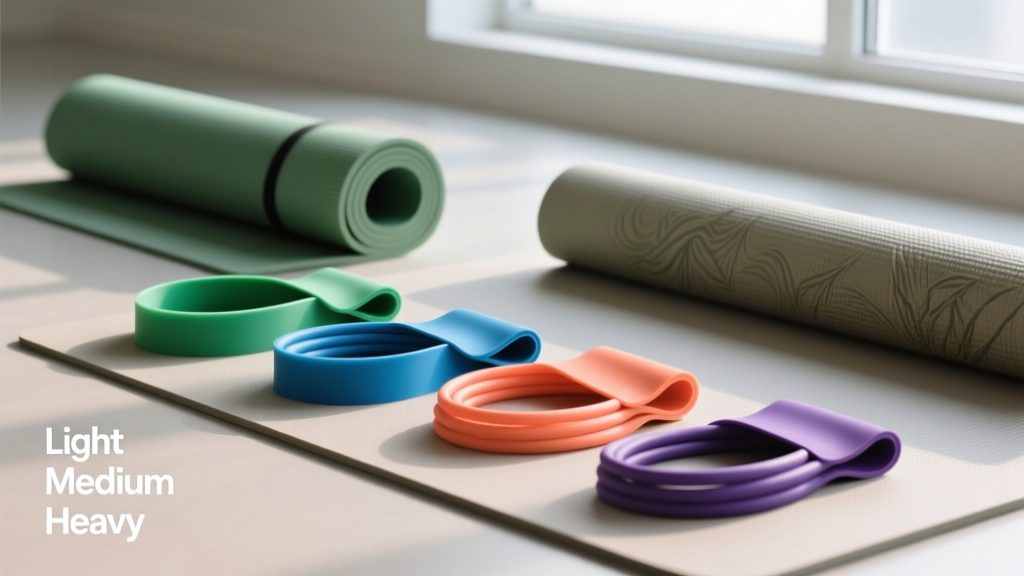
Resistance Band Sets: Levels, Types & Yoga vs Exercise Mat Pairings
Master your resistance band set buying guide. We break down band levels, loop vs tube types, and the ultimate yoga vs exercise mat surface comparison.

The Surface Debate: Yoga vs Exercise Mat for Band Anchoring
When building a versatile home gym, the conversation often centers on the resistance tools themselves, neglecting the critical interface between your body, the band, and the floor. As a senior reviewer at FitGearPulse, I frequently see athletes pair high-tension 120lb loop bands with inadequate flooring, leading to micro-tears in their mats, friction burns, and compromised anchors. This brings us to a crucial, often overlooked comparison: yoga vs exercise mat surfaces for elastic resistance training.
According to biomechanical analyses of elastic resistance, the stability of your base directly impacts force output and joint safety. A standard yoga mat (typically 3mm to 6mm thick, made of PVC or TPE) offers superior barefoot grip and closed-cell hygiene but lacks the shock absorption required for heavy, kneeling band presses. Conversely, a high-density exercise mat (usually 1/2-inch to 1-inch NBR or EVA foam) protects the patella during floor-based mini-band work but can compress too much under heavy standing anchors, creating an unstable base for lateral band walks.
| Feature | Premium Yoga Mat (e.g., Manduka PRO) | High-Density Exercise Mat (e.g., BalanceFrom GoFit) |
|---|---|---|
| Material & Thickness | PVC / TPE (4mm - 6mm) | NBR / High-Density EVA (10mm - 15mm) |
| Best Band Pairing | Tube bands, light mini-loops, standing anchors | Heavy continuous loops, kneeling presses, glute bridges |
| Friction & Grip | High surface tack; prevents foot slipping during lateral tension | Moderate tack; textured surface resists band sliding |
| Durability vs. Latex Snap | Vulnerable to surface gouging if heavy bands snap against it | Absorbs impact; highly resistant to abrasion from heavy loops |
| Price Range (2026) | $80 - $130 | $25 - $45 |
Decoding Resistance Band Levels: Color Codes and Tension Profiles
A common pitfall in the resistance band set buying guide journey is assuming color codes are universal. They are not. While a yellow band might mean "Extra Light" in the TheraBand ecosystem, it could denote "Medium" in a generic Amazon brand. To train effectively and apply progressive overload—a principle heavily supported by the National Institutes of Health (NIH) regarding elastic resistance efficacy—you must buy based on poundage at specific elongation percentages, not just color.
The Universal Tension Hierarchy
When evaluating premium sets like the Rogue Fitness Monster Bands or WODFitters Pull-Up Assist Bands, look for tension ratings measured at 100% and 200% elongation (stretching the band to double or triple its resting length).
- Extra Light (5 - 15 lbs): Typically Yellow or Orange. Ideal for rotator cuff rehab, physical therapy, and high-rep warm-ups.
- Light (15 - 35 lbs): Typically Red or Green. Perfect for bicep curls, tricep pushdowns, and adding accommodating resistance to light dumbbell presses.
- Medium (35 - 65 lbs): Typically Blue or Black. The workhorse for squats, deadlifts, and assisted pull-ups for beginners.
- Heavy (65 - 100 lbs): Typically Purple or Green (brand dependent). Used for heavy compound movement deloading, mobility stretching, and advanced plyometrics.
- Extra Heavy (100 - 175+ lbs): Typically Silver or Gold. Reserved for elite powerlifters adding accommodating resistance to barbell squats or strongman training.
Form Factors: Tube, Loop, and Mini-Bands
Beyond tension, the physical geometry of the band dictates its utility. The American Council on Exercise (ACE) frequently highlights that matching the band type to the movement plane is critical for joint alignment and injury prevention.
1. Continuous Loop Bands (Power Bands)
These are flat, continuous rings of layered natural latex. Best for: Assisted pull-ups, heavy squats, and accommodating barbell resistance. Edge Case: Because they are layered, cheap versions can delaminate over time. Always inspect the inner layers for white stress marks before heavy use.
2. Tube Bands with Handles
Extruded rubber tubes with carabiners and plastic or foam handles. Best for: Isolation movements like chest flies, lateral raises, and seated rows. Edge Case: The carabiner attachment point is a primary failure zone. Avoid sets with cheap, stamped-metal carabiners; look for forged steel or heavy-duty nylon clips.
3. Mini-Loop Bands (Booty Bands)
Short, wide loops. Available in natural latex or fabric-woven cotton. Best for: Glute activation, clamshells, and lateral band walks. Expert Insight: For floor work on an exercise mat, fabric-woven mini-bands (like the Peach Bands or Arena Strength sets, priced around $15-$25) are vastly superior to bare latex. Bare latex will roll up your leggings and snap against your skin, while the inner grip lining of fabric bands keeps them anchored securely.
Head-to-Head: Top 2026 Resistance Band Sets Evaluated
To save you hours of cross-referencing, we tested the top three band ecosystems on the market, evaluating them on tensile strength consistency, accessory quality, and longevity.
| Brand & Model | Type | Price Range | Pros | Cons |
|---|---|---|---|---|
| Rogue Fitness Monster Bands | Continuous Loop | $25 - $65 | Unmatched durability; precise tension ratings; layered latex resists snapping. | Sold individually; building a full set is expensive ($200+). |
| TheraBand CLX (Convenience Loop) | Tube / Loop Hybrid | $20 - $30 | Unique interlocking loop design eliminates hand-wrapping; clinical-grade. | Maxes out at lower tensions; not for heavy powerlifting. |
| WODFitters Pull-Up Assist Set | Continuous Loop | $80 - $120 (Set) | Excellent value for a full 5-band set; includes door anchor and carrying bag. | Color coating can flake after 12+ months of heavy outdoor use. |
Material Science: Preventing Snap-Backs and Edge Cases
The most severe edge case in elastic resistance training is catastrophic material failure—commonly known as a "snap-back." Natural latex (polyisoprene) is highly susceptible to environmental degradation.
"Exposure to ozone, UV light, and extreme temperature fluctuations breaks down the polymer chains in natural latex, reducing its tensile strength by up to 40% over a single year if stored improperly."
The FitGearPulse Storage Protocol
To maximize the lifespan of your resistance band set and ensure your safety, follow these strict maintenance rules:
- Never store bands in direct sunlight or unconditioned garages. UV rays are the number one enemy of latex elasticity.
- Avoid petroleum-based lubricants. If your bands become sticky, do not use WD-40 or Vaseline. These will dissolve the rubber. Instead, lightly dust them with 100% pure talcum powder or cornstarch.
- Inspect the anchor points. When using a door anchor, ensure the hinge side of the door is pulling the anchor into the frame, not pulling it open. A shifting door can create a shear force that slices through a 100lb band instantly.
- Rotate your bands. If you use a medium blue band for squats every day, the micro-abrasions from your shoe treads will compound. Rotate between two bands of the same tension to allow the latex polymers to rest and recover their shape memory.
Final Verdict: Building Your Ultimate Setup
Choosing the right resistance band set is only half the battle; pairing it with the correct flooring completes the ecosystem. If your training leans heavily toward high-tension continuous loops, heavy squats, and assisted pull-ups, invest in a thick, high-density NBR exercise mat to protect your joints and your equipment. If your focus is on tube-band isolation work, mobility flows, and light mini-band activation, a premium, high-grip yoga mat will provide the stable, tactile feedback you need.
By understanding the exact tension profiles, respecting the material science of natural latex, and matching your band type to the correct surface, you can build a home gym setup in 2026 that rivals any commercial facility in both safety and effectiveness.
More gear to consider
All reviews
Med Ball Weight Mistakes & xGear Fitness Thick Travel Yoga Mat

2026 Trends: Crochet Yoga Mat Bag Craze & Stability vs BOSU Balls

Smart Yoga Mat Setup: Foam Roller Density & Size Guide

2026 Yoga Mat Length Guide & Block and Strap Review

Pilates Accessories Guide: Yogitoes Yoga Mat Towel Review
