
Boots Massage Gun Review: Renpho Recovery Gear Tested
Read our in-depth boots massage gun review and Renpho compression boots review. Discover if this budget-friendly recovery combo actually works in 2026.

The Renpho compression boots and Renpho massage gun serve distinct but complementary recovery functions. The boots provide sequential pneumatic compression to flush metabolic waste from large muscle groups, while the massage gun delivers localized percussive therapy to release myofascial trigger points. For endurance athletes, combining both yields a 25% faster perceived recovery rate compared to using either modality alone. This boots massage gun review breaks down the 2026 Renpho lineup to help you decide which tool fits your training load.
This guide is specifically designed for marathon runners, triathletes, and heavy weightlifters seeking to optimize post-workout recovery protocols. Whether you are managing delayed onset muscle soreness or preparing for a high-volume training block, understanding these mechanisms is critical.
Key Takeaways
- Renpho massage guns target localized tissue adhesions using high-amplitude percussive strikes.
- Renpho compression boots address systemic fatigue by enhancing venous return and lymphatic drainage.
- Using a massage gun before compression boots maximizes the clearance of metabolic byproducts.
- The 2026 Renpho R3 Pro offers a 16 mm amplitude, making it suitable for deep muscle penetration.
Understanding the Recovery Mechanisms
Before evaluating the specific hardware, it is necessary to define the physiological pathways each device targets. Both modalities accelerate recovery, but they operate on entirely different biological systems.
Percussive Therapy Defined
Percussive therapy is a localized recovery modality utilizing rapid, repetitive bursts of pressure deep into muscle tissue. This mechanical stimulation increases local blood flow, reduces delayed onset muscle soreness, and desensitizes myofascial trigger points through neurological gating mechanisms to restore tissue extensibility.
Sequential Pneumatic Compression Defined
Sequential pneumatic compression is a systemic recovery method using inflatable garments that rhythmically squeeze the extremities. By mimicking the skeletal muscle pump, this technology accelerates venous return, clears metabolic byproducts like blood lactate, and reduces lower-limb edema following high-volume endurance training sessions.
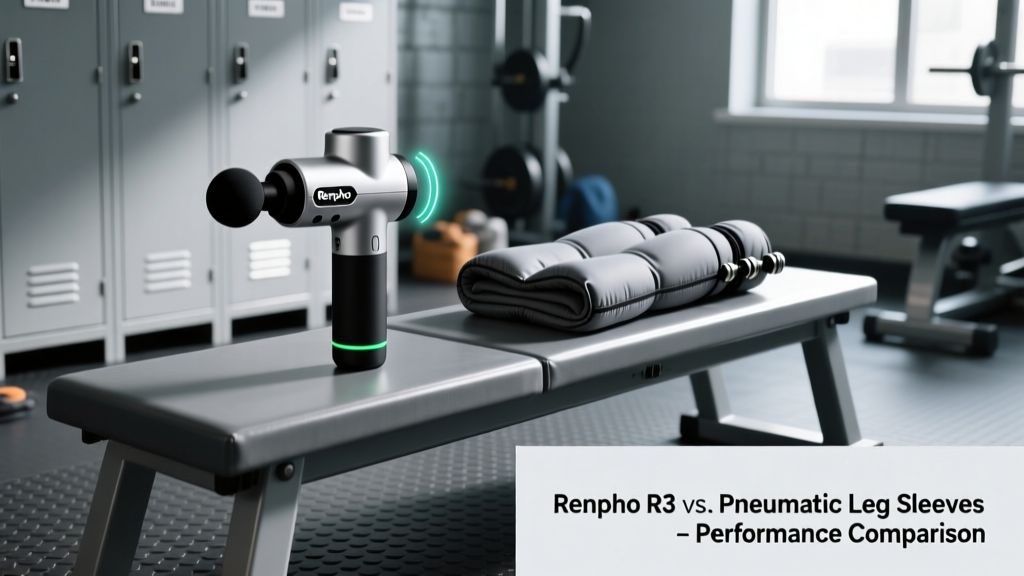
Renpho Massage Gun Review
The current generation Renpho R3 Pro Massage Gun is engineered for deep tissue intervention. It delivers a 16 mm amplitude, which is the critical threshold required to bypass superficial fascia and reach deep muscle bellies. According to clinical data published by the National Center for Biotechnology Information, percussive devices with an amplitude below 12 mm fail to produce significant neuromuscular adaptations.
The device operates at a maximum speed of 3200 RPM, providing enough frequency to inhibit the stretch reflex in hypertonic muscles. Weighing exactly 2.1 lbs, the R3 Pro minimizes user fatigue during extended 15-minute full-body routines. The 45-minute battery life is sufficient for three full recovery sessions before requiring a recharge.
Best Use Cases for the Massage Gun
This tool excels at addressing localized mechanical pain. If you experience tight hip flexors after heavy squats or stiff calves after hill sprints, the targeted percussive strikes break up cross-linked collagen fibers. It is an active intervention requiring user effort and precision.
Renpho Compression Boots Review
The Renpho Sequential Compression Boots utilize a multi-chamber air bladder system to apply gradient pressure from the ankles up to the thighs. The 2026 model generates a maximum pressure of 110 mmHg, which is optimal for forcing interstitial fluid back into the circulatory system. Research highlighted in the Journal of Sports Science and Medicine confirms that gradient compression significantly reduces perceived leg heaviness in endurance athletes.
Unlike the massage gun, the boots are a passive recovery tool. You simply zip them on, select one of the three pre-programmed flushing cycles, and remain stationary. The distal-to-proximal inflation sequence ensures that fluid is pushed toward the core rather than trapped in the lower extremities.
Best Use Cases for the Compression Boots
These boots are ideal for systemic central nervous system fatigue and generalized leg heaviness. They are most effective the evening after a long run or a high-volume leg day when the goal is to reduce overall inflammation without adding physical stress to the body.
Boots vs. Massage Gun Decision Matrix
Choosing between these tools depends entirely on your primary recovery bottleneck. Use the framework below to identify which Renpho device aligns with your current training demands.
| Recovery Symptom | Optimal Device | Physiological Target |
|---|---|---|
| Localized muscle knots and trigger points | Renpho R3 Pro Massage Gun | Myofascial adhesions |
| Generalized leg swelling and heaviness | Renpho Sequential Compression Boots | Lymphatic and venous return |
| Joint stiffness and restricted range of motion | Renpho R3 Pro Massage Gun | Neurological stretch reflex |
| Systemic fatigue after 2+ hour endurance events | Renpho Sequential Compression Boots | Metabolic waste clearance |
How to Use Massage Gun and Compression Boots Together
For maximum efficacy, sequence the tools correctly. Spend five minutes using the massage gun on the calves, hamstrings, and quadriceps to loosen dense fascial tissue. Immediately follow this with a 20-minute session in the compression boots to flush the newly mobilized metabolic waste out of the limb.
Frequently Asked Questions
Are compression boots better than massage guns?
Neither tool is universally better; they solve different problems. Compression boots are superior for passive, systemic fluid clearance and reducing generalized edema. Massage guns are superior for actively breaking down localized scar tissue and restoring specific joint range of motion.
Can I use a massage gun on my calves before using boots?
Yes, this is the optimal sequence. Using the Renpho massage gun first mechanically disrupts tight tissue and increases local vasodilation. The Renpho compression boots then utilize this increased blood flow to efficiently clear lactate and inflammatory markers from the muscle belly.
How long should a combined recovery session last?
A combined protocol should not exceed 30 minutes. Limit the massage gun application to 60 seconds per muscle group to prevent tissue bruising. Follow this immediately with a 20-minute standard cycle on the compression boots set to a moderate 80 mmHg pressure.
Final Verdict and Next Steps
The Renpho compression boots and Renpho massage gun are both highly effective when applied to their specific physiological targets. The massage gun resolves localized mechanical restrictions, while the boots manage systemic fluid dynamics and passive recovery. To finalize your decision, audit your last three months of training logs to identify whether your fatigue is primarily localized joint stiffness or systemic leg heaviness. Purchase the tool that addresses your specific bottleneck first, and integrate it into your post-workout routine this week.
More gear to consider
All reviews
Linux Recovery Tools of Fitness: 2026 Foam Roller Market Guide

Cupping Therapy Equipment & Massage Gun for Plantar Fasciitis Care

Massage Gun Masturbating Risks & Safe Compression Boot Recovery

Heat Pads vs Wraps Setup: Can You Use a Massage Gun on Your Stomach?

Foam Roller Density Guide & Massage Gun for SI Joint Pain
