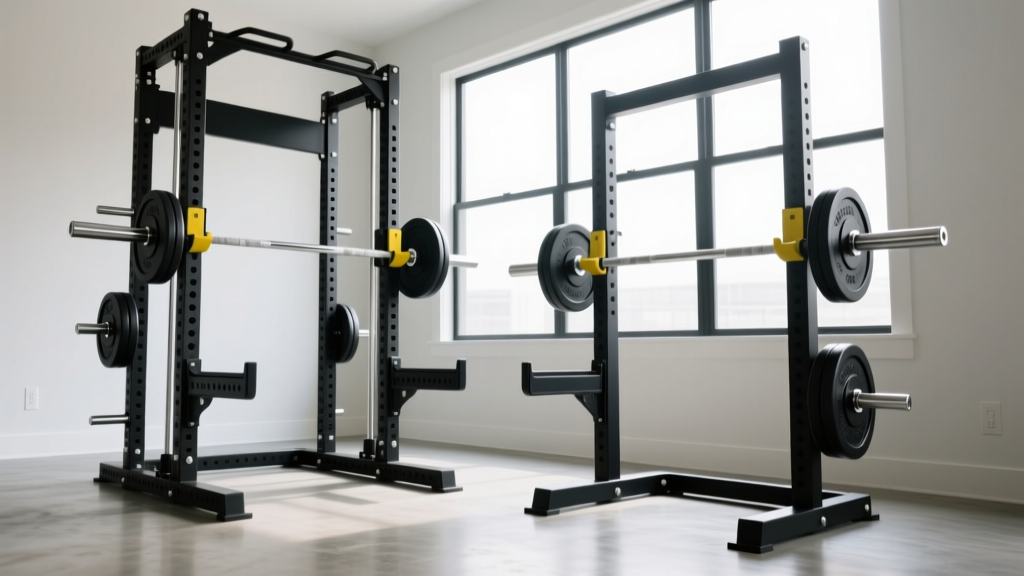
Power Rack vs Squat Stand: Setup for Single Dumbbell Deadlifts
Master your home gym layout. Compare power racks, squat racks, and stands while optimizing floor space and installation for single dumbbell deadlifts.

Designing a high-performance home gym requires balancing heavy barbell infrastructure with the negative space needed for dynamic, unilateral movements. While most installation guides focus solely on where the barbell goes, they ignore the "hinge zone"—the critical lateral floor space required for exercises like the single dumbbell deadlift (including suitcase deadlifts and single-leg RDLs). Choosing between a full power rack, a half squat rack, or minimalist squat stands dictates not just your squat mechanics, but your ability to safely execute and drop heavy unilateral implements.
The Spatial Paradox: Rack Mass vs. Unilateral Hinge Zones
When performing a single dumbbell deadlift, particularly the suitcase variation, your body requires a wide, unobstructed base to resist lateral flexion. A standard Olympic barbell setup demands a 7-foot linear clearance, but unilateral dumbbell work demands a 36-to-48-inch radial clearance around the lifter to account for the offset center of mass and the natural arc of the implement. If your rack footprint consumes this zone, you compromise your biomechanics and risk striking the steel uprights during the eccentric phase of the lift. Understanding this spatial paradox is the first step in engineering a hybrid gym that supports both heavy bilateral rack pulls and high-volume unilateral floor work.
2026 Hardware Matrix: Footprints and Clearances
Before unboxing any steel, you must map your available square footage against the hardware's physical footprint. Below is a comparison of three industry-standard configurations, analyzing their impact on your available floor space for unilateral training.
| Equipment Type | Reference Model | Footprint (L x W) | Est. Price (2026) | Lateral Clearance Rating |
|---|---|---|---|---|
| Full Power Rack | Rogue RML-390F Flat Foot | 49" x 49" | $1,150 | Poor (Consumes central floor) |
| Half Squat Rack | Titan Fitness T-2 Short Rack | 48" x 24" | $450 | Moderate (Opens one side) |
| Squat Stands | Rep Fitness SR-4000 | 48" x 18" (Base) | $399 | Excellent (Maximizes floor) |
As noted by equipment testing authorities at Garage Gym Reviews, squat stands offer the most versatile floor plans for hybrid lifters who split their time between heavy rack work and high-volume dumbbell conditioning. However, this spatial freedom comes with strict installation and safety requirements that must be addressed during setup.
Complete Installation Walkthrough: Flooring to Final Torque
Installing your rack is only 40% of the job. The remaining 60% involves preparing the subfloor to handle the localized impact forces of heavy dumbbell drops—a common occurrence when bailing on a heavy single dumbbell deadlift or losing balance during a single-leg RDL.
Phase 1: Subfloor Protection and Shock Mapping
Do not place bare steel on standard 1/2-inch interlocking foam tiles. When a 100-pound dumbbell is dropped from hip height during a failed unilateral hinge, the kinetic energy transfers directly through the foam, cracking the concrete subfloor beneath.
- Base Layer: Lay down a 6-mil vapor barrier if installing over unfinished concrete to prevent moisture from degrading rubber over time.
- Impact Zones: Install 3/4-inch thick vulcanized rubber mats (commonly sourced as horse stall mats, roughly $55 per 4x6 sheet). These have a durometer rating high enough to disperse impact energy laterally rather than vertically.
- The Hinge Zone: Ensure the rubber matting extends at least 4 feet laterally from the rack uprights. This is your dedicated single dumbbell deadlift zone, ensuring that if you lose grip or balance during a heavy suitcase pull, the implement lands on shock-absorbent rubber, not bare concrete or the rack's base plate.
Phase 2: Assembly and Hardware Tolerances
Micro-wobbles in a squat stand can become catastrophic if you accidentally clip the upright with a heavy dumbbell during a lateral movement.
- Fastener Selection: Ensure your rack uses 5/8-inch Grade 5 or Grade 8 zinc-plated bolts. Never substitute with hardware store Grade 2 bolts, which will strip under dynamic loading.
- Torque Specifications: Use a calibrated torque wrench. Most 11-gauge steel rack manufacturers require between 60 and 80 ft-lbs of torque on primary structural bolts. Hand-tightening leaves a 2-3mm tolerance gap that amplifies shaking during re-racking.
- Threadlocker Application: Apply a medium-strength threadlocker (e.g., Loctite 242) to the base plate bolts. The vibrational frequency of dropping heavy dumbbells nearby will slowly back out untreated nuts over a 6-month period.
Unlike a 4-post power rack, independent squat stands are highly susceptible to tipping if loaded asymmetrically. When setting up for a single dumbbell deadlift, never rest your heavy working dumbbell on the stand's crossbar or j-cups. Always store unilateral implements on a dedicated floor rack or weight tree positioned outside the hinge zone.
Engineering the Single Dumbbell Deadlift Zone
To properly integrate unilateral deadlifting into a rack-centric gym, you must treat the floor space as an active training implement. Here is how to optimize your layout based on your chosen hardware:
Scenario A: The Full Power Rack Setup
If you opted for a 49x49-inch power rack, the interior of the cage is your only safe unilateral zone. Pro-Tip: Remove the bottom cross-members (if your model allows, like the Rogue Flat Foot series) to create a flush floor inside the rack. This allows you to perform deficit single dumbbell deadlifts by standing on a 25lb or 45lb bumper plate inside the cage. You can also utilize the rack's band pegs at the base to attach resistance bands to the dumbbell handle for accommodating resistance, a technique highly effective for overcoming sticking points in the lockout phase of the suitcase deadlift.
Scenario B: The Squat Stand Setup
Squat stands push the steel to the back wall, opening up the entire front and lateral floor space. Position your stands 6 inches from the wall to allow for wall-mounted weight storage. This leaves a massive 6x6 foot open rubber mat zone directly in front of the stands. You can perform walking single-leg RDLs or heavy suitcase deadlifts without ever worrying about clipping a steel upright with the dumbbell head.
Real-World Failure Modes in Hybrid Gym Setups
Through years of testing and observing home gym installations, three specific failure modes consistently plague lifters attempting to mix heavy rack work with unilateral floor lifts:
- Mat Separation: Dropping heavy hex dumbbells repeatedly in the exact same "hinge zone" causes cheap rubber mats to compress and separate at the seams. Over time, the concrete beneath takes the brunt of the force. Fix: Use a 4x6 solid sheet mat rather than interlocking tiles in the primary deadlift zone to eliminate seam vulnerability.
- Upright Interference: Lifters using adjustable dumbbells (like Nuobell or PowerBlock) often miscalculate the width of the dumbbell head. During a wide-stance sumo single dumbbell deadlift, the lateral edges of the dumbbell can strike the 3x3 uprights of a squat rack if you stand too close. Always measure your dumbbell's max width and add 12 inches of buffer space from any steel.
- Anchor Bolt Shear: If you bolt your rack into a wood subfloor (like a second-story gym or garage attic) rather than concrete, the lateral shear force of dropping a 120lb dumbbell nearby can loosen the lag bolts. Always use 3/8-inch structural lag screws (like Simpson Strong-Tie SDS) driven at least 2 inches directly into the floor joists, not just the OSB subfloor.
Expert FAQ: Rack Setups and Unilateral Training
Can I use the rack's base plate as a deficit platform for single dumbbell deadlifts?
It is not recommended. Most rack base plates are 2x2 or 3x3 steel tubing, creating an uneven, raised surface. Standing on the edge of a base plate while hinging a heavy dumbbell introduces a severe ankle rollover risk. Use calibrated bumper plates on a flat rubber mat for deficit work instead.
How do I store heavy dumbbells without cluttering my deadlift zone?
Invest in a vertical A-frame dumbbell rack or a rack-mounted weight storage pair of pins. If using squat stands, wall-mounted vertical dumbbell holsters are an excellent 2026 space-saving trend that keeps the floor entirely clear for unilateral hinge movements while keeping the implements at an ergonomic loading height.
Does the type of dumbbell matter for clearance?
Absolutely. Urethane round-head dumbbells roll away if dropped during a failed single-leg RDL, potentially striking your squat stands or rolling into your hinge zone. Hex-head rubber dumbbells or competition-grade kettlebells are vastly superior for floor-based unilateral setups because they stay exactly where you drop them, protecting your hardware and your subfloor.
More gear to consider
All reviews
Rubber Hex vs Urethane: 2026 Dumbbell Press Out Trends

Rubber Hex vs Urethane: 2026 Trends & the Dumbbell Lawnmower Pull

Dumbbell Rack Trends 2026: Storage for Dumbbell Lying Leg Curls

Half Kneeling Single Arm Dumbbell Press: Urethane vs Rubber Hex Trends
Best Loadable Handles for a 17 lb Dumbbell Setup (2026)
