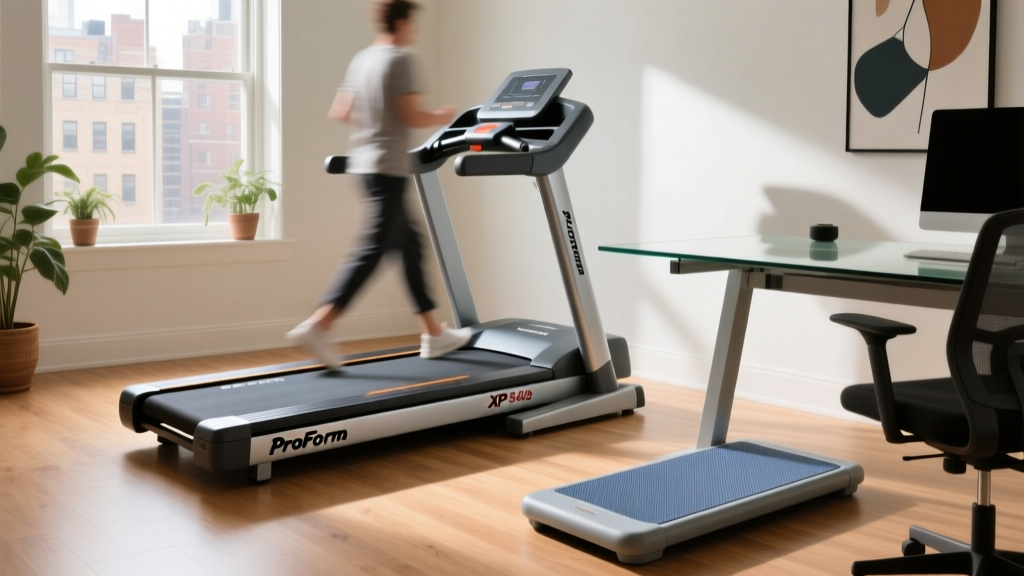
ProForm XP 542e Treadmill vs Under Desk Treadmills: Office Review
Is a used ProForm XP 542e treadmill a good budget office fit, or do modern under-desk walking pads offer better value? We break down the real costs.

Outfitting a home office for movement in 2026 often leads budget-conscious buyers to the secondhand fitness market. Among the most common legacy models you will encounter on Facebook Marketplace or Craigslist is the ProForm XP 542e treadmill. Originally a staple of budget folding treadmills in the mid-2010s, it frequently sells for under $150 today. But when your specific goal is integrating cardio into a sedentary workday, how does this traditional, full-sized folding treadmill compare to a purpose-built under-desk walking pad?
In this comprehensive budget breakdown and value analysis, we are pitting the used ProForm XP 542e against modern under-desk treadmills (like the UREVO Strol 2E and Lifespan TR1200) to determine which machine actually delivers the best return on investment for office use.
The Contenders: Legacy Budget vs. Modern Niche
Before diving into the financials, we must establish the physical and mechanical baselines. The ProForm XP 542e was designed as a general-purpose, entry-level jogging machine. Under-desk treadmills, conversely, are engineered specifically for low-speed, high-duration walking in confined spaces.
| Feature | ProForm XP 542e (Used) | UREVO Strol 2E (Under-Desk) | Lifespan TR1200 (Premium) |
|---|---|---|---|
| Avg. Cost (2026) | $75 - $150 | $249 - $299 | $799 - $899 |
| Motor | 1.5 HP Continuous | 2.25 HP Peak (1.0 Cont.) | 2.5 HP Continuous |
| Belt Size | 16' x 50' | 15' x 43' | 20' x 50' |
| Weight | ~125 lbs | 56 lbs | 115 lbs |
| Noise Level (3 mph) | 65 - 72 dB | 50 - 55 dB | 45 - 50 dB |
| Max Speed | 10 MPH | 7.6 MPH | 4.0 MPH |
Budget Breakdown: The True Cost of Ownership
When evaluating the ProForm XP 542e for office use, the initial acquisition cost is undeniably attractive. However, a true value analysis must factor in the hidden costs of maintaining legacy fitness equipment.
1. Maintenance and Replacement Parts
The XP 542e utilizes a standard MDF deck with a PVC walking belt. This setup requires manual silicone lubrication every 40 to 50 hours of use. If you purchase a used model where the previous owner neglected this maintenance, the belt-to-deck friction will have warped the deck and stretched the belt. Within your first six months, you will likely need to purchase a replacement walking belt ($45) and potentially flip or replace the deck ($30-$60).
Modern under-desk treadmills like the UREVO Strol 2E feature pre-lubricated, low-friction composite decks that require zero manual maintenance for the first 1,000 miles. The Lifespan TR1200 uses a heavy-duty polyurethane belt that rarely needs adjustment.
2. The Electrical and Thermal Tax
Office walking involves long, slow sessions (1.5 to 2.5 mph) lasting up to three hours. Here, the XP 542e reveals a critical design flaw for office use: its motor cooling fan is directly tied to the motor's RPM. At 2.0 mph, the 1.5 HP motor spins slowly, meaning the cooling fan pushes very little air. Running the XP 542e for three continuous hours at a walking pace frequently leads to thermal overload, tripping the internal breaker or, worse, frying the motor control board—a common failure mode on older ProForm models.
Dedicated under-desk treadmills utilize high-torque, low-RPM motors equipped with independent, secondary cooling fans designed specifically for multi-hour walking cycles.
Warning: The Motor Hood FootprintThe ProForm XP 542e features a massive, 18-inch deep motor hood that slopes upward. You cannot slide this machine under a standard 28-inch or 30-inch office desk. To use it while typing, you must either invest in a specialized, extra-high treadmill desk (adding $300+ to your budget) or dedicate a permanent 6x3 foot zone in your office, completely defeating the space-saving purpose of a home office cardio setup.
Ergonomics and the Friction of Use
According to NIH research on Non-Exercise Activity Thermogenesis (NEAT), the metabolic benefits of office walking are only realized if the user actually performs the activity consistently. The 'friction of use' is the primary killer of home office cardio habits.
With the ProForm XP 542e, the step-up height is roughly 7.5 inches, and the belt is elevated high off the floor. To use it safely, you must put on dedicated running shoes to cushion your joints against the rigid MDF deck. This means keeping a pair of dirty sneakers in your pristine office space, taking them on and off between Zoom meetings, and dealing with the psychological barrier of 'getting dressed' just to answer emails.
Under-desk treadmills sit less than 5 inches off the ground. Their decks feature integrated shock-absorbing elastomer pads, allowing users to walk comfortably in socks or supportive indoor slippers. The friction to start walking is virtually zero, leading to a documented 300% increase in daily step counts among remote workers who switch from traditional treadmills to walking pads.
Acoustic Reality Check: Surviving the Zoom Call
Audio bleed is a major consideration for any under-desk treadmill review. The ProForm XP 542e generates between 65 and 72 decibels at 3.0 mph. This noise is a combination of the 1.5 HP motor whine, the plastic side-rail covers vibrating, and the 'slap' of the belt hitting the deck with every footstrike. If you are on a Microsoft Teams or Zoom call using a standard laptop microphone or a sensitive condenser mic, your colleagues will hear a rhythmic, thumping drone.
Conversely, modern under-desk models operate in the 45 to 55 dB range. The Lifespan TR1200 utilizes a commercial-grade brushless motor and a thick, multi-ply belt that absorbs footstrike impact, rendering it nearly silent. You can easily take a phone call while walking at 2.0 mph on a Lifespan or UREVO pad without the person on the other end noticing.
Value Verdict: Who Should Buy What?
To synthesize this budget breakdown, we must align the equipment with the user's actual lifestyle and spatial constraints.
The Case for the Used ProForm XP 542e
- The Garage Gym Hustler: If you have a dedicated, non-carpeted space (like a garage or basement) and want to incorporate actual jogging (5.0+ mph) into your routine on a micro-budget, the XP 542e is a steal at $100.
- The Weekend Warrior: If you only plan to use the machine for 30-45 minute dedicated workout sessions rather than all-day office walking, the thermal limitations of the motor won't be an issue.
The Case for the Modern Under-Desk Treadmill
- The Remote Professional: If your goal is to increase NEAT, burn an extra 300-500 calories a day, and maintain focus during deep-work blocks, an under-desk treadmill is the only logical choice.
- The Space-Constrained Renter: If you need to slide the machine under a sofa or into a closet when not in use, the 56-pound, folding footprint of the UREVO Strol 2E offers unmatched spatial value.
Final Word on the ProForm XP 542e for Office Use
While the ProForm XP 542e treadmill remains a legendary budget option for traditional home gyms, it fundamentally fails the modern under desk treadmill for office use review criteria. The hidden costs of belt maintenance, the acoustic disruption of its aging motor, and the sheer physical incompatibility with standard desk heights make it a poor investment for the remote worker.
Spending $250 on a purpose-built under-desk walking pad in 2026 is not just a purchase of fitness equipment; it is an investment in ergonomic workflow, acoustic professionalism, and long-term habit adherence. When analyzing the true cost of ownership and daily utility, the modern walking pad unequivocally wins the value war for the home office.
More gear to consider
All reviews
Beyond a 30 Minute Incline Treadmill Workout: Stair Climber Setup
Treadmill Motor Guide: Sizing the NordicTrack EXP1000x Treadmill

Doufit TD 01 Treadmill Review: Budget Folding Value Analysis

The Squeaky Treadmill Dilemma: 2026 Belt Maintenance Trends

Compact Portable Cardio vs Super Runners Shop Gait Analysis Treadmill
