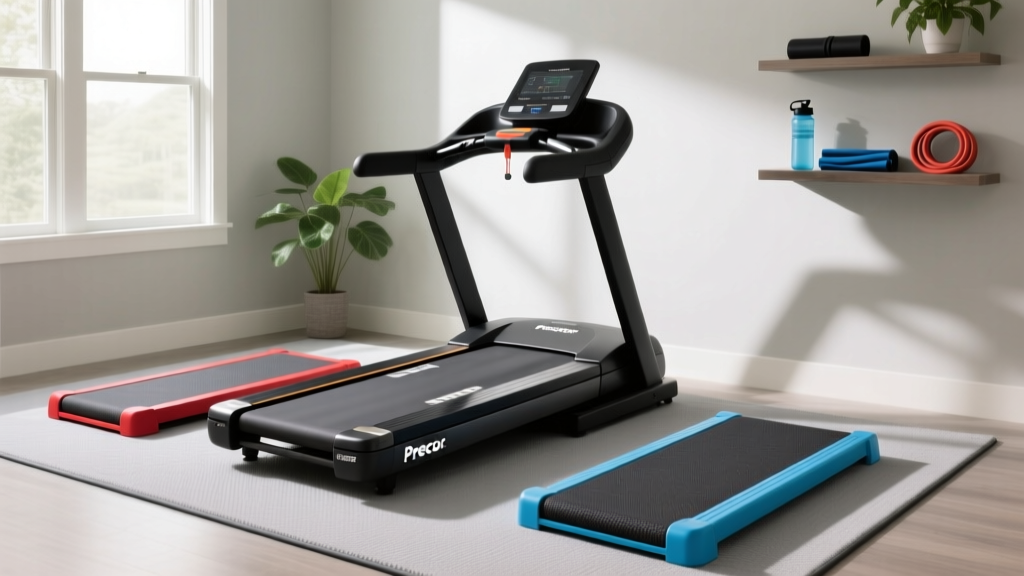
Precor 956 Treadmill vs Walking Pads: 2026 Buyer Guide
Compare the commercial-grade Precor 956 treadmill with top 2026 walking pads. Explore pricing, space needs, and motor specs in our in-depth review.

The Great Home Gym Divide: Commercial Power vs. Compact Convenience
As we navigate the fitness equipment landscape in 2026, home gym enthusiasts face a stark bifurcation in cardiovascular training. On one end of the spectrum sits the ultra-premium, commercial-clone traditional treadmill, epitomized by the legendary Precor 956 treadmill (Experience Series TRM 956). On the other end, the hyper-minimalist walking pad has exploded in popularity, catering to the work-from-home demographic seeking to maximize Non-Exercise Activity Thermogenesis (NEAT). But how do you choose between a $12,000 biomechanical masterpiece and a $500 under-desk slider?
This in-depth buying guide and comparison review breaks down the engineering, spatial requirements, failure modes, and real-world utility of the Precor TRM 956 against the leading walking pads of 2026, including the UREVO Strol 2E and KingSmith WalkingPad R3. According to the Centers for Disease Control and Prevention (CDC), adults need at least 150 minutes of moderate-intensity aerobic activity weekly. Whether you achieve that via high-incline power walking on a commercial deck or pacing on a folding pad depends entirely on your budget, space, and biomechanical needs.
Quick Decision Matrix
- Choose the Precor 956 if: You have a dedicated 20-amp circuit, a $10,000+ budget, require a 22" x 60" running surface for sprint intervals, and want a machine that will outlast a decade of heavy daily abuse.
- Choose a Walking Pad if: You live in an apartment, need to store the machine under a sofa, primarily walk at 2.0–4.0 mph while working, and have a budget under $600.
Deep Dive: The Precor TRM 956 Experience Series
The Precor TRM 956 is not merely a home treadmill; it is the exact model you find in luxury health clubs and Division 1 collegiate athletic facilities. In 2026, it remains the gold standard for heavy-duty cardiovascular conditioning.
Motor, Deck, and Biomechanics
At the heart of the TRM 956 is a 4.0 HP AC Continuous Duty Motor. Unlike the DC motors found in residential treadmills, AC motors do not rely on carbon brushes, eliminating a primary point of friction and failure. This allows the Precor to run continuously for 12+ hours a day without thermal degradation. The running surface spans a massive 22 inches wide by 60 inches long, accommodating runners with long strides without the psychological fear of stepping off the back edge.
Precor’s proprietary Integrated Footplant Technology (IFT) and Ground Effects® Impact Control System dynamically adjust the belt speed in micro-increments to match the natural deceleration and acceleration of your footstrike. As noted in research regarding joint impact and treadmill biomechanics by the Mayo Clinic, reducing repetitive impact stress is crucial for long-term joint health, and the Precor’s flex-batten deck absorbs up to 3x more shock than standard rigid residential decks.
The Reality of Ownership: Cost, Space, and Electrical
Owning a Precor 956 requires significant logistical planning. Pricing in 2026 ranges from $11,500 to $13,500, depending on whether you select the P30 (simplified LED) or P80 (capacitive touchscreen with streaming) console. The unit weighs approximately 450 lbs and requires a dedicated 20-amp NEMA 5-20R electrical circuit. Plugging a 4.0 HP AC motor into a standard 15-amp bedroom circuit shared with a space heater or air conditioner will trip the breaker immediately.
The 2026 Walking Pad Contenders: UREVO & KingSmith
Walking pads have evolved from flimsy novelty items into robust micro-cardio tools. They are designed for NEAT—keeping your metabolism active during sedentary work hours rather than facilitating high-intensity interval training (HIIT).
UREVO Strol 2E: The Hybrid Foldable
Priced around $399, the UREVO Strol 2E bridges the gap between a traditional treadmill and a pure walking pad. It features a 2.25 HP DC motor and a 16.5-inch wide belt. The standout feature is its 180-degree folding hinge, allowing it to slide under a bed or stand vertically in a closet. It maxes out at 7.6 mph, which is sufficient for light jogging, though the 40-inch belt length makes running unsafe for anyone over 5'8".
KingSmith WalkingPad R3: The Under-Desk Specialist
The KingSmith R3 (approx. $599) utilizes a 1.25 HP motor for flat walking and a 2.5 HP peak when the telescopic handlebar is raised for running. Its 17.3-inch wide belt is slightly more forgiving than the UREVO, and the aircraft-grade aluminum frame supports up to 265 lbs. However, its primary use case remains under-desk walking at speeds between 1.5 and 4.0 mph.
Head-to-Head Comparison Matrix
| Feature | Precor TRM 956 | UREVO Strol 2E | KingSmith R3 |
|---|---|---|---|
| Motor Type | 4.0 HP AC Continuous | 2.25 HP DC | 1.25 / 2.5 HP DC |
| Belt Dimensions | 22" x 60" | 16.5" x 43.3" | 17.3" x 47.2" |
| Top Speed | 12.0 mph | 7.6 mph | 7.5 mph (w/ handle) |
| Incline Range | 0% to 15% | Fixed 0% | Fixed 0% |
| Machine Weight | 450 lbs | 62 lbs | 88 lbs |
| 2026 MSRP | $11,500 - $13,500 | $399 | $599 |
| Electrical Need | Dedicated 20-Amp | Standard 15-Amp | Standard 15-Amp |
Failure Modes and Maintenance Realities
Understanding how cardio machines fail is the hallmark of an informed buyer. The engineering philosophies behind commercial treadmills and walking pads result in vastly different maintenance requirements and edge-case failures.
Precor 956: The Wax System and MCO Vulnerability
The Precor TRM 956 utilizes a wax-impregnated belt system. Unlike residential treadmills that require manual silicone lubrication every 150 miles, the Precor features an internal wax reservoir that automatically applies a micro-layer of wax to the deck. The critical failure mode: If the owner ignores the console's "Replace Wax" warning, the deck dries out. Friction spikes, which causes the AC motor to draw excessive amperage. This eventually blows the Motor Controller Board (MCO). A replacement MCO for an Experience Series Precor costs upwards of $450, plus labor. Furthermore, due to its 450 lb footprint, moving the Precor requires professional riggers; attempting to pivot it on hardwood floors without a specialized dolly will destroy the leveling feet and scratch the floor.
Walking Pads: Thermal Overload and Belt Fraying
Walking pads utilize small DC motors with limited thermal mass. The critical failure mode: Thermal shutdown. If a 220 lb user walks at 4.0 mph on a KingSmith or UREVO for 90 continuous minutes in a warm room, the DC motor will overheat, triggering the internal thermal cutoff switch. The machine will abruptly stop, requiring a 30-minute cool-down period. Additionally, because walking pad belts are narrow and lack heavy-duty tracking rollers, users who naturally walk with a slight lateral drift will cause the belt to rub against the side rails. This edge-fraying is the number one reason walking pads require belt replacements within the first 18 months of ownership.
Final Verdict: Which Cardio Machine Belongs in Your Home?
The choice between the Precor 956 treadmill and a modern walking pad is not a matter of which machine is "better," but rather which machine aligns with your physiological goals and architectural constraints.
If you are a serious runner, a triathlete training for a marathon, or a household with multiple heavy users who demand incline training and sprint intervals, the Precor TRM 956 is an investment in biomechanical longevity. Its 22" x 60" deck and AC motor provide a safe, joint-friendly environment that mimics outdoor running perfectly.
Conversely, if your goal is to combat the sedentary nature of a remote tech job, the UREVO Strol 2E or KingSmith R3 offers unparalleled convenience. By sliding a walking pad under your standing desk, you can effortlessly accumulate 10,000 steps a day without dedicating a 30-square-foot room to a massive piece of gym equipment. For the modern hybrid worker, the walking pad isn't just a treadmill alternative; it is a productivity tool.
More gear to consider
All reviews
NordicTrack Treadmill C2500 vs Modern Compact Portable Cardio Options

Rowing Machine Guide: Cross-Training for 5K Run on Treadmill

NYRR Run Center Gait Analysis: Replicate It on a Budget
NordicTrack Treadmill Maintenance Kit & Belt Lube Review
Troubleshooting Your Pregnancy Treadmill Workout: Curved vs Motorized Mistakes
