
Power Rack, Squat Rack or Stand Setup: Does Walmart Sell Dumbbells
Master your 2026 home gym installation with our power rack vs squat rack vs squat stand guide, plus the truth on whether Walmart sells quality dumbbells.

The Core Dilemma: Power Rack vs. Squat Rack vs. Squat Stand
Architecting a home gym in 2026 requires balancing spatial constraints, budget, and safety. When selecting the centerpiece of your free weight zone, you are essentially choosing between three distinct structural categories: the fully enclosed power rack, the open-back squat rack, and the minimalist squat stand. According to BarBend's equipment analysis, your choice dictates not only the exercises you can safely perform alone but also the installation footprint and anchoring requirements.
A power rack (e.g., Rogue R-3 or Titan T-3) features four to six vertical posts, offering complete 360-degree safety via catch straps or pin-pipe safeties. A squat rack typically features two main uprights with rear stabilizers and spotter arms, saving floor space but limiting overhead pressing clearance. A squat stand consists of two independent, heavily weighted bases with adjustable J-cups, offering maximum portability but requiring meticulous spotter arm placement.
| Feature | Power Rack (4-Post/6-Post) | Squat Rack (Open Back) | Squat Stand (2-Post) |
|---|---|---|---|
| Avg. Footprint | 48" x 48" to 53" x 53" | 48" x 30" to 48" x 42" | 24" x 24" per stand |
| Steel Gauge | 11-Gauge (3x3" or 2x3") | 11-Gauge or 14-Gauge | 11-Gauge to 14-Gauge |
| Safety Mechanism | Internal Pin/Pipe or Straps | External Spotter Arms | External Spotter Arms |
| 2026 Price Range | $600 - $1,800+ | $350 - $900 | $150 - $450 |
| Installation Need | Mandatory Anchoring | Highly Recommended | Weight-Dependent |
Pre-Installation Walkthrough: Spatial and Structural Prerequisites
Before unboxing your 300-pound steel shipment, you must verify your spatial clearances. The most common installation failure in residential garages is ceiling height interference. Standard power racks stand at 90 inches, which fits comfortably under an 8-foot ceiling (96 inches) until you add a pull-up bar and attempt an overhead press. If your ceiling is exactly 8 feet, you must opt for a 'Short' rack variant (typically 82 to 84 inches tall) to allow for barbell clearance and plate loading.
Subfloor Warning: Never anchor a power rack directly into standard OSB or particleboard subflooring. The dynamic downward force of a dropped barbell can easily exceed 1,500 lbs of localized pressure, shattering the subfloor and pulling the anchors loose. You must anchor into concrete or structural wood joists.Step-by-Step Anchoring and Assembly Guide
Proper installation ensures your rig does not tip during kipping pull-ups or heavy rack pulls. Follow this sequence for a permanent concrete slab installation, referencing Simpson Strong-Tie concrete anchoring guidelines for structural integrity.
- Position and Mark: Assemble the base of the rack loosely. Position it on your 3/4-inch horse stall mats, ensuring at least 18 inches of clearance on all sides for plate loading. Mark the anchor holes through the base plates directly onto the concrete.
- Drill the Concrete: Move the rack aside. Using a hammer drill with a 1/2-inch carbide-tipped masonry bit, drill holes to a depth of 4 inches (exactly 1/2 inch deeper than your 3-1/2 inch anchor embedment to allow for concrete dust).
- Clean the Holes: This is the most skipped step. Use a wire brush and a shop vac to remove all concrete dust from the holes. Residual dust reduces the holding power of wedge anchors by up to 40%.
- Set the Anchors: Insert 1/2-inch x 3-3/4-inch zinc-plated wedge anchors through the rack base plates into the holes. Tap them flush with a hammer.
- Torque to Spec: Using a calibrated torque wrench, tighten the nuts to 60 ft-lbs. This expands the wedge at the base of the anchor, locking it into the concrete matrix. Tighten all upright bolts to manufacturer specifications (usually 80-100 ft-lbs for 3x3 11-gauge steel).
Outfitting Your Rig: Free Weights and the Big-Box Store Question
Once the steel is bolted down, you need iron. As lifters map out their 2026 equipment budgets, a highly searched question inevitably surfaces among beginners and budget-conscious builders: does walmart sell dumbbells that are actually viable for a serious home gym setup?
The short answer is yes, Walmart sells dumbbells. However, understanding the retail landscape is critical before you fill your newly installed rack. Walmart's inventory is heavily skewed toward neoprene-coated fixed hex dumbbells (brands like Cap Barbell, Yes4All, and Tone Fitness) and budget adjustable spin-lock sets. These typically cap out at 50 to 70 lbs per hand in-store, though online marketplaces extend slightly higher.
Walmart's 2026 Inventory vs. Specialty Retailers
- Material & Durability: Walmart's stock is predominantly cast iron with vinyl or neoprene coatings. While fine for light isolation work, neoprene degrades, tears, and develops a permanent odor when exposed to heavy sweat and garage humidity over time. Specialty retailers like Rogue Fitness or Rep Fitness offer urethane-coated or calibrated steel dumbbells that withstand decades of abuse.
- Knurling & Ergonomics: Big-box store dumbbells often feature shallow, passive knurling and overly thick handles (35mm+), which severely limits grip strength during heavy Romanian deadlifts or lunges. Specialty brands utilize 28mm to 32mm shafts with aggressive, Olympic-bar-style knurling.
- Weight Accuracy: Budget dumbbells can have a weight variance of +/- 5%. If you buy a 50 lb dumbbell from a general retailer, it might actually weigh 47 lbs or 53 lbs. Commercial-grade sets guarantee a +/- 1% to 2% tolerance.
- Price Per Pound Analysis: Big-box cast iron or neoprene sets average $1.25 to $2.00 per pound. Commercial-grade urethane sets from dedicated fitness brands sit between $3.00 and $4.50 per pound. You are paying a premium for the urethane, the precise calibration, and the handle ergonomics.
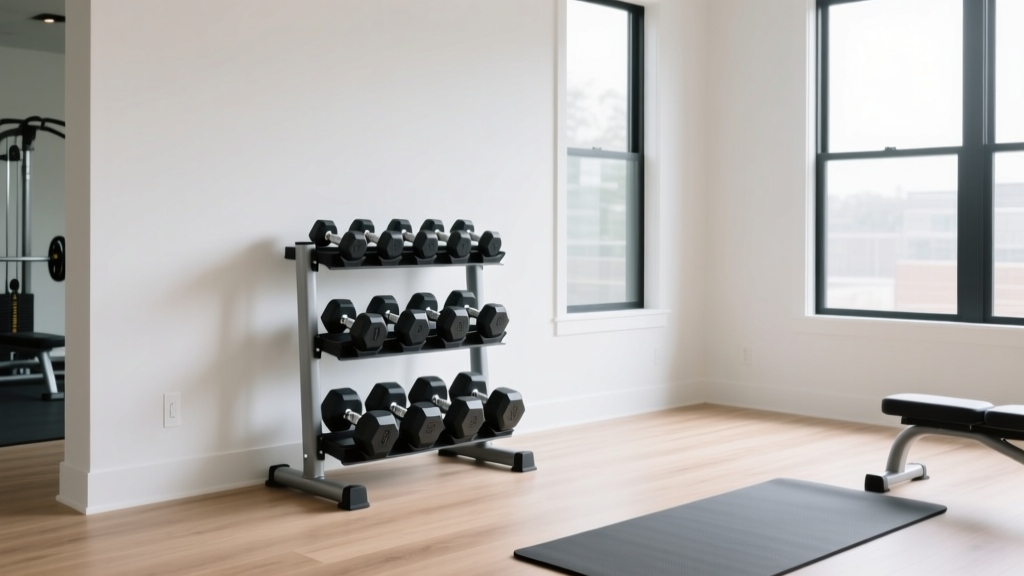
Verdict: If you are outfitting a squat stand for light accessories and general fitness, Walmart's Cap Barbell hex sets are a cost-effective starting point. If you have just bolted down a 4-post power rack and plan to run heavy drop-sets, rack work, or high-volume hypertrophy blocks, bypass the big-box stores and invest in a commercial-grade urethane set with a heavy-duty storage tree.
Final Calibration and Safety Checks
With the rack anchored and the weights acquired, perform a final calibration before loading the bar.
"A power rack is only as safe as its lowest safety point. Always set your spotter straps or pin-pipes one to two inches below your absolute maximum range of motion failure point. If you bottom out a back squat, the bar should rest on the safeties without compressing your spine or forcing you to unload the plates manually."
Check the UHMW plastic liners on your J-cups to ensure they are fully seated; these protect your barbell's knurling and dampen the noise of re-racking heavy loads. Finally, verify that all crossmember bolts are flush and that the pull-up bar is locked in with the provided hitch pins. Your 2026 home gym installation is now complete, structurally sound, and ready for heavy loading.
More gear to consider
All reviews
Space-Saving Racks for an Upper Back Workout With Dumbbells (2026)

Best Adjustable Dumbbells for the Dumbbell Triceps Kickback (2026)
Clear Floor Space for the Dumbbell Glute Bridge March: Rack Guide
Maintaining Dumbbells with Rubber: Hex vs Urethane Longevity Guide
Cast Iron vs Competition Kettlebells & Dumbbell One Arm Push Press
