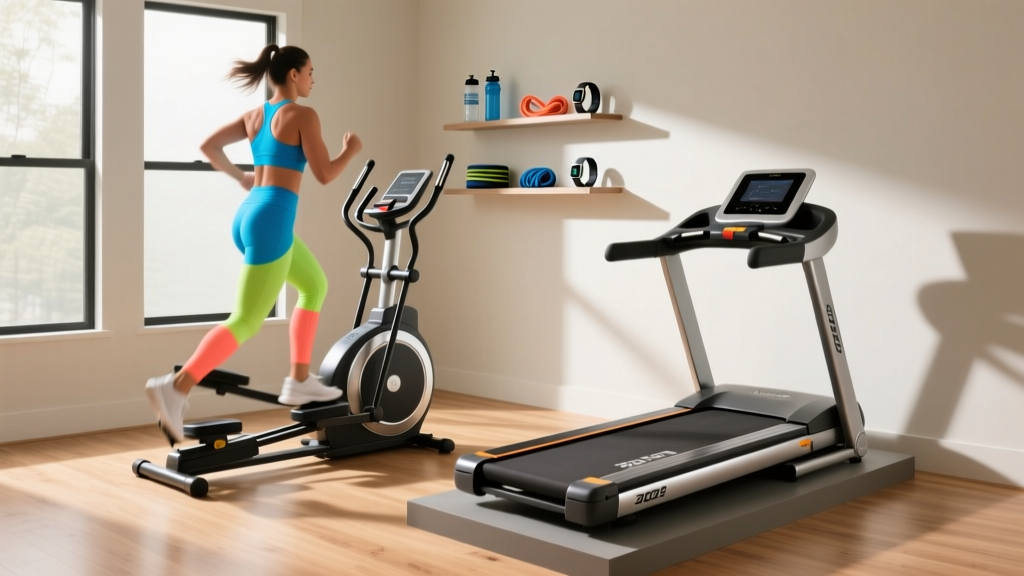
2026 Market Trends: Portable Cardio vs. Treadmill Advantages
Explore 2026 market trends in compact portable cardio equipment and how they compare to traditional treadmill advantages for home fitness buyers.

The 2026 Micro-Fitness Shift: Why Compact Cardio is Surging
As urban living spaces shrink and remote work solidifies into a permanent global norm, the home fitness equipment market has undergone a radical restructuring. According to recent industry analyses, the compact and portable cardio equipment segment has grown by over 18% year-over-year entering 2026. Consumers are increasingly trading massive, dedicated home gym footprints for 'micro-fitness' solutions: under-desk ellipticals, foldable walking pads, and mini-steppers that slide beneath a sofa. However, this spatial convenience forces a critical biomechanical and metabolic compromise. For serious buyers and fitness professionals, the central debate of 2026 revolves around whether these portable innovations can genuinely replicate the foundational treadmill advantages that have made motorized treadmills the gold standard of cardiovascular health for decades.
To understand this market dynamic, we must look past the marketing hype of '10,000 steps a day' and analyze the physiological realities of compact cardio equipment versus traditional full-sized treadmills. This trend report deconstructs the engineering, metabolic output, and long-term utility of the portable cardio market, providing a data-driven framework for buyers navigating this crowded space.
Biomechanical Reality: Defending Core Treadmill Advantages
The term 'treadmill advantages' is often casually thrown around, but from a kinesiology and sports science perspective, it refers to three specific, measurable benefits that compact portable equipment struggles to replicate. Understanding these advantages is crucial for evaluating whether a $300 walking pad can truly replace a $900 traditional treadmill.
1. Osteogenic Loading and Bone Density
One of the most critical, yet overlooked, treadmill advantages is controlled impact loading. The Mayo Clinic highlights that weight-bearing exercises with moderate impact are essential for stimulating osteogenesis (bone formation). Traditional treadmills, equipped with multi-zone elastomer cushioning systems, allow users to run or jog at speeds of 6.0 to 10.0 mph. This generates the necessary ground reaction forces to maintain bone mineral density. Compact walking pads, which cap out at 3.5 to 4.0 mph and lack advanced shock absorption, restrict users to low-impact walking, effectively eliminating the high-impact osteogenic benefits required for long-term skeletal health.
2. Full-Stride Gait Biomechanics
Standard treadmills feature running surfaces measuring 20 to 22 inches wide and 55 to 60 inches long. This accommodates a natural, unrestricted stride length, particularly for users over 5'8'. In contrast, the average 2026 portable walking pad offers a belt width of just 15 to 17 inches and a length of 40 to 45 inches. This forces a shortened, truncated gait cycle. Prolonged use of restricted-stride equipment can lead to altered hip flexor engagement and reduced gluteal activation, potentially causing lower back compensation over time.
3. High-Intensity Metabolic Output (The MET Gap)
Metabolic Equivalent of Task (MET) measures the energy cost of physical activities. The ability to rapidly shift between MET zones is a primary advantage of traditional treadmills, enabling High-Intensity Interval Training (HIIT). Portable equipment simply lacks the motor torque and thermal management to support these shifts.
'While walking pads are excellent for breaking up sedentary behavior during the workday, they cannot replace the cardiovascular conditioning achieved through the incline and speed variations inherent to traditional treadmill training.' — 2026 Sports Medicine & Biomechanics Review
Market Leaders: Compact Equipment Chasing the Standard
Despite the biomechanical limitations, the portable cardio market in 2026 is dominated by highly engineered devices that push the boundaries of what compact motors can achieve. Below, we analyze the market leaders and how they attempt to bridge the gap.
KingSmith WalkingPad R3 (2026 Edition)
Price Range: $599 - $649
Footprint (Stored): 10.6 sq ft
Motor: 1.25 CHP
The WalkingPad R3 remains the premium benchmark for foldable treadmills. KingSmith has upgraded the 2026 model with a slightly wider 18-inch belt and an integrated handrail that locks into place, addressing the safety concerns of earlier iterations. While it still maxes out at 6.2 mph (a light jog), its auto-speed adjustment via foot-pressure sensors is a technological marvel. However, the 1.25 CHP motor means it is strictly rated for users under 220 lbs to prevent belt stalling and motor overheating.
UREVO Strol 2E Smart Treadmill
Price Range: $279 - $299
Footprint (Stored): 12.1 sq ft
Motor: 1.0 CHP
The Strol 2E targets the budget-conscious remote worker. It features a dual-fold design that allows it to slide under a standard 6-inch clearance bed frame. It includes a basic 5% fixed incline—a rare feature in the sub-$300 portable market, attempting to mimic the caloric burn of a traditional treadmill's incline motor. The trade-off is a highly restrictive 15-inch belt width, making it suitable only for walking at speeds up to 3.8 mph.
Cubii JR2 Under-Desk Elliptical
Price Range: $299
Footprint (In Use): 2.5 sq ft
Resistance: 8 Magnetic Levels
Stepping away from treadmills, the Cubii JR2 represents the seated portable cardio market. It offers zero-impact, seated elliptical motion. While it brilliantly solves the spatial constraint and allows for concurrent desk work, its metabolic ceiling is low. Harvard Health notes that seated, low-resistance pedaling burns roughly 150-200 calories per hour—significantly less than the 300-450 calories burned during moderate-pace walking on a traditional treadmill.
Comparative Data Matrix: Portable vs. Traditional
To visualize the engineering and performance gaps in the 2026 market, we compared the top-selling portable options against a traditional benchmark, the Horizon T202, across critical performance metrics.
| Equipment Model | Category | Belt / Stride Dimensions | Motor / Resistance | Max MET Output (Est.) | Retail Price (2026) |
|---|---|---|---|---|---|
| Horizon T202 | Traditional Treadmill | 20' x 60' | 2.75 CHP | 9.5 - 11.0 METs | $799 - $899 |
| KingSmith R3 | Foldable Walking Pad | 18' x 47' | 1.25 CHP | 5.0 - 6.5 METs | $599 - $649 |
| UREVO Strol 2E | Compact Walking Pad | 15' x 43' | 1.0 CHP | 3.5 - 4.0 METs | $279 - $299 |
| Cubii JR2 | Under-Desk Elliptical | N/A (Seated Elliptical) | Magnetic (8 Levels) | 2.0 - 2.8 METs | $299 |
The Buyer's Decision Framework
Choosing between portable cardio equipment and a traditional treadmill is not about finding the 'best' machine, but about aligning the equipment with your specific physiological goals and spatial constraints. Use this 2026 decision matrix to guide your purchase.
When to Buy Compact Portable Cardio:
- Your primary goal is NEAT enhancement: If you want to increase Non-Exercise Activity Thermogenesis (fidgeting, light walking) while working from home, a walking pad or under-desk elliptical is unmatched.
- Severe spatial constraints: If you live in a studio apartment or multi-use room where a 7-foot long machine would permanently dominate the floor plan.
- Joint rehabilitation: If you are recovering from an injury and require strict, low-impact, low-velocity movement without the risk of a high-speed motorized belt.
When to Insist on Traditional Treadmill Advantages:
- Cardiovascular conditioning and VO2 Max: If your goal is to improve heart health through Zone 2 training or HIIT, you need the speed (8.0+ mph) and incline (10-15%) capabilities of a full-sized treadmill.
- Bone density maintenance: Runners and older adults requiring osteogenic loading must utilize the impact profile of a traditional deck.
- Heavy or tall users: Users over 220 lbs or taller than 6'0' will quickly outgrow the belt length and motor capacity of portable options, leading to premature motor burnout.
Future Outlook: Will Portable Tech Bridge the Gap?
As we move through 2026, the engineering focus in the portable cardio sector is shifting from mere miniaturization to 'smart resistance.' Brands are experimenting with electromagnetic braking systems on walking pads to simulate hill climbs without requiring a bulky incline motor. Furthermore, expert reviews from major publications note that the integration of AI-driven posture correction via companion apps is becoming standard, helping to mitigate the shortened-stride issues inherent to small belts.
However, the laws of physics remain unchanged. A 1.0 horsepower motor housed in a 4-inch thick chassis cannot replicate the momentum, shock absorption, and metabolic ceiling of a 300-pound machine with a 3.0 CHP motor. Compact portable cardio equipment is a phenomenal supplemental tool for the modern, space-starved consumer. It is brilliant for daily step accumulation and breaking up sedentary work hours. But for those seeking the profound cardiovascular, skeletal, and performance-based treadmill advantages, the traditional full-sized treadmill remains an irreplaceable cornerstone of the home gym.
More gear to consider
All reviews
Stationary Bike Types: Budgeting to Improve Treadmill Times (2026)
Air Bike vs Assault Bike & Treadmill 500 Pound Weight Capacity

Elliptical vs NordicTrack T6.1 Treadmill: Home Space Layout Guide

Stair Climber vs Pro2000 Treadmill: Home Buying Guide
Treadmill Broken Deck? Compact Portable Cardio Options & Care
