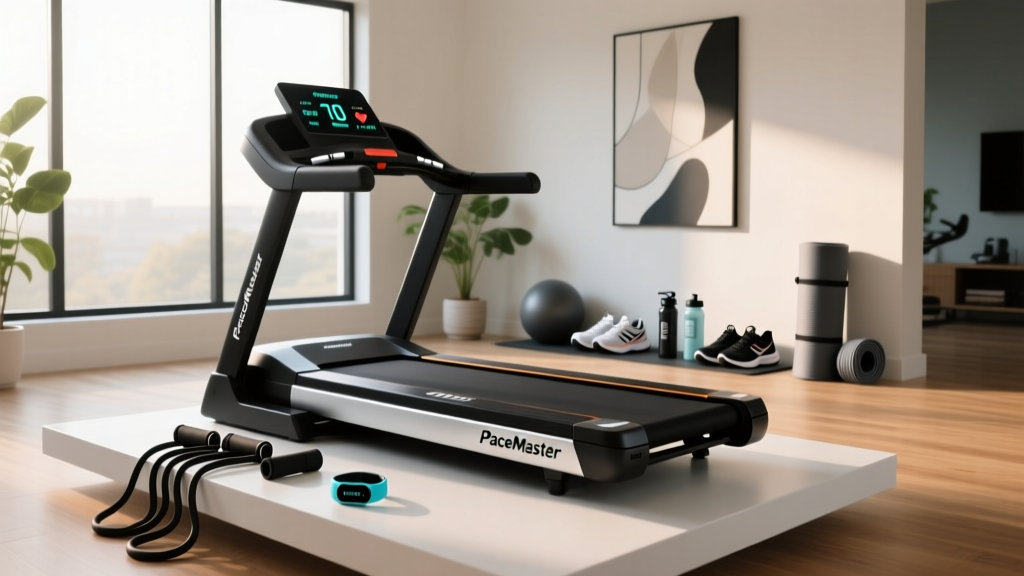
PaceMaster ProSelect Treadmill: 2026 Feature Buying Guide
Discover how the legendary PaceMaster ProSelect treadmill sets the standard for our 2026 buying guide, comparing core specs and modern features.

The PaceMaster ProSelect Treadmill: A Benchmark for Mechanical Integrity
In the rapidly evolving fitness equipment market of 2026, consumers are frequently distracted by massive HD touchscreens, integrated streaming services, and AI-driven coaching. However, veteran fitness technicians and physical therapists know that the mechanical core of a treadmill dictates its lifespan and biomechanical safety. To build a truly effective treadmill buying guide, we must look to the historical gold standard of home gym durability: the PaceMaster ProSelect treadmill. Originally engineered in the early 2000s, the PaceMaster ProSelect was renowned for its commercial-grade welded steel frame, 3.0 continuous duty horsepower (CHP) motor, and massive 2.5-inch crowned rollers. While finding a new unit today is impossible, analyzing the engineering principles of the PaceMaster ProSelect treadmill provides the perfect framework for evaluating modern 2026 alternatives like the Sole F80, Horizon 7.0 AT, and NordicTrack Commercial series.
According to the American Heart Association, adults need at least 150 minutes of moderate-intensity aerobic activity per week, making a reliable home treadmill a critical long-term health investment. This guide uses the legacy of the PaceMaster ProSelect to break down the exact specifications, failure modes, and feature comparisons you need to make an informed purchase this year.
Core Feature Comparison: Vintage Commercial vs. 2026 Smart Treadmills
How do the top-selling treadmills of 2026 stack up against the mechanical benchmark set by the legendary PaceMaster ProSelect? Below is a structural and performance comparison matrix focusing on the components that actually dictate machine longevity and running comfort.
| Model / Benchmark | Motor (CHP) | Belt Size | Roller Diameter | 2026 Avg Price |
|---|---|---|---|---|
| PaceMaster ProSelect (Refurbished) | 3.0 CHP | 20 x 55 in | 2.5 in | $600 - $900 |
| Sole F80 (2026 Model) | 3.5 CHP | 22 x 60 in | 2.5 in | $1,099 |
| Horizon 7.0 AT | 3.0 CHP | 22 x 60 in | 2.36 in | $1,099 |
| NordicTrack 2450 | 4.0 CHP | 22 x 60 in | 2.5 in | $2,799 + Sub |
The 2026 Treadmill Buying Framework: 4 Non-Negotiable Specs
When Consumer Reports evaluates cardio equipment, the emphasis is heavily placed on user weight capacity and motor thermal limits. Using the PaceMaster ProSelect as our baseline, here are the four critical specifications you must verify before purchasing any treadmill in 2026.
1. Continuous Duty Horsepower (CHP) vs. Peak HP
The most deceptive marketing tactic in the fitness industry is the use of Peak Horsepower. A treadmill might advertise a 4.0 Peak HP motor, but if its Continuous Duty Horsepower (CHP) is only 2.0, the motor will overheat and trip the internal breaker during a sustained 45-minute tempo run at 7.5 mph. The PaceMaster ProSelect utilized a true 3.0 CHP motor, meaning it could deliver that power continuously without thermal degradation. For 2026 buyers, never accept less than 3.0 CHP for running, and 3.5 CHP if multiple users in your household exceed 200 lbs. A 3.5 CHP motor running at 6 mph with a 220 lb user typically draws between 10 to 12 amps, keeping it well within the safe limits of a standard 15-amp residential circuit.
Expert Warning: Always check the motor warranty. A manufacturer confident in their CHP rating will offer a lifetime warranty on the motor and frame. If the motor warranty is only 1 to 5 years, assume the CHP rating is inflated and the internal copper windings are undersized.2. Belt Dimensions and Roller Diameter
The PaceMaster ProSelect featured 2.5-inch precision-machined crowned rollers. Why does roller diameter matter? Larger rollers reduce the rotational friction on the drive belt and the walking belt. When a belt wraps around a small 1.9-inch roller, the sharp bend creates immense internal friction and heat, degrading the belt adhesives and forcing the motor to work 20% harder. Furthermore, crowned rollers (slightly thicker in the middle) naturally keep the belt centered, eliminating the need for constant manual tension adjustments. In 2026, insist on a minimum 22 x 60-inch belt for runners to accommodate natural stride over-extension, paired with rollers no smaller than 2.3 inches.
3. Deck Cushioning and Impact Absorption
Running on asphalt generates ground reaction forces equivalent to 2.5 times your body weight. The Mayo Clinic highlights that proper shock absorption is vital for preserving joint health during repetitive aerobic exercise. Modern premium treadmills utilize multi-zone elastomer cushioning systems that are softer at the strike zone and firmer at the push-off zone. Avoid entry-level models that use basic silicone spray on a raw MDF wood deck, as these offer zero kinetic energy return and will cause shin splints within weeks.
4. Console Ecosystem and Subscription Traps
While the PaceMaster ProSelect featured a basic LED dot-matrix display that lasted for decades, 2026 consoles are essentially Android tablets. The critical buying factor here is offline functionality. Ensure the treadmill you buy allows manual mode, custom program creation, and Bluetooth FTMS (Fitness Machine Service) connectivity without requiring a mandatory $39/month subscription. Horizon and Sole excel here, allowing full machine functionality offline, whereas some competitors lock the incline and speed controls behind a paywall if your credit card expires.
Common Failure Modes and Edge Cases in Modern Treadmills
Even the best machines fail if maintenance is ignored. Based on service technician data, here are the most common failure modes in modern home treadmills and how to prevent them:
- Optical Speed Sensor Dust Buildup: Located near the motor flywheel, this sensor reads speed via a slotted disc. Household dust and pet hair can block the infrared beam, causing the console to throw an E1 or E2 error code and abruptly stop the belt. Fix: Vacuum the motor hood every 3 months.
- Incline Motor Potentiometer Drift: If your treadmill randomly changes incline or fails to calibrate to zero, the internal potentiometer in the incline lift motor has likely worn out. Fix: Avoid leaving the treadmill at a high incline when not in use, which keeps constant tension on the lift gear.
- Walking Belt Friction and Thermal Shutdown: A dry belt increases amp draw. If the motor draws over 15 amps consistently, the control board will initiate a thermal shutdown to prevent a fire. Fix: Lubricate the deck every 150 miles or 3 months using 100% silicone treadmill lubricant. Never use petroleum-based aerosols like WD-40.
Frequently Asked Questions
Can I still buy a PaceMaster ProSelect treadmill today?
PaceMaster ceased manufacturing operations years ago, and the brand was eventually absorbed and discontinued. However, because of their legendary over-engineered steel frames and 3.0 CHP motors, refurbished and used PaceMaster ProSelect and ProPlus models are highly sought after on secondary markets like Facebook Marketplace and Craigslist. Expect to pay between $600 and $900 for a professionally refurbished unit, which remains an exceptional value for pure mechanical durability.
Do I need a dedicated electrical circuit for a 2026 treadmill?
Yes. While many modern treadmills will plug into a standard 15-amp household outlet, sharing that circuit with high-draw appliances (like a refrigerator, space heater, or window AC unit) will cause voltage drops. This can damage the treadmill's lower control board and void the warranty. For any treadmill with a 3.5 CHP or 4.0 CHP motor, hiring an electrician to install a dedicated 20-amp circuit is highly recommended.
How does Bluetooth FTMS change the buying decision?
FTMS (Fitness Machine Service) is an open-source Bluetooth protocol that allows the treadmill to communicate directly with third-party apps like Zwift, Peloton Digital, and KinoMap. If you plan to do virtual racing or automated gradient training, you must verify the treadmill explicitly supports FTMS. Without it, the app cannot automatically control the treadmill's incline and resistance in real-time.
More gear to consider
All reviews
Elliptical vs Treadmill Longevity: How to Jog on a Treadmill Safely

Lichico YRUN Treadmill: Buying Mistakes & Troubleshooting
Round Treadmill vs Rower: 2026 Buying & Technique Guide

Stationary Bike Types vs Weslo Cadence G 5.9i Folding Treadmill
Setup Guide: Curved vs Motorized for Brisk Walking on Treadmill
