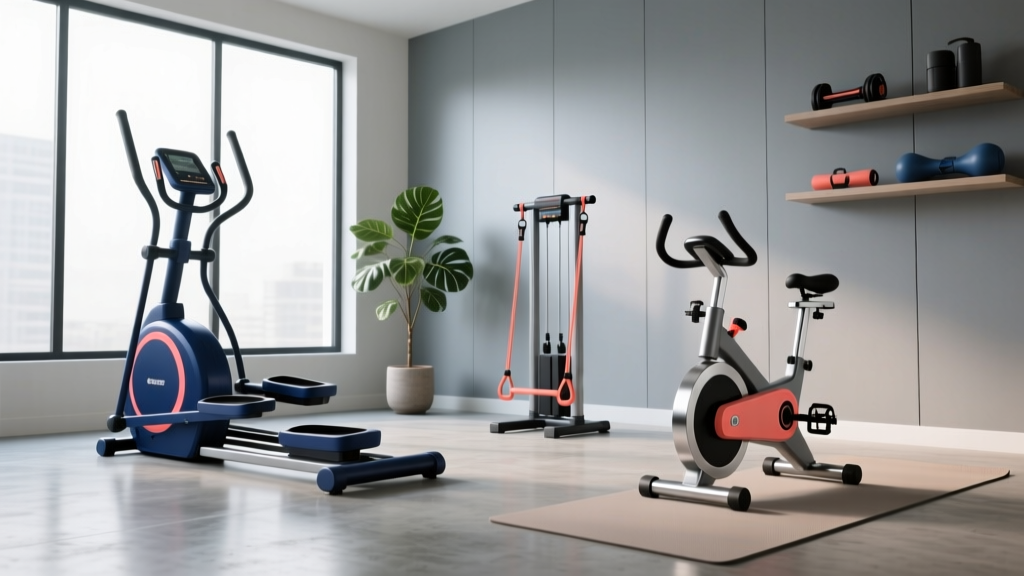
Beyond NordicTrack Treadmill Disassembly: Compact Cardio Swaps
Master NordicTrack treadmill disassembly or downsize your home gym. Explore the best compact portable cardio equipment options for space optimization.

The Space Crisis: Why Owners Search for NordicTrack Treadmill Disassembly
The allure of a commercial-grade treadmill is undeniable. Models like the NordicTrack Commercial 1750 or the T Series 10S offer immersive incline training, massive HD touchscreens, and robust continuous horsepower (CHP) motors. However, the reality of integrating a machine with a 76-inch by 30-inch footprint into a standard 12x12 spare bedroom often triggers a spatial crisis. As home gym layouts evolve in 2026, many fitness enthusiasts realize their primary cardio machine dominates the room, blocks natural traffic flow, and creates a claustrophobic environment.
This realization typically leads to one of two paths: searching for NordicTrack treadmill disassembly guides to move the unit into storage or a larger space, or pivoting entirely to compact portable cardio equipment options. This guide covers the technical realities of breaking down a NordicTrack machine, but more importantly, provides a comprehensive space-optimization framework featuring the best space-saving cardio alternatives on the market.
Expert Guide to NordicTrack Treadmill Disassembly (If You Must Move It)
If you are relocating or storing your machine, improper teardown can lead to severed wiring, cracked console bezels, or personal injury. Professional fitness equipment movers in 2026 charge between $175 and $350 for this service, but DIY disassembly is manageable with the right technical approach.
⚠️ Critical Hardware Warning: Never yank the main console ribbon cable. The plastic locking tab on the motherboard connector is notoriously brittle. Flip the small black latch up before sliding the ribbon out. Static discharge can also fry the lower control board; always touch a grounded metal surface before handling internal wires.Step-by-Step Teardown Process
- Preparation & Power: Unplug the machine and secure the power cord with velcro ties to the main frame to prevent it from being crushed under the deck during transit.
- Console Removal: Use a Phillips-head screwdriver to remove the 4 to 6 screws securing the console hood. Carefully lift the hood, disconnect the ground wire, and unclip the data ribbon cable as warned above.
- Upright Mast Detachment: The upright mast on a Commercial series can weigh upwards of 85 lbs. Have a second person support the mast while you use an 8mm Allen wrench (or 15mm socket, depending on the exact model year) to remove the main pivot bolts at the base.
- Handrail & Side Rail Separation: Remove the side rail bolts to separate the left and right handrails. Bag all hardware immediately and tape the bags to the corresponding frame parts.
- Deck & Motor Hood: For tight stairwells, you may need to remove the motor hood (usually secured by 4 Phillips screws) and detach the drive belt to reduce the base footprint.
According to guidelines referenced by the American Council on Exercise (ACE), maintaining an organized teardown with labeled zip-lock bags for hardware reduces reassembly time by over 40% and prevents the loss of critical spacer washers that keep the frame from squeaking.
The Pivot: Top Compact Portable Cardio Equipment Options
If disassembly reveals that your space simply cannot accommodate a traditional treadmill, it is time to downsize without sacrificing cardiovascular output. The 2026 market for compact portable cardio equipment options has matured significantly, offering high-performance metrics in fractional footprints.
1. Auto-Folding Treadmills: Echelon Stride-S
The Echelon Stride-S solves the spatial issue with a motorized auto-fold mechanism. At the push of a button, the deck folds vertically, reducing the depth from 69 inches to just 10 inches.
Specs: 300 lb weight capacity, 12 mph top speed, 4.5-inch clearance when folded flat against a wall.
Price Range: $899 - $1,099
2. High-Performance Walking Pads: WalkingPad R3
For those who prioritize low-impact steady-state (LISS) cardio or under-desk walking, the WalkingPad R3 is the industry benchmark. Unlike flimsy budget pads, the R3 features a structural aluminum alloy frame and a foldable handrail that locks into place for speeds up to 7.5 mph.
Specs: 265 lb capacity, 63" x 22" x 9" folded dimensions, built-in transport wheels.
Price Range: $499 - $599
3. Vertical-Split Rowers: Concept2 RowErg
Rowing engages 86% of the body's musculature. While the Concept2 RowErg is 94 inches long during use, its true genius lies in its space-optimization design. The machine separates into two pieces in seconds without tools. The flywheel assembly measures just 25" x 33" x 54", allowing it to slide into a standard closet or stand upright in a corner.
Specs: 500 lb capacity, PM5 performance monitor, chain drive.
Price Range: $990 - $1,100
4. Ultra-Compact Ellipticals: Sunny Health & Fitness SF-E905
Ellipticals are notorious space-hogs, but the SF-E905 is a rare exception. Designed for micro-apartments, it lacks a massive rear flywheel, utilizing a front-drive compact crank system instead.
Specs: 250 lb capacity, 48" total footprint, 11" stride length (ideal for shorter users or warm-ups).
Price Range: $179 - $219
Spatial Layout Matrix: Footprint vs. Active Clearance
When designing a home gym layout, the physical dimensions of the machine are only half the equation. The U.S. Consumer Product Safety Commission (CPSC) strictly advises maintaining adequate clearance behind motorized treadmills to prevent entrapment injuries and allow for emergency egress. Below is a spatial matrix to help you plan your room layout.
| Equipment Type | Stored Footprint | Active Clearance Needed | Ceiling Height Req. |
|---|---|---|---|
| Standard Treadmill | 76" L x 30" W | 39" rear (CPSC standard) | User Height + 10" |
| Auto-Fold Treadmill | 69" L x 10" D (Folded) | 39" rear (when deployed) | User Height + 10" |
| Walking Pad (R3) | 63" L x 22" W x 9" H | 24" rear / 12" sides | Standard (8 ft) |
| Concept2 RowErg | 25" x 33" (Split) | 94" L x 48" W (Active) | Standard (8 ft) |
Layout Design Rules for Micro Home Gyms
Optimizing a room for compact portable cardio equipment options goes beyond just measuring the floor. Implement these architectural and ergonomic principles to maximize the utility of your space:
- The 'Triangle' Traffic Flow: Borrowing from kitchen design, ensure there is a clear, unobstructed path between the door, your primary cardio machine, and your free-weight or stretching zone. Never place a folding treadmill in a corner where deploying it requires moving other furniture.
- Mirror Placement for Spatial Illusion: Mounting a large, shatterproof acrylic gym mirror on the wall directly facing your compact cardio station bounces light and creates the psychological illusion of double the square footage, reducing the claustrophobia of small-room training.
- Acoustic and Vibration Dampening: Compact machines, particularly walking pads and lightweight ellipticals, can transmit high-frequency vibrations directly into the floor joists. Use 3/4-inch thick vulcanized rubber stall mats (typically 4x6 feet) rather than thin PVC puzzle mats. This protects your subfloor and dampens noise transfer to rooms below.
- Ventilation and Airflow: According to Mayo Clinic's home fitness guidelines, proper ventilation is critical for thermoregulation during cardio. In a micro-gym, CO2 and heat build up rapidly. Position your compact machine facing an open window or install a wall-mounted, oscillating fan that does not consume floor space.
Frequently Asked Questions
Can I store a walking pad vertically under a bed?
Most premium walking pads like the WalkingPad R2 or R3 are roughly 8 to 9 inches thick when folded. Standard bed frame clearances range from 6 to 10 inches. Always measure your specific bed clearance and ensure the pad's wheels can engage without scraping the floor.
Is it safe to leave a folding treadmill deployed but unplugged?
If space permits, leaving it deployed reduces mechanical wear on the hydraulic or motorized folding hinges. However, ensure the safety magnetic key is removed and stored out of reach of children or pets to prevent accidental activation.
Final Thoughts on Space Optimization
Whether you are undertaking a complex NordicTrack treadmill disassembly to reclaim your guest room, or you are investing in a high-tech auto-folding treadmill or modular rower, the goal remains the same: aligning your fitness equipment with your architectural reality. By prioritizing active clearance, vertical storage capabilities, and multi-planar cardio options, you can build a highly effective, code-compliant home gym that enhances your living space rather than consuming it.
More gear to consider
All reviews
Confidence Fitness Treadmill vs Air Bike: Assault Guide

XTERRA TRX3500 Treadmill Review: Setup & Walking Pad Comparison

Katie Austin Treadmill Maintenance & Compact Portable Cardio Care
Stair Climber Guide: Cursor Fitness Home Folding Treadmill Reviews

Horizon Fitness 101 Treadmill Maintenance: Belt Lubrication Guide
