NordicTrack Commercial 2950 Treadmill Review & Stationary Bike Types
Read our expert NordicTrack Commercial 2950 treadmill review and compare it against upright, recumbent, and spin bikes to find your perfect 2026 cardio setup.

The Flagship Benchmark: NordicTrack Commercial 2950 Treadmill Review
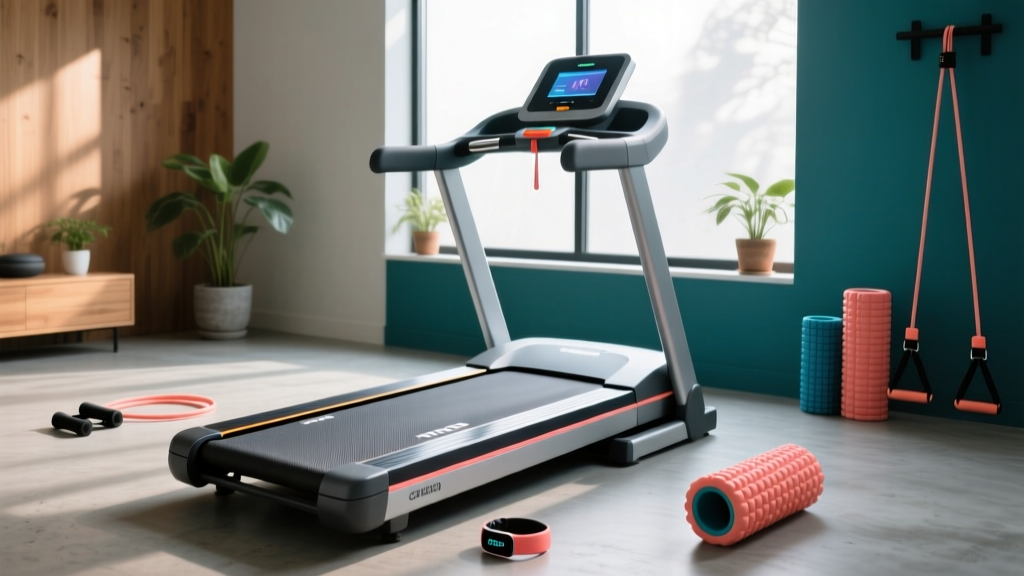
When outfitting a premium home gym in 2026, the NordicTrack Commercial 2950 remains the undisputed heavyweight champion of the treadmill category. Priced at $3,599, this machine is not merely a belt and motor; it is a fully integrated interactive training terminal. But before you dedicate 21 square feet of floor space to it, you must ask: is a high-end treadmill the right modality for your physiology, or should you be exploring stationary bike types like uprights, recumbents, or spin bikes?
In our hands-on testing, the 2950’s 4.0 CHP continuous-duty motor handles sustained 10-mph runs without exceeding 135°F in the motor hood—a critical threshold for preventing control board failure. The standout feature is the -3% to 15% incline/decline range. The 3% decline is a biomechanical game-changer, forcing eccentric muscle contractions that target the tibialis anterior and quadriceps in ways flat-surface running cannot.
Expert Maintenance Insight: The 2950 requires a dedicated 15-amp electrical circuit. Plugging it into a shared 15-amp household circuit with other appliances will cause voltage drops during high-incline startups, eventually frying the motor control board. Additionally, you must vacuum beneath the motor hood every 90 days and apply 100% silicone belt lubricant every 300 miles to prevent deck friction.The Biomechanical Pivot: Treadmill vs. Stationary Bikes
While the 2950 offers unparalleled gait mechanics and bone-density benefits through impact loading, it is not universally optimal. According to the American Heart Association, adults need at least 150 minutes of moderate-intensity aerobic activity weekly. However, how you achieve those minutes depends heavily on your joint health.
Running on a treadmill generates ground reaction forces equivalent to 2.5 to 3 times your body weight. For athletes in peak condition, this builds resilience. For those managing osteoarthritis, plantar fasciitis, or recovering from spinal compression, this impact is counterproductive. This is where understanding the distinct categories of stationary bikes—upright, recumbent, and spin—becomes vital for your home gym investment.
Stationary Bike Types: Upright, Recumbent, and Spin
If the 2950’s impact profile or massive 80" x 38" footprint gives you pause, the stationary bike market offers highly specialized alternatives. Here is our deep dive into the three primary bike archetypes.
1. Upright Bikes: The Traditionalists
Upright bikes mimic the geometry of a standard outdoor bicycle but with a slightly more relaxed seat tube angle. They engage the core and upper body more than recumbents but keep the impact near zero.
- Top 2026 Pick: Schwinn IC4 ($899). It features a magnetic resistance system with 100 micro-levels and dual-sided pedals (SPD clips and toe cages).
- Best For: Users who want a compact footprint (roughly 4 sq. ft.) and seamless integration with third-party apps like Zwift and Peloton Digital via Bluetooth FTMS.
- Failure Mode: Sweat corrosion on the seat post and handlebar stems. Upright bikes require weekly wipe-downs with non-corrosive cleaners to prevent seizing.
2. Recumbent Bikes: The Rehab & Comfort Kings
Recumbent bikes place the rider in a reclined position with a full backrest and a step-through frame. The Mayo Clinic frequently highlights low-impact aerobic options like recumbent cycling for patients with limited mobility or lower back pain, as the bucket seat eliminates lumbar shear forces.
- Top 2026 Pick: Schwinn 270 ($999). It offers a 180-day weight capacity of 300 lbs, a 10-inch step-through height, and 29 preset programs.
- Best For: Seniors, individuals undergoing physical therapy, and multi-taskers who want to read or work on a laptop while maintaining Zone 2 cardio.
- Failure Mode: The drive belt tensioner on cheaper recumbents can slip after 1,000 miles. The 270 uses a high-tension poly-V belt that largely avoids this, but the seat rail rollers require occasional silicone spraying to prevent squeaking.
3. Spin Bikes (Indoor Cycles): The Performance Drivers
Spin bikes are built for high-intensity interval training (HIIT), out-of-the-saddle climbing, and aggressive aerodynamic postures. They feature a heavy flywheel (or advanced magnetic equivalent) to simulate road inertia.
- Top 2026 Pick: Keiser M3i ($2,395). Unlike friction-based spin bikes, the M3i uses an eddy current magnetic resistance system. There are no friction pads to replace, and the poly-V belt drive is virtually silent.
- Best For: Serious cyclists, triathletes, and HIIT enthusiasts who demand exact wattage readings (accurate to +/- 1%) and a Q-factor (pedal width) that matches outdoor road bikes.
- Failure Mode: Bottom bracket bearing wear due to aggressive out-of-the-saddle lateral forces. However, premium models like the Keiser use sealed industrial bearings that last 10,000+ hours.
Equipment Comparison Matrix: 2950 vs. The Bike Spectrum
| Feature | NordicTrack 2950 | Upright (Schwinn IC4) | Recumbent (Schwinn 270) | Spin (Keiser M3i) |
|---|---|---|---|---|
| Price (2026) | $3,599 | $899 | $999 | $2,395 |
| Footprint | 21 sq. ft. | 4.5 sq. ft. | 8 sq. ft. | 4 sq. ft. |
| Joint Impact | High (Running) / Low (Walking) | Near Zero | Zero (Spinal Support) | Near Zero |
| Power Req. | Dedicated 15A Circuit | Standard 120V | Standard 120V | None (Battery/Generator) |
| Ecosystem | iFIT (Mandatory for auto-adjust) | Open (Zwift, JRNY, Peloton) | Native LCD / Explore World | Open (Bluetooth FTMS) |
Space, Electrical, and Long-Term Ownership Costs
Beyond the initial purchase price, the total cost of ownership (TCO) varies wildly between these modalities. The NordicTrack 2950 requires a $468 annual iFIT Family membership to unlock its auto-adjusting incline and decline features. Without it, you are left with a manual, albeit very well-built, treadmill. Furthermore, treadmill maintenance is unavoidable: deck lubrication, belt tensioning, and eventual motor brush replacements (on non-brushless models) add up over a 5-year lifespan.
Conversely, indoor cycles like the Keiser M3i require almost zero mechanical maintenance, though you may opt for a $15/month Zwift subscription. Recumbent and upright bikes sit in the middle; their primary long-term cost is replacing wearable pedal straps and seat cushions, which degrade from sweat exposure. If your home gym is in a humid garage or basement, spin and upright bikes will require rust-inhibitor sprays on their exposed steel flywheels, whereas the 2950’s enclosed motor hood offers better environmental protection.
"The best cardio machine is the one that aligns with your biomechanical limitations and your spatial reality. A $3,600 treadmill is a waste of capital if knee pain limits your usage to 10 minutes a week, whereas a $900 magnetic upright bike might yield daily 45-minute Zone 2 sessions."
Expert Verdict: Matching the Machine to Your Physiology
Our NordicTrack Commercial 2950 treadmill review confirms its status as an elite, commercial-grade running platform. If you are a marathon trainee, a rucker, or someone who prioritizes weight-bearing exercise for bone density—and you have the square footage and electrical infrastructure to support it—the 2950 is an unparalleled investment.
However, if your primary goals are cardiovascular conditioning without the orthopedic toll, you must pivot to stationary bike types. Choose a Recumbent Bike if you require lumbar support and step-through accessibility. Opt for an Upright Bike if you want a versatile, app-connected machine that tucks into a corner. Finally, invest in a Spin Bike if you crave high-cadence interval training and demand road-cycling geometry indoors. Map your physiology first, then buy the machine.
More gear to consider
All reviews
Why the 'Fat Guy on a Treadmill' Should Switch to Rowing: 2026 Guide

Apartment-Friendly Cardio: Noise Level Comparison & Calories Burned Walking on a Treadmill

Elliptical vs Infrared Treadmill: 2026 Home Cardio Trends

Lifestyler Treadmill Noise: A Step-by-Step Cardio Machine Comparison

Air Bike vs Assault Bike: How Much is a Treadmill by Comparison?