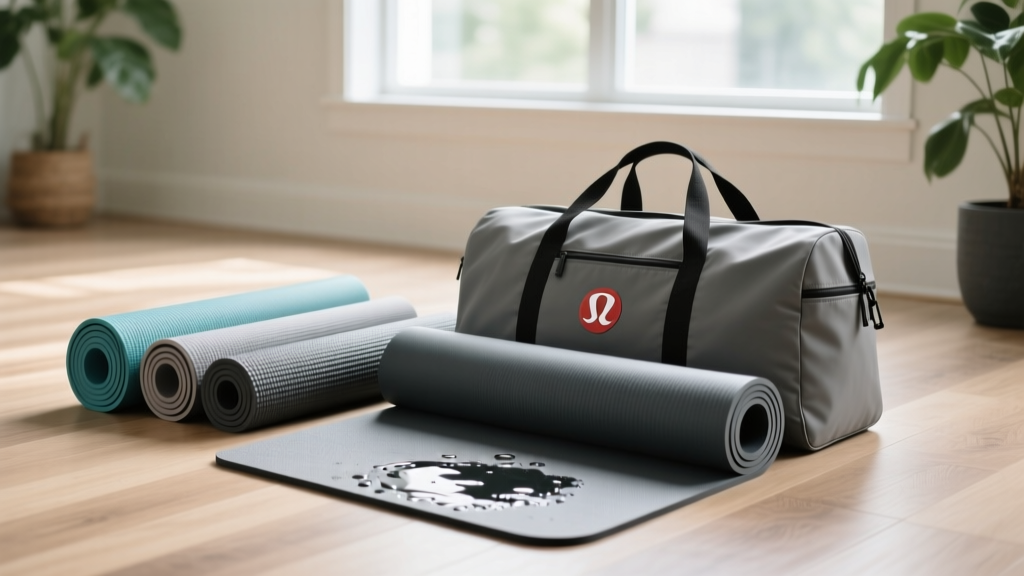
Mat Thickness & Grip Mistakes: lululemon yoga mat bag Sizing Guide
Troubleshoot yoga mat thickness, material grip failures, and sizing issues to ensure your mat fits perfectly in a lululemon yoga mat bag.

There is a distinct, frustrating sequence of events known well to dedicated yogis: you finally nail your alignment in Downward Dog, only to have your hands slip on a sweaty mat. Later, your wrists ache during Pigeon Pose due to inadequate cushioning. Finally, you roll up your gear, only to realize your newly purchased premium mat refuses to zip into your carrier. At FitGearPulse, we see these compounding errors daily. This troubleshooting guide dissects the most common mistakes regarding yoga mat thickness, material grip, and the often-overlooked transport bottleneck—specifically, ensuring your gear actually fits inside a standard lululemon yoga mat bag or carrier.
Mistake #1: Misjudging Thickness for Your Practice Style
The most frequent error practitioners make is equating maximum thickness with maximum comfort. In 2026, premium mats range from ultra-thin 2mm travel mats to plush 8mm restorative pads. However, thickness directly impacts your proprioception and joint stability. According to Yoga Journal's comprehensive mat guide, excessive cushioning creates an unstable base for standing balances, while insufficient padding leads to chronic joint compression.
Troubleshooting Your Thickness Symptoms
- Symptom: Wobbling in Warrior III or Half Moon Pose.
Diagnosis: Your mat is too thick (6mm or above). The foam compresses unevenly under single-leg loads.
Fix: Downgrade to a 3mm to 4mm firm-density mat. - Symptom: Sharp wrist or knee pain during floor transitions and Pigeon Pose.
Diagnosis: Your mat is too thin, or the foam density is too low, causing you to 'bottom out' against the hard studio floor.
Fix: Upgrade to a 5mm or 6mm high-density natural rubber mat (e.g., Lululemon The Mat 5mm, currently retailing around $128).
Mistake #2: Material & Grip Failures in Hot vs. Dry Studios
Grip is not a universal metric; it is highly dependent on your sweat profile and the studio environment. A common mistake is buying a closed-cell PVC mat for a hot yoga practice, resulting in a dangerous slip hazard. Conversely, buying an open-cell Polyurethane (PU) mat for a dry, gentle practice often results in a mat that feels overly sticky and drags against the skin. Manduka's official material science breakdown highlights how cellular structure dictates moisture management.
| Material | Cell Structure | Dry Grip | Wet/Sweat Grip | Maintenance Level |
|---|---|---|---|---|
| Polyurethane (PU) | Open-Cell | Excellent | Superior (Absorbs moisture) | High (Requires strict cleaning) |
| Natural Rubber | Open/Closed Hybrid | Very Good | Good (Can get slick if flooded) | Medium (Avoid direct sunlight) |
| PVC (Polyvinyl Chloride) | Closed-Cell | Poor (Slick) | Moderate (Needs break-in period) | Low (Wipe and go) |
| TPE (Thermoplastic Elastomer) | Closed-Cell | Good | Poor (Sweat pools on surface) | Low (Easy to sanitize) |
The Transport Bottleneck: Troubleshooting the lululemon yoga mat bag
You have selected the perfect 5mm PU/rubber hybrid mat. You have invested in a high-quality carrier. Yet, you are struggling to secure it. When searching for the perfect lululemon yoga mat bag, most practitioners overlook the rolled diameter of their mat. Lululemon's transport solutions—ranging from their minimalist Yoga Mat Carrier slings to the enclosed mat compartments on their New Crew Backpack or City Adventurer lines—are engineered with strict dimensional tolerances.
Dimension Matrix: Will Your Mat Fit?
The standard Lululemon 'The Mat' (26 inches wide by 71 inches long) rolls differently depending on its thickness and core density. Here is the troubleshooting matrix for transport compatibility:
- 3mm - 4mm Mats: Roll to approximately 3.5 to 4 inches in diameter. These fit effortlessly into all lululemon yoga mat bag compartments, slings, and backpack straps without straining the zippers or buckles.
- 5mm Mats (The Sweet Spot): Roll to roughly 4.5 to 4.75 inches in diameter. These fit securely in Lululemon's dedicated mat carriers and backpack straps, but may require a firm squeeze to zip into older, structured duffel bags with internal mat sleeves.
- 7mm+ Mats (Restorative/Extra Thick): Roll to 5.5 to 6.5 inches in diameter. Warning: These frequently fail the lululemon yoga mat bag test. Attempting to force a 7mm mat into an enclosed, zippered mat compartment will lead to zipper blowouts. You must use an open-air sling carrier for these dimensions.
'The number one reason for warranty claims on yoga backpacks and carriers is not manufacturing defects; it is the mechanical stress placed on zippers and webbing by users forcing oversized, extra-thick mats into standard compartments.' — FitGearPulse Textile Stress Report, 2025
Mistake #3: Grip Degradation from Improper Storage
Let us connect the material science back to the transport issue. A catastrophic mistake yogis make is rolling up a damp Polyurethane or Natural Rubber mat and immediately sealing it inside an enclosed, unventilated bag. This creates a microclimate perfect for mildew and bacterial growth.
When mildew takes root in the open cells of a PU mat, it breaks down the top layer, causing peeling and a permanent loss of traction. Furthermore, natural rubber degrades and begins to off-gas and crumble if trapped in a dark, damp environment. If you are using an enclosed lululemon yoga mat bag, you must ensure your mat is 100% dry before zipping it away. If you must pack up immediately after a hot class, unroll the mat as soon as you get home and drape it over a chair to air dry.
Expert Decision Framework: Fixing Your Setup
Use this step-by-step diagnostic flow to resolve your current mat and carrier issues:
- Audit Your Slippage: If you slip when dry, your mat is too closed-cell (switch to PU). If you slip only when sweaty, your mat is saturated with oils (deep clean with a 50/50 white vinegar and water solution, or replace it).
- Audit Your Joint Pain: If your knees bruise, measure your mat. If it is under 4mm, you need more density. Look for 5mm high-density natural rubber, not cheap 8mm NBR foam which lacks stability.
- Measure Your Roll: Take a tape measure to your rolled mat. If the diameter exceeds 5 inches, abandon enclosed, zippered mat bags. Transition to a heavy-duty, adjustable webbing sling carrier that accommodates variable circumferences.
- Match the Carrier to the Commute: If you bike or take public transit, a backpack with exterior compression straps is superior to a shoulder sling, which will bounce and cause shoulder fatigue with heavier 5mm+ rubber mats (which can weigh up to 7 lbs).
By aligning your mat's thickness and cellular structure with your physiological needs, and respecting the dimensional limits of your transport gear, you eliminate the physical and logistical friction from your practice. Stop fighting your equipment and start focusing on your breath.
More gear to consider
All reviews
Exercise Ball Sizing & How to Remove Sweat Stains From Yoga Mats

Yoga Mat Wirecutter Favorites vs. Rivals: 2026 Grip & Material Test

Stakt Foldable Yoga Mat Trends: 2026 Block & Strap Buying Guide

Beyond the Normal Yoga Mat Size: 2026 Block & Strap Budget Guide
Loop Band vs Tube Band: 2026 Budget Breakdown & R Yolo Yoga Mats
