
Massage Gun for Quads vs Stretching Tools: 2026 Buyer's Guide
Discover the best massage gun for quads and top stretching equipment. Compare percussive therapy vs. flexibility tools for optimal leg recovery in 2026.

Quadriceps tightness is a universal complaint among runners, cyclists, and heavy lifters. When the quads lock up, they don't just limit your squat depth or running stride; they pull on the pelvis, often triggering a cascade of anterior pelvic tilt and lower back pain. In 2026, the recovery market offers two primary solutions for this issue: high-torque percussive devices and mechanical stretching equipment. But which modality actually restores tissue length, and which merely masks the pain?
This in-depth buyer's guide bridges the gap between percussive therapy and flexibility tools. We will dissect the biomechanics of the quadriceps, review the top-tier massage guns for quads, evaluate dedicated stretching equipment, and provide a hybrid protocol to maximize your hip and knee range of motion (ROM).
The Biomechanics of Quad Tightness: Why Standard Stretching Fails
To choose the right recovery tool, you must understand the anatomy. The quadriceps femoris is a four-headed muscle group. Three of these heads (vastus lateralis, medialis, and intermedius) only cross the knee joint, acting purely as knee extensors. However, the rectus femoris crosses both the knee and the hip joint.
When you sit at a desk all day or cycle in an aerodynamic tuck, the rectus femoris adapts to a shortened position. According to the Mayo Clinic, chronic shortening of bi-articular muscles directly compromises joint ROM and alters movement mechanics. Simply standing up and grabbing your ankle (the traditional standing quad stretch) often fails because the lower back compensates, arching excessively before the rectus femoris reaches its true end-range. This is where specialized equipment becomes mandatory.
Top Massage Guns for Quads: 2026 Market Leaders
A massage gun for quads must possess two non-negotiable traits: deep amplitude (to penetrate the thick vastus lateralis) and high stall force (so the motor doesn't die when you apply heavy pressure on dense muscle bellies). Here are the top performers for lower-body recovery.
1. Theragun PRO Plus (Best Overall for Deep Tissue)
- Price: $599
- Amplitude: 16mm
- Stall Force: 60 lbs
- Quad-Specific Edge: The 16mm stroke length easily bypasses the superficial fascia to reach the deep vastus intermedius. The integrated Smart App features AI-guided routines that map out the exact angle needed to target the rectus femoris origin at the AIIS (anterior inferior iliac spine).
2. Hyperice Hypervolt 2 PRO (Best for Sweep Techniques)
- Price: $429
- Amplitude: 14mm
- Stall Force: 35 lbs
- Quad-Specific Edge: While the amplitude is slightly shallower, the Hypervolt 2 PRO excels at broad, sweeping flushes across the entire quad complex. Its QuietGlide technology and ergonomic handle make it significantly easier to self-administer on the anterior thigh without fatiguing your shoulder and wrist.
3. Bob and Brad X6 Pro (Best Budget High-Torque Option)
- Price: $169
- Amplitude: 12mm
- Stall Force: 60 lbs
- Quad-Specific Edge: It is rare to find a 60 lb stall force under $200. The X6 Pro allows aggressive, deep-pressure trigger point therapy on stubborn vastus medialis knots near the knee cap without the motor bogging down.
Never use the hard bullet attachment directly on the quad. The thigh lacks heavy bone protection near the surface. Use the Dampener or Large Ball for the vastus lateralis, and the Wedge attachment to scrape along the IT band and rectus femoris separation line to promote fascial sliding.
Top Stretching Equipment for Quad & Hip Flexor Mobility
While percussive therapy down-regulates the nervous system and increases local blood flow, it does not permanently alter tissue length. For structural flexibility changes, mechanical stretching equipment is required. The American Council on Exercise (ACE) highlights that proprioceptive neuromuscular facilitation (PNF) and loaded progressive stretching yield the highest long-term ROM gains.
1. HPN Sports Leg Stretcher (Best for Supine PNF Stretching)
- Price: $149
- Mechanism: Pulley-based mechanical advantage system.
- Application: By lying supine and using the pulley system, you can isolate the rectus femoris by keeping the knee bent while pulling the hip into extension, completely removing the lower back from the equation. It allows for hands-free PNF hold-relax cycles.
2. OPTP Pro-Roc Stretch Strap (Best for Active Isolated Stretching)
- Price: $28
- Mechanism: Multi-loop heavy-duty nylon strap.
- Application: Essential for Active Isolated Stretching (AIS). You can perform prone quad stretches by looping the strap around the ankle and gently pulling the heel to the glute, holding for exactly 2 seconds, and releasing. This bypasses the stretch reflex, allowing for safer, deeper quad elongation.
3. ProsourceFit Tri-Fold Folding Tumbling Mat (Best for Kneeling Stretches)
- Price: $65
- Mechanism: High-density EPE foam wedge/mat.
- Application: The 'Couch Stretch' is the gold standard for quad and hip flexor mobility, but doing it against a wall can compress the patella. Using a folded high-density mat as a wedge under the knee and shin distributes the load, allowing you to sink deeper into the stretch for the recommended 2-to-3-minute hold times without joint pain.
Head-to-Head Comparison Matrix: Percussive vs. Mechanical
Understanding when to deploy your massage gun for quads versus when to strap into your stretching equipment is critical for an efficient recovery routine.
| Feature | Massage Guns (Percussive) | Stretching Equipment (Mechanical) |
|---|---|---|
| Primary Mechanism | Neurological down-regulation, hyperemia (blood flow) | Sarcomere addition, fascial remodeling, creep |
| Best Used For | Pre-workout prep, acute DOMS relief, trigger points | Post-workout cooldown, chronic postural correction |
| Time Commitment | 2–4 minutes per leg | 5–10 minutes per leg (requires sustained holds) |
| Impact on Patellar Tendon | High risk if used incorrectly (avoid bony prominences) | Low risk (tension is distributed through muscle belly) |
| Cost Range (Premium) | $400 - $600 | $100 - $250 |
The Hybrid Protocol: Combining Modalities for Maximum Flexibility
Relying exclusively on one tool leaves recovery on the table. The most effective physical therapy clinics utilize a sequenced approach. According to guidelines discussed by the Cleveland Clinic, tissue temperature and neurological readiness dictate the success of a stretching session. Here is the optimal 2026 hybrid protocol for locked-up quads:
- Phase 1: Percussive Vasodilation (3 Minutes)
Use the Theragun PRO Plus with the Large Ball attachment. Sweep up and down the vastus lateralis and rectus femoris at a moderate speed (around 1750 RPM). Do not linger on one spot; the goal is to stimulate mechanoreceptors and increase tissue temperature, not to bruise the muscle. - Phase 2: Active Isolated Priming (2 Minutes)
Use the OPTP Pro-Roc Strap. Lie on your stomach, loop the strap around your ankle, and actively contract your hamstrings to pull the heel toward your glute. Assist with the strap only at the very end range. Hold for 2 seconds, release. Repeat 10 times. This lubricates the knee joint and prepares the muscle spindle for static loading. - Phase 3: Mechanical Loaded Stretch (4 Minutes)
Move to the HPN Sports Leg Stretcher or set up your modified Couch Stretch on the folding mat. Sink into the deep stretch. Because the nervous system was pacified in Phase 1, the stretch reflex (myotatic reflex) will be blunted, allowing you to access your true end-range. Hold for 2 minutes per side, breathing deeply to promote parasympathetic engagement.
Common Mistakes & Edge Cases to Avoid
Warning: The IT Band FallacyMany athletes aggressively jam their massage gun into the side of their thigh, believing they are 'breaking up' a tight IT band. The iliotibial band is a thick layer of fascia, not a contractile muscle. It cannot be stretched or smashed into lengthening. Aggressive percussive therapy here only inflames the lateral femoral epicondyle. Instead, target the tensor fasciae latae (TFL) near the hip pocket and the gluteus maximus, which are the actual muscular anchors that pull on the IT band.
Another critical edge case involves the patellar tendon. When using a massage gun for quads, never drift below the muscle belly into the tendon just below the kneecap. Tendons lack the vascular network of muscles and respond poorly to high-frequency percussive trauma, which can exacerbate patellar tendinopathy (jumper's knee). Keep the device strictly on the soft tissue above the knee.
Final Verdict: What Should You Buy?
If your primary issue is acute soreness, heavy leg fatigue, and localized trigger points after heavy squats or long runs, investing in a premium massage gun for quads like the Theragun PRO Plus will yield the most immediate relief. However, if your issue is chronic postural dysfunction, anterior pelvic tilt, and a physical inability to achieve full hip extension, mechanical stretching equipment like the HPN Leg Stretcher is non-negotiable. For the complete athlete, integrating both tools via the hybrid protocol outlined above is the ultimate standard for lower-body longevity and performance.
More gear to consider
All reviews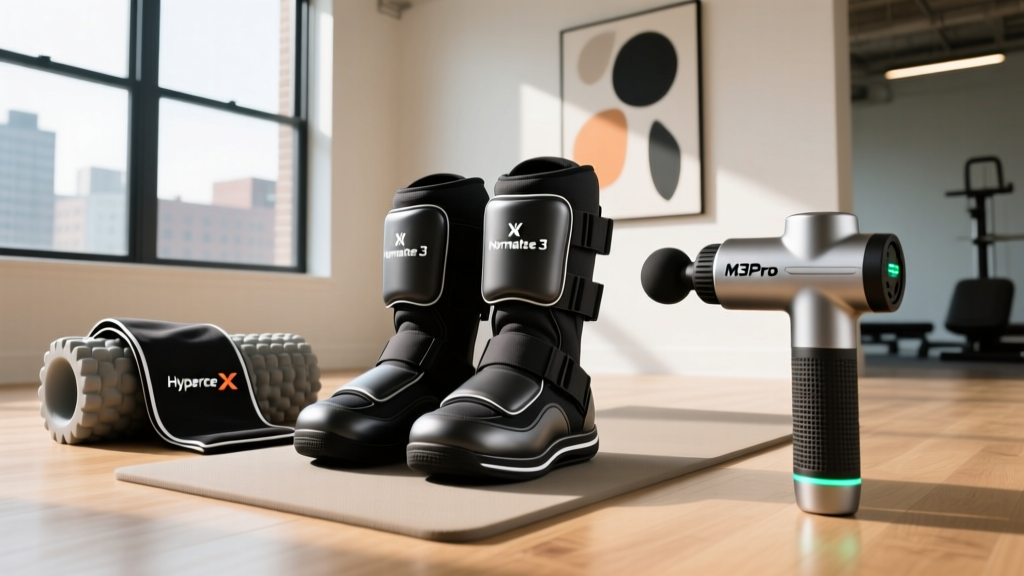
Normatec 3 vs Hyperice X & M3 Pro Massage Gun Stack

Smart Stretching Tech: Download Recovery Tool for Windows 10?

Heat Wraps vs Massage Gun for Tight Hamstrings: 2026 Guide

Who Invented the Massage Gun? And Why Stretching Tools Are Better

Flexibility Station Setup: Stretching Gear & Massage Gun Description
