
Marcy Home Gym MWM-990 & Weight Selection: How Much Do You Need?
Discover how much weight you need for your home gym. We analyze the Marcy Home Gym MWM-990 footprint, pulley ratios, and space-saving layout strategies.

Designing a home gym in a spare bedroom, basement corner, or compact garage requires solving a complex spatial puzzle: how do you accommodate progressive overload without sacrificing your entire floor plan? When researching a home gym weight selection guide how much weight you need, most advice defaults to calculating Olympic plate requirements. However, from a space optimization and layout design perspective, free weights are incredibly inefficient. They demand massive lateral clearance and dedicated storage zones.
This is where all-in-one selectorized machines become the ultimate spatial hack. In this guide, we are using the Marcy Home Gym MWM-990—a cornerstone compact fitness station featuring a 150-pound weight stack—as our baseline case study. We will break down exactly how much resistance you actually need, the hidden physics of cable pulley ratios, and how to map this specific machine into a high-traffic room without creating a claustrophobic bottleneck.
The Spatial Economics of Resistance: Vertical Stacks vs. Horizontal Plates
To understand weight selection in small spaces, you must shift your thinking from the X-Y axis (floor space) to the Z-axis (vertical space). Free weights consume horizontal real estate. A standard 7-foot Olympic barbell requires 84 inches of lateral clearance, plus an additional 24 inches on each side for loading plates. That is a minimum 132-inch (11-foot) wide operational zone, not including the footprint of the power rack itself.
Conversely, the Marcy Home Gym MWM-990 utilizes a vertical weight stack. Its dimensions are approximately 68 inches long by 42 inches wide by 79 inches high. This yields a physical footprint of just 19.8 square feet. By stacking 150 pounds of resistance vertically, you completely eliminate the need for plate trees, barbell racks, and wide loading zones.
| Setup Type | Equipment Footprint | Required Operational Clearance | Total Spatial Demand | Max Weight Capacity |
|---|---|---|---|---|
| Standard Power Rack + Barbell | 16 sq ft (48' x 48') | ~65 sq ft (11ft width for bar clearance) | ~81 sq ft | 500+ lbs (Limited by plates owned) |
| Marcy MWM-990 Selectorized | 19.8 sq ft (68' x 42') | ~15 sq ft (User movement & lat pull) | ~35 sq ft | 150 lbs (Fixed Stack) |
Calculating Your Load: The 150-Pound Threshold
How much weight do you actually need? According to American Council on Exercise (ACE) guidelines, your required load depends entirely on your training age and goals. For muscular endurance, lighter loads (50-70% of your 1-rep max) are sufficient. For hypertrophy (muscle growth), you need moderate to heavy loads that induce fatigue within 8-12 repetitions.
For the vast majority of home gym users focusing on upper body isolation (bicep curls, tricep pushdowns, lateral raises) and moderate compound movements, a 150-pound ceiling is highly adequate. The Mayo Clinic's strength training recommendations emphasize that consistency and progressive tension matter far more than absolute maximum load for general health and body composition.
Expert Insight: If your primary goal is powerlifting (e.g., achieving a 400-lb deadlift or 300-lb bench press), a 150-lb fixed stack will bottleneck your progress within six months. However, if your goal is general fitness, hypertrophy, and circuit training within a 40-square-foot footprint, 150 lbs is the sweet spot for spatial efficiency.
The Pulley Ratio Trap: Why 150 lbs Isn't Always 150 lbs
This is the most critical failure point for buyers researching weight stacks. You must account for mechanical advantage. Many all-in-one home gyms, including various configurations of cable towers, utilize a 2:1 pulley ratio on their high and low pulleys to ensure smooth cable travel and reduce the physical height of the machine.
In a 2:1 system, the cable travels twice the distance of the weight stack, which halves the resistance felt at the handle. Therefore, 150 pounds on the stack yields only 75 pounds of actual resistance at the lat bar. If you weigh 180 pounds and expect to perform heavy, bodyweight-equivalent lat pulldowns, a 150-lb stack with a 2:1 ratio will feel far too light. Always verify the specific pulley ratio of the machine's attachment points when calculating your weight needs.
Designing the Layout: MWM-990 Clearance & Flow
Integrating the Marcy MWM-990 into a room requires strategic placement. You cannot simply shove it into a tight corner and expect full functionality. The machine features dual-function press arms, a leg developer, and a lat tower, each requiring distinct user clearance zones.
Step-by-Step Layout Mapping
- The Anchor Point: Place the 79-inch high lat tower facing the center of the room, not a wall. You need at least 36 inches of clearance behind the seat for wide-grip lat pulldowns and seated rows.
- The Press Zone: The dual-function press arms extend forward. Ensure a minimum of 48 inches of clear space in front of the machine so the user can mount, dismount, and perform seated chest presses without hitting a wall or adjacent furniture.
- The Leg Developer Arc: The leg developer requires a swinging arc. Position the machine so the front rollers have a 30-inch unobstructed radius to prevent kicking over dumbbell racks or mirrors.
- Ventilation & Lighting: Selectorized towers block airflow. Do not place the MWM-990 directly in front of your primary floor fan or AC vent. Position it perpendicular to windows to utilize natural light without creating screen glare on any mounted fitness trackers.
Outgrowing the Stack: Space-Saving Supplemental Weight
What happens when your leg press or chest press strength surpasses the 150-pound limit of the MWM-990? You do not need to abandon your space-optimized layout and buy a power rack. Instead, integrate micro-expansions that respect your spatial boundaries.
- Adjustable Dumbbells: Adding a pair of Nuobell or Bowflex SelectTech 552 dumbbells provides 5 to 52.5 pounds per hand. Stored on a 2-square-foot bench, this allows you to perform heavy goblet squats, Romanian deadlifts, and flat bench presses that exceed the machine's cable limits.
- Resistance Band Integration: You can loop heavy-duty loop bands (e.g., Rogue Fitness Monster bands) around the base of the MWM-990 and the press arms to add 40-80 pounds of variable accommodating resistance at the peak of the contraction, effectively simulating a 200+ pound stack without adding physical mass to the room.
- Kettlebell Supersets: Keep a single heavy kettlebell (e.g., 53 lbs or 70 lbs) in the corner. Use it to superset with the cable stack for high-fatigue compound movements like Bulgarian split squats.
Final Verdict: Is the Fixed Stack Right for Your Layout?
Choosing the right weight for your home gym is ultimately an exercise in compromise between your physiological ceiling and your architectural reality. The Marcy Home Gym MWM-990 represents a masterclass in spatial density, condensing an intermediate lifter's entire upper-body and accessory repertoire into a footprint smaller than a standard dining table.
Pros for Space Optimization
- Eliminates the 11-foot lateral clearance required by Olympic barbells.
- Zero plate storage required; keeps floors clear and reduces tripping hazards.
- Quick-drop weight selection enables high-density circuit training in tight zones.
Cons & Edge Cases
- Pulley ratios may halve the effective resistance on cable attachments, limiting advanced back development.
- Fixed 150-lb ceiling will stall lower-body compound progress (squats/deadlifts) within the first year for intermediate lifters.
- Heavy steel frame requires placement on a high-density rubber mat (3/8-inch minimum) to protect subfloors from point-load damage.
By understanding the true spatial cost of resistance, you can confidently select a weight system that builds your physique without dismantling your living space.
More gear to consider
All reviews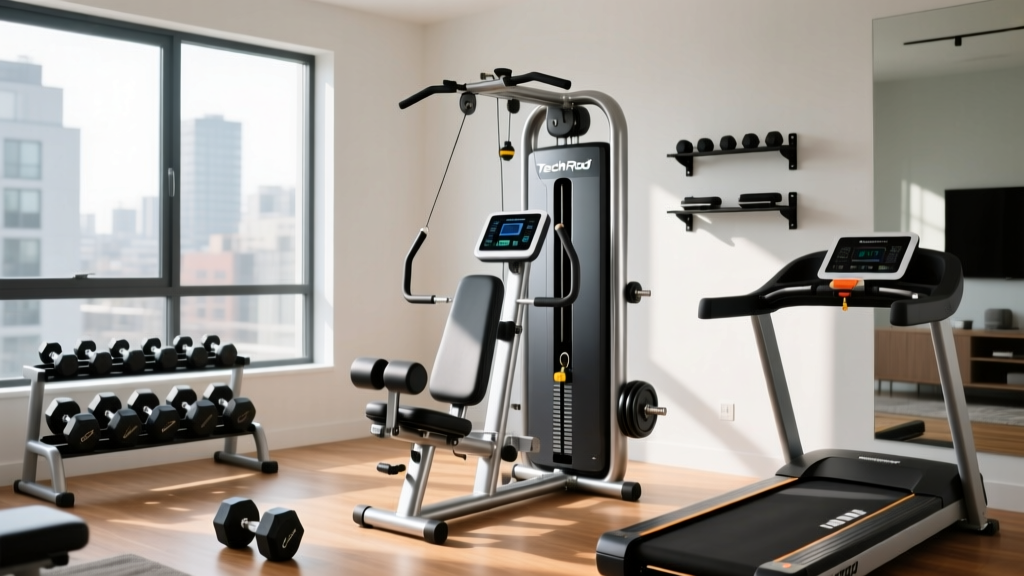
2026 Electrical & Safety Guide for Your TechRod Home Gym

Home Gym Ideas Small Space: Garage Flooring & Ventilation Errors

Beginner Starter Kit: Space Layouts For Home Gym Leg Exercises

Smart Gifts for Home Gym: Mirror & Lighting Budget Guide

Troubleshooting Your Home Gym Weider Pro 9940 in a Rental Apartment
