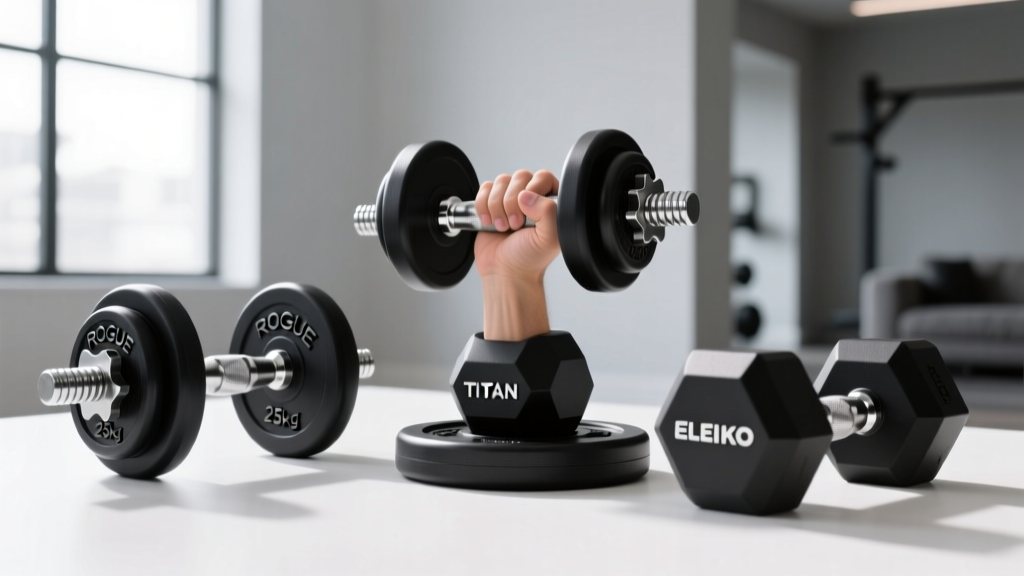
Best Loadable Dumbbells for Front Delt Raises (2026)
Expert hands-on review of the best loadable dumbbells for front delt raises. Compare Rogue, Titan, and Eleiko handles for micro-loading and grip.

When isolating small, stubborn muscle groups like the anterior deltoids, the equipment you use dictates the quality of your hypertrophy stimulus. Fixed hex dumbbells force you into arbitrary 5-pound weight jumps—a massive 20% to 30% increase when you are lifting 15 to 25 pounds. This is where a front delt raises dumbbell setup utilizing loadable handles with interchangeable plates becomes a non-negotiable tool for serious lifters. By sliding on fractional plates and precise iron increments, you unlock true progressive overload without compromising your form.
As a senior equipment tester for FitGearPulse, I have spent the last six months evaluating Olympic loadable dumbbell handles specifically for high-rep, strict isolation work. In this 2026 hands-on review, we break down the exact handle geometries, knurl patterns, and sleeve lengths that make or break your anterior deltoid training.
The Biomechanics of the Front Delt Raises Dumbbell Selection
According to biomechanical analyses of shoulder flexion, the anterior deltoid acts as the primary mover when the arm is raised in the scapular plane. Because the moment arm is exceptionally long at the top of the movement, the mechanical tension on the muscle is immense, even with relatively light loads. As noted by ExRx.net, strict execution requires minimizing momentum and scapular elevation.
However, most lifters fail to realize that handle diameter is the hidden variable in dumbbell isolation. If your loadable handle is too thick (e.g., 32mm or higher), your forearm flexors will fatigue before your anterior deltoids do. Your grip becomes the limiting factor, effectively turning a shoulder exercise into a grip-endurance test. Furthermore, the sleeve length dictates how many plates you can load. If you are using standard 45lb iron plates, you will max out the sleeve at around 60-70 lbs per hand. For front raises, this is rarely an issue, but for those who superset front raises with heavy dumbbell floor presses, sleeve real estate matters.
Hands-On Reviews: Top Olympic Loadable Handles
1. Rogue Olympic Loadable Dumbbell (The Gold Standard)
Price: $175.00 per pair | Shaft Diameter: 28.5mm | Sleeve Length: 6.6 inches
The Rogue Loadable Dumbbell remains the benchmark for commercial and elite home gyms. Machined from solid steel, the 28.5mm shaft is the sweet spot for isolation movements. It is thick enough to withstand heavy drops but thin enough to allow a secure, thumb-wrapped grip during a 15-rep set of front raises. The knurling is a medium-depth 'volcano' pattern—aggressive enough to prevent slipping when your hands get sweaty, but it will not tear your calluses during high-volume supersets. The 6.6-inch sleeve easily accommodates up to 45 lbs of standard iron plates per side, or roughly 25 lbs of thicker bumper plates.
2. Titan Fitness Olympic Dumbbell Handle (The Budget Workhorse)
Price: $89.99 per pair | Shaft Diameter: 30mm | Sleeve Length: 7.5 inches
Titan Fitness offers a highly affordable entry into plate-loaded training. The standout feature here is the 7.5-inch sleeve, which offers significantly more real estate for interchangeable plates than the Rogue. However, the 30mm shaft diameter is a distinct disadvantage for a dedicated front delt raises dumbbell routine. During our testing, lifters with smaller hands experienced premature grip failure around rep 12 on strict, non-momentum raises. If you have large hands or primarily use these for heavy pressing and rows, the Titan is an incredible value. For pure isolation, you may need to invest in lifting straps or grip trainers to compensate.
3. Eleiko Olympic Dumbbell Handle (The Premium Competition Choice)
Price: $265.00 per pair | Shaft Diameter: 28mm | Sleeve Length: 6.1 inches
Eleiko’s engineering is legendary, and their loadable handle is a masterpiece of tactile feedback. The 28mm shaft features a proprietary diamond knurl that provides unparalleled grip security without the abrasiveness of cheaper carbon steel. When executing slow, eccentric-focused front raises (e.g., a 3-second negative), the Eleiko handle feels like an extension of your arm. The trade-off is the shorter 6.1-inch sleeve, which limits maximum loading capacity to about 35 lbs of plates per side. Given that anterior delts rarely require loads exceeding 50 lbs total, this is a minor compromise for the premium feel.
Specification Comparison Matrix
| Brand & Model | Price (Pair) | Shaft Diameter | Sleeve Length | Knurl Type | Best For |
|---|---|---|---|---|---|
| Rogue Olympic Loadable | $175.00 | 28.5mm | 6.6' | Medium Volcano | Overall Best / Hypertrophy |
| Titan Fitness Olympic | $89.99 | 30.0mm | 7.5' | Shallow Mountain | Budget / Heavy Compound |
| Eleiko Olympic Handle | $265.00 | 28.0mm | 6.1' | Fine Diamond | Premium Feel / Strict Form |
The Micro-Loading Framework for Anterior Delts
Progressive overload is the primary driver of muscle hypertrophy, as extensively documented in Schoenfeld's foundational research on muscle growth mechanisms. But how do you progressively overload a muscle that maxes out at 25 lbs per hand?
The answer lies in fractional interchangeable plates. To build the ultimate loadable setup, you must pair your handles with 0.25kg (0.55lb) and 0.5kg (1.1lb) change plates.
Expert Tip: The 2.5% RuleFor small isolation muscles like the lateral and anterior deltoids, aim to increase the load by no more than 2.5% to 5% per week. If you are raising 20 lbs, adding a single 0.5lb plate to each side represents a 5% increase. Attempting to jump from 20 lbs to 25 lbs (a 25% increase) using standard fixed dumbbells will inevitably lead to form breakdown, excessive trap recruitment, and anterior shoulder impingement.
Common Failure Modes and Edge Cases
When building a front delt raises dumbbell system with interchangeable plates, users frequently encounter three specific equipment failure modes:
- Collar Slippage on Eccentrics: If you use cheap spring collars, the plates will shift during the eccentric (lowering) phase of the raise. This shifts the center of gravity, causing the dumbbell to twist in your hand. Solution: Always use machined aluminum lock-jaw collars or heavy-duty spin-lock collars to secure the plates flush against the sleeve.
- Sleeve Bottoming Out with Bumpers: Standard 10lb bumper plates are incredibly thick. If you try to load 30 lbs using only 10lb bumpers, you will run out of sleeve space before you reach your target weight. Solution: Use calibrated steel competition plates or thin urethane grip plates for isolation movements to maximize sleeve density.
- Asymmetrical Loading Errors: Unlike fixed dumbbells, loadable handles require you to manually match the weight on both sides. A 1lb discrepancy between the left and right hand can cause spinal rotation and uneven scapular elevation over a 4-set workout. Solution: Invest in a digital luggage scale or a dedicated dumbbell scale to verify symmetry before starting your working sets.
Step-by-Step: Executing the Perfect Loadable Raise
Once you have selected your handle and loaded your fractional plates, follow this execution protocol to maximize anterior deltoid recruitment while minimizing bicep tendon interference:
- The Grip: Use a neutral or slightly pronated grip. Wrap your thumb securely around the 28mm or 28.5mm shaft. Do not use a 'thumbless' suicide grip on loadable dumbbells, as the plates can shift if the collar fails.
- The Stance: Stand with feet shoulder-width apart, slight bend in the knees. Engage the glutes and brace the core to prevent lumbar hyperextension.
- The Path: Raise the dumbbells in the scapular plane (about 30 degrees forward of your torso), not directly out to the sides or strictly in front of your belly button. This aligns with the natural fiber orientation of the anterior deltoid.
- The Apex: Stop when the dumbbell reaches eye level. Raising higher shifts the load entirely onto the upper trapezius.
Frequently Asked Questions
Can I use standard 1-inch plates on these Olympic handles?
No. All the handles reviewed above feature 50mm (2-inch) Olympic sleeves. You must use Olympic interchangeable plates with 2-inch center holes. Attempting to use standard plates will result in an unstable, dangerous fit.
Are loadable dumbbells better than adjustable selectorized dumbbells (like Nuobell or PowerBlock)?
For heavy compound movements, selectorized dumbbells offer faster weight changes. However, for a dedicated front delt raises dumbbell routine, loadable handles are superior because they allow for micro-loading via fractional plates, which selectorized dumbbells typically lack. Furthermore, loadable handles offer a more natural center of gravity compared to the blocky profile of PowerBlocks.
How do I maintain the knurling on my loadable handles?
Chalk and sweat will accumulate in the knurl valleys, leading to rust and degraded grip. Once a month, scrub the shaft with a stiff nylon brush and apply a light coat of 3-in-One oil or mineral oil to protect the carbon steel or chrome finish.
For more detailed specifications on the equipment tested in this review, you can visit the Rogue Fitness official product page.
More gear to consider
All reviews
Gear Care: Cast Iron vs Competition & Beginner Dumbbell Arm Workout

Top Adjustable Floor Press Dumbbells: 2026 Buying Guide

Barbell Collar Types Compared: Moving Beyond 70 lbs Dumbbells
Beyond Back and Bicep Exercises with Dumbbells: Barbell Collar Guide

Optimizing Rows with Dumbbells: Rubber Hex vs Urethane Value
