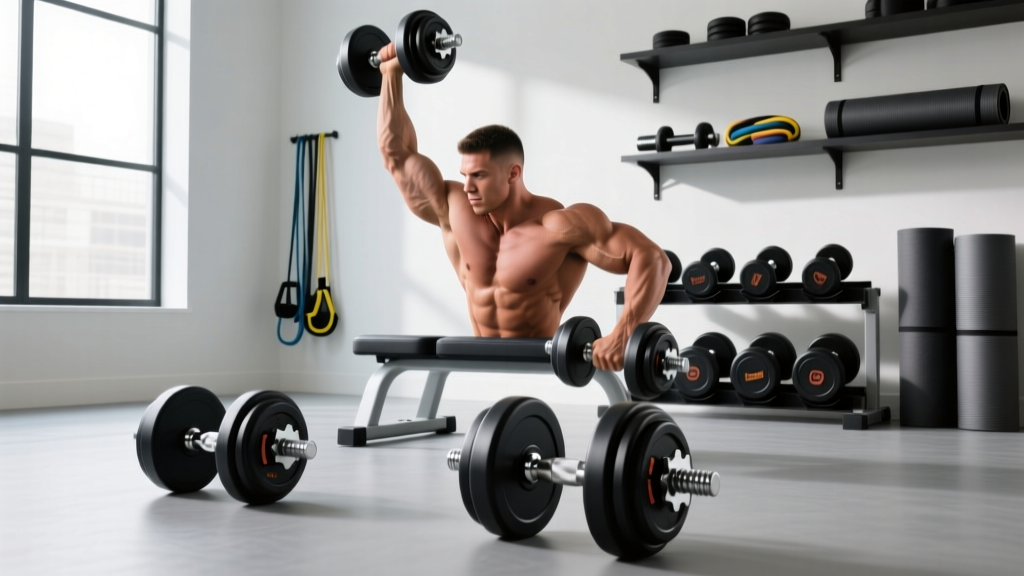
Compact Gym Layouts: Loadable Dumbbells for Arnold Dumbbell Curls
Optimize your compact home gym layout using loadable dumbbells with interchangeable plates without sacrificing form on Arnold dumbbell curls.

The Spatial Paradox: Heavy Loads vs. Rotational Clearance
Designing a high-density home gym in 2026 requires balancing maximum weight capacity with strict spatial limitations. For lifters prioritizing space optimization, loadable dumbbells with interchangeable plates are the undisputed champions of footprint reduction. A standard 50-pound fixed dumbbell set requires upwards of 12 square feet of rack space, whereas a loadable system condenses that same resistance into a 2.5-square-foot tray. However, this massive gain in floor space introduces a distinct biomechanical challenge when performing complex, multi-planar isolation movements.
The most prominent casualty in compact gym setups is the execution of Arnold dumbbell curls. This exercise, popularized by Arnold Schwarzenegger, demands a simultaneous supination and flexion of the wrist and elbow. According to ExRx.net's biomechanical breakdown, the movement requires starting with a pronated or semi-pronated grip (palms facing the body) before rotating the wrists outward as the weight ascends. If your loadable dumbbell features a bulky, protruding plate profile, the physical dimensions of the equipment will violently collide with your thighs at the bottom of the movement or your forearms at the top, entirely ruining the range of motion.
This guide explores how to select, arrange, and optimize loadable dumbbell systems specifically to preserve the ergonomic integrity of rotational exercises like Arnold dumbbell curls, all while maintaining a hyper-efficient gym layout.
Loadable Dumbbell Profiles: Which Models Clear the Shoulders?
Not all interchangeable plate systems are created equal. The spatial geometry of the dumbbell ends dictates whether you can perform an Arnold curl without bruising your wrists. Below is a comparison of the most popular loadable and adjustable systems on the market, evaluated specifically for rotational clearance and space efficiency.
| Model / System | Load Mechanism | Max Length (at 50 lbs) | End Profile Geometry | Arnold Curl Clearance | Approx. Cost (50lb Set) |
|---|---|---|---|---|---|
| Ironmaster Quick-Lock V2 | Screw-Lock | 14.5 inches | Square / Flat Edges | Moderate (Corners can catch on thighs) | $899 |
| Nuobell 80 | Dial / Interchangeable | 15.5 inches | Cylindrical / Smooth | Excellent (Mimics fixed urethane DBs) | $459 |
| Titan Fitness Loadable | Spring Clip / Collar | 15.0+ inches | Round / Protruding Plates | Poor (Plates hit thighs during pronation) | $250 (Handles + Plates) |
| PowerBlock Elite USA | Pin / Caged | 12.0 inches | Rectangular Cage | Poor (Cage walls block supination arc) | $419 |
For lifters strictly focused on the Arnold dumbbell curl, the Nuobell system offers the most anatomically accurate profile. Despite being slightly longer, its smooth, cylindrical sleeve allows the weight to glide past the thighs and forearms during the rotational phase. Conversely, traditional plate-loaded handles like the Titan Fitness model require wide outer collars that physically prevent the hands from starting in the required pronated position against the thighs.
The Biomechanical Constraint of the Supination Arc
During the concentric phase of the Arnold curl, the biceps brachii acts as both a flexor and a powerful supinator. The American Council on Exercise (ACE) notes that maximizing the supination arc is critical for full motor unit recruitment in the biceps. If a loadable dumbbell's interchangeable plates add even 2 inches of lateral width to the handle, the lifter is forced to abduct their shoulders unnaturally just to avoid the equipment hitting their torso. This shifts the tension away from the biceps and places undue stress on the medial deltoid and rotator cuff.
Space-to-Ergonomics Ratio (SER): When calculating your gym layout, do not just measure the storage footprint of the dumbbell tray. You must calculate the dynamic spatial envelope—the 3D space your body and the equipment occupy during the most extreme points of the exercise's range of motion. A loadable dumbbell might save 10 square feet on the floor, but if it forces you to widen your bench stance by 6 inches, you lose that spatial advantage in your lateral clearance.Designing the 50-Square-Foot Dumbbell Zone
To properly integrate loadable dumbbells into a compact layout while accommodating rotational movements, you must design a dedicated "Dumbbell Drop Zone." This zone encompasses your adjustable FID (Flat/Incline/Decline) bench, the interchangeable plate storage tray, and the necessary clearance arcs.
Step-by-Step Layout Optimization
- Bench Placement (The 36-Inch Rule): Never place your FID bench flush against a wall or power rack upright. For heavy Arnold dumbbell curls (40+ lbs per hand), you must perform a "kick-up" to get the weights into position, and a controlled drop at the end of the set. You need a minimum of 36 inches of lateral clearance on both sides of the bench to allow the elbows to track backward and the dumbbells to drop safely without striking a wall or plate tree.
- Tray Positioning: Store the loadable dumbbell tray perpendicular to the head of the bench, exactly 18 inches away. This allows you to reach forward, grip the handles, and row them to your knees without twisting your lumbar spine. For systems with loose interchangeable plates (like Ironmaster), use a tiered wall-mounted rack directly above the tray to keep fractional plates (1.25 lb and 2.5 lb) off the floor.
- Mirror Alignment: Mount a frameless gym mirror on the wall directly in front of the bench. Because the Arnold curl requires precise visual feedback to ensure simultaneous supination and flexion, visual alignment is non-negotiable. Ensure the mirror starts at 12 inches off the floor to capture the bottom of the curl arc.
Real-World Failure Modes in Compact Gym Setups
When merging heavy loadable plates with high-density layouts, several specific failure modes frequently occur. Anticipating these will save your equipment and your joints.
- Knurling Tearing Upholstery: Loadable dumbbell handles feature aggressive knurling to secure grip during heavy presses. When performing drop sets of Arnold curls, lifters often rest the knurled handles directly on the bench pad while changing plates. Over time, this shreds the vinyl upholstery. Solution: Place a 3mm rubber horse-stall mat under the bench tray zone to rest the dumbbells on between sets.
- Plate Rattle During Rotation: The Arnold curl involves a rapid wrist snap at the top of the movement. On spring-clip loadable dumbbells (e.g., Titan Fitness), this rotational torque causes the interchangeable plates to shift and rattle, distracting from the mind-muscle connection and potentially loosening the collar. Solution: Use screw-down collars or dial-based systems that lock the plates into a unified solid mass.
- Floor Loading and Vibration: Dropping 100 lbs of combined loadable dumbbells (50 lbs per hand) onto a second-floor home gym can cause structural vibration and damage the interlocking foam tiles often used in compact spaces. Solution: Build a dedicated 4x6 foot drop pad using 3/4-inch vulcanized rubber flooring, specifically positioned under the bench drop zone.
Advanced Storage: Vertical vs. Horizontal Plate Trees
The primary advantage of interchangeable plates is the ability to scale weight from 5 lbs to 120+ lbs using a fraction of the space. However, how you store the loose plates dictates the flow of your workout. In a space-optimized layout, floor-standing plate trees are a tripping hazard that infringes on the 36-inch lateral clearance required for the Arnold curl.
"The most efficient compact gyms treat floor space as sacred. If a storage solution does not serve a dual purpose or mount to a structural wall, it is actively degrading your training environment." — BarBend's Home Gym Design Guidelines
Instead of a floor tree, install a wall-mounted pegboard or slatwall system directly behind the dumbbell tray. Use 2-inch steel pegs to hang the interchangeable plates by their center holes. This keeps the plates at eye level, allows for rapid weight changes between drop sets of curls, and completely eliminates the tripping hazard, preserving the spatial envelope needed for unrestricted rotational movements.
FAQ: Loadable Dumbbells and Space Constraints
Can I perform Arnold curls with standard Olympic loadable dumbbell handles?
Technically yes, but it is highly discouraged. Standard Olympic loadable handles use 2-inch diameter sleeves and require thick collars. The sheer width of the setup (often exceeding 18 inches total length) makes it physically impossible to start the curl with the dumbbells resting against your thighs in a pronated grip without your hands hitting your legs.
How much weight do I need for Arnold curls compared to standard curls?
Due to the mechanical disadvantage of starting in a pronated position and the extended time-under-tension caused by the rotational arc, most lifters will use 20% to 30% less weight on Arnold dumbbell curls compared to standard supinated bicep curls. This makes loadable dumbbells in the 5-50 lb range perfectly adequate for advanced lifters, further saving space by eliminating the need for 60+ lb interchangeable plates.
What is the best bench angle for Arnold curls in a tight space?
While Arnold curls are typically performed seated flat (0 degrees) or standing, setting an FID bench to a 15-degree incline can help isolate the biceps by preventing torso sway. In a compact layout, ensure the bench's adjustment ladder does not protrude into your lateral drop zone when set to this micro-incline.
More gear to consider
All reviews
Power Rack vs Squat Rack vs Squat Stand: Setup & Standing Marches with Dumbbells

Bumper vs Iron Plates & Woodchop Exercise Dumbbell Gym Layouts
Olympic Barbell Buying Guide: Knurling & Dumbbell Pullover Exercise

Best Racks for 200 lbs Dumbbells: 2026 Heavy-Duty Storage Guide

The Long Dumbbell Name Guide: EZ Curl vs Straight Bar Layouts
