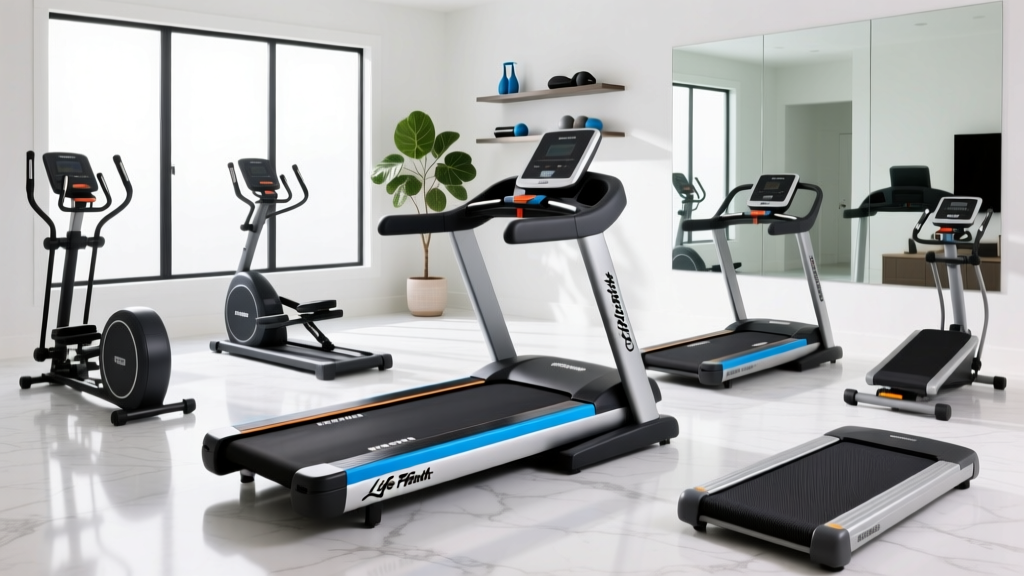
Life Fitness Club Series+ Treadmill vs Folding Small Space Models
We analyze the Life Fitness Club Series+ Treadmill against top 2026 folding models to find the best small-space cardio solution for compact home gyms.

The 2026 Compact Cardio Conundrum: Performance vs. Square Footage
As urban living spaces continue to shrink and multi-purpose rooms become the standard in 2026, the home fitness market has seen a massive pivot toward 'compact cardio.' Consumers are no longer dedicating entire spare bedrooms to their workouts; they are integrating equipment into living rooms, home offices, and studio apartments. This spatial constraint has triggered a surge in demand for folding treadmills. However, this trend forces a critical question for serious runners: does folding convenience compromise mechanical integrity and running biomechanics?
To answer this, we must establish a performance benchmark. In the light-commercial and premium home market, the Life Fitness Club Series+ Treadmill remains the gold standard for biomechanical accuracy, deck shock absorption, and motor longevity. But it does not fold. In this market analysis and small-space review, we will dissect the spatial economics of the Life Fitness Club Series+ Treadmill and compare it directly against the top-performing folding treadmills of 2026 to help you make an evidence-based purchasing decision.
Analyst Insight: The 'Permanent Footprint' Reality
Many buyers assume a folding treadmill solves all spatial issues. However, according to ASTM International safety standards for motorized treadmills, you must maintain a minimum of 30 inches (76 cm) of clear space behind the machine to prevent severe injury in the event of a fall. Therefore, a folding treadmill only saves space when stored, not when operated. If your room cannot accommodate the operational length plus 30 inches of rear clearance, no treadmill is safe for that space.
The Benchmark: Life Fitness Club Series+ Treadmill Profile
Before evaluating folding alternatives, we must understand what performance metrics we are sacrificing when we choose a compact, folding model. The Life Fitness Club Series+ Treadmill is engineered for the home user who demands commercial-gym biomechanics without the massive footprint of a full commercial club treadmill (like the Integrity or Elevation series).
Specifications & Spatial Requirements
- Dimensions (Unfolded): 81" L x 34" W x 58" H
- Folding Capability: None (Solid welded steel frame)
- Motor: 3.0 HP Continuous Duty AC Motor
- Belt Size: 20" x 60" (Accommodates runners up to 6'4" comfortably)
- Weight Capacity: 350 lbs
- Current Market Price: $3,899 - $4,299 (depending on Track Connect console integration)
The primary advantage of the Club Series+ in this context is its FlexDeck Shock Absorption System, which reduces joint stress by up to 30% compared to outdoor running. Because the frame does not fold, the running deck is a single, continuous piece of phenolic-coated wood, completely eliminating the 'hinge flex' or micro-stutters that runners often feel on folding models when their foot strikes the center of the belt. According to Life Fitness engineering data, the solid frame also prevents the lateral belt drift that plagues cheaper folding treadmills over time.
Top Folding Treadmills for Small Spaces (2026 Market Review)
If your living situation strictly requires a machine that can be tucked away to reclaim 18 to 22 square feet of floor space after your workout, the Club Series+ is not viable. Here are the top three folding treadmills that offer the best compromise between spatial efficiency and mechanical reliability in 2026.
1. Sole Fitness F63: The Heavy-Duty Folder
The Sole F63 remains a dominant force in the folding category. While it requires a larger footprint than ultra-compact walking pads, its 3.0 HP motor and 20" x 60" belt closely mimic the performance of the Club Series+.
- Unfolded: 78" L x 35" W
- Folded Depth: 43" L (Saves 35 inches of length)
- Price: ~$1,199
- Trade-off: The hydraulic lift cylinder is robust, but the machine weighs 260 lbs, making the actual act of folding and unfolding physically demanding for some users.
2. Horizon Fitness T202: The Agile Mid-Range
Horizon's T202 utilizes a unique featherlight folding mechanism that makes storing the deck significantly easier than the Sole F63. It features a slightly shorter belt, making it ideal for walkers and joggers under 6'0".
- Unfolded: 76" L x 34" W
- Folded Depth: 42" L
- Price: ~$999
- Trade-off: The 2.75 HP motor runs hotter during sustained 10% incline intervals compared to the AC motor found in the Life Fitness Club Series+ Treadmill.
3. ProForm Carbon TLX: The Ultra-Compact Pivot
For severe spatial constraints, ProForm's Carbon TLX folds entirely flat and can be rolled into a closet or under a bed. It sacrifices belt width and motor mass for ultimate concealment.
- Unfolded: 70" L x 30" W
- Folded Depth: 10" H (Folds flat, not upright)
- Price: ~$699
- Trade-off: The 2.5 HP motor and 18" x 55" belt restrict this machine strictly to walking and light jogging. It cannot sustain an 8-minute mile pace without motor overheating.
Spatial Economics & Performance Matrix
The following data table synthesizes the operational and stored footprints against critical performance metrics, illustrating the exact trade-offs you make when prioritizing small-space storage.
| Model | Operational Footprint | Stored Footprint (L x W) | Motor (CHP) | Deck Continuity |
|---|---|---|---|---|
| Life Fitness Club Series+ | 81" x 34" | N/A (Does not fold) | 3.0 HP AC | Solid 1-Piece |
| Sole F63 | 78" x 35" | 43" x 35" | 3.0 HP DC | Hinged |
| Horizon T202 | 76" x 34" | 42" x 34" | 2.75 HP DC | Hinged |
| ProForm Carbon TLX | 70" x 30" | 70" x 30" (Flat) | 2.5 HP DC | Hinged |
Mechanical Failure Modes: The Hidden Cost of Hinges
When conducting a long-term market analysis of cardio equipment, independent treadmill testing consistently highlights specific failure modes inherent to folding designs that solid-frame machines like the Life Fitness Club Series+ Treadmill completely avoid.
1. Hydraulic Cylinder Degradation
Folding treadmills rely on hydraulic shock cylinders to safely lower the heavy running deck. Over a 3-to-5-year lifespan, the internal seals in these cylinders frequently degrade, leading to compressed air or fluid leaks. When this happens, the deck loses its resistance and can slam down onto the frame, posing a severe crush hazard to children or pets. Solid-frame treadmills eliminate this liability entirely.
2. Deck Flex and Hinge Squeaking
The folding joint on a treadmill deck is a structural weak point. As the user's foot strikes the belt directly over the hinge, the deck experiences micro-flexing. Over thousands of miles, this flexing causes the hinge bolts to loosen, resulting in rhythmic squeaking and a subtle 'bump' in the running surface that can alter a runner's gait and lead to IT band or knee irritation. The Club Series+ utilizes a solid, continuous deck bolted directly to a welded steel frame, ensuring a perfectly flat strike zone for the lifespan of the machine.
3. Lateral Belt Drift
Because the front and rear rollers on a folding treadmill are mounted to separate, hinged sections of the frame, the tension and parallel alignment of the rollers can shift slightly every time the machine is folded and unfolded. This misalignment is the primary cause of lateral belt drift, requiring frequent manual tensioning and lubrication.
"If your primary goal is marathon training or high-volume interval running, the biomechanical consistency of a solid-frame machine is non-negotiable. Folding treadmills are engineered for spatial convenience, not repetitive high-impact endurance work."
The 2026 Buyer's Decision Framework
Choosing between the Life Fitness Club Series+ Treadmill and a folding small-space model ultimately comes down to a strict audit of your room dimensions, your budget, and your biomechanical needs.
Choose the Life Fitness Club Series+ Treadmill If:
- You have a dedicated space that can permanently house an 81" x 34" machine, plus 30" of rear clearance.
- You are a serious runner (sub-9-minute mile pace) who requires a 60-inch belt length and commercial-grade shock absorption.
- You want a 'buy it for life' appliance with zero hydraulic hinges or folding joints to maintain.
- Your budget accommodates the $3,900+ premium price tag.
Choose a Folding Model (Sole F63 / Horizon T202) If:
- Your workout space doubles as a living room, bedroom, or home office, and you must reclaim at least 15 square feet of floor space daily.
- Your primary cardio consists of walking, incline hiking, or light jogging (under 6 mph).
- You are working within a strict budget of $1,000 to $1,500.
- You are physically capable of safely lifting and lowering a 200+ lb folding deck, or you are willing to pay extra for motorized folding features.
Final Verdict
The 2026 market offers incredible advancements in compact cardio, but physics and engineering remain bound by strict limitations. The Life Fitness Club Series+ Treadmill is undeniably superior in performance, longevity, and safety due to its rigid, non-folding architecture. However, its spatial demands make it entirely unsuitable for true 'small space' living. If spatial reclamation is your primary constraint, the Sole F63 offers the most reliable mechanical bridge between the performance of a solid-frame machine and the convenience of a folding design. Measure your space, account for the 30-inch safety zone, and buy accordingly.
More gear to consider
All reviews
Reebok Treadmill Belt Maintenance: Optimizing Room Layout
Air Bike vs Assault Bike: Treadmill Mileage Calculator Conversions

Evaluating a Planet Fitness Treadmill for Sale: Motor Guide

Elliptical vs Treadmill: Space Layouts & Solo F80 Treadmill Fit

Treadmill vs Elliptical vs Bike vs Stair Climber: Home Guide
