Cast Iron vs Competition Kettlebells + Adding Resistance Bands to Dumbbells
Expert guide comparing cast iron vs competition kettlebells, plus a masterclass on adding resistance bands to dumbbells for accommodating strength gains.

The Great Kettlebell Debate: Cast Iron vs. Competition
When outfitting a home gym or upgrading a commercial facility in 2026, the choice between cast iron and competition kettlebells remains one of the most hotly debated topics in the strength community. While both tools serve the fundamental purpose of offsetting mass for ballistic and grind movements, their geometries, handle specifications, and intended use cases diverge significantly. According to Kettlebell Kings, understanding these nuances is critical for matching the implement to your specific training modality and avoiding costly purchasing mistakes.
Cast Iron Kettlebells: The Traditionalist’s Choice
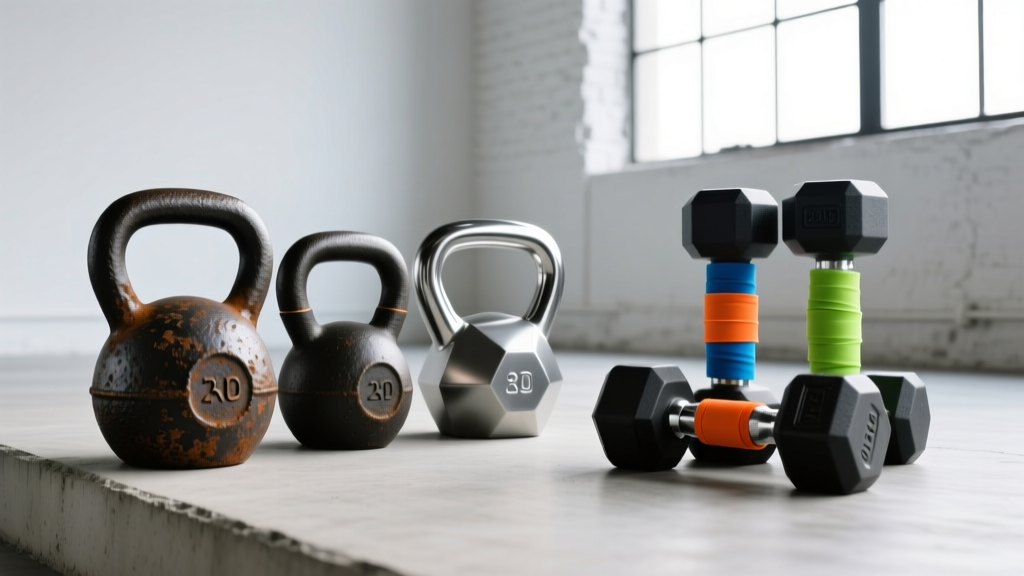
Cast iron kettlebells, such as the Rogue Cast Iron series or CAP Barbell’s standard lineup, are forged from a single piece of cast iron (or feature a welded handle on cheaper models) and typically finished with a powder coat or e-coat. Their defining characteristic is their variable geometry: as the weight increases, the physical size of the bell, the diameter of the handle, and the width of the base all scale up proportionally.
- Handle Diameter: Typically ranges from 30mm (for lighter women’s bells) to 35mm or even 38mm on heavy male-centric models (24kg+). This thicker grip is excellent for building forearm endurance and crushing-grip strength but can cause hand tearing during high-rep snatches.
- Base Dimensions: Heavier cast iron bells have wider, flatter bottoms, making them incredibly stable for renegade rows, pull-throughs, and deficit push-ups.
- Pricing: Highly economical, generally ranging from $1.50 to $2.20 per pound, making them the default choice for budget-conscious garage gyms.
Competition Kettlebells: The Technical Lifter’s Edge
Competition kettlebells (like those from Onnit or Kettlebell Kings) are engineered for Girevoy sport and technical consistency. Regardless of whether you are holding an 8kg or a 32kg bell, the physical dimensions remain identical. They feature a steel shell filled with lead or steel shot, and a distinct color-coded band on the handle or body for quick identification.
- Handle Diameter: A strict 33mm across all weights. This thinner, often squarer handle allows the bell to rest securely on the forearm in the rack position without crushing the wrist or causing impingement.
- Handle Window: The space between the handle and the bell’s body is wider and more rectangular, accommodating a two-handed grip more comfortably for swings, yet narrow enough to prevent the bell from slipping off the forearm during cleans.
- Pricing: Premium manufacturing costs push these to $3.00 to $4.50 per pound.
Head-to-Head Comparison Matrix
| Feature | Cast Iron Kettlebells | Competition Kettlebells |
|---|---|---|
| Handle Diameter | Variable (30mm - 38mm) | Uniform (33mm) |
| Bell Dimensions | Scales with weight | Uniform across all weights |
| Base Stability | High on heavier bells, low on light | Moderate (consistent footprint) |
| Price per Pound | $1.50 - $2.20 | $3.00 - $4.50 |
| Best Modality | Hardstyle, Swings, Get-ups | Girevoy Sport, Snatches, Cleans |
Beyond the Bell: Adding Resistance Bands to Dumbbells
While kettlebells provide unparalleled ballistic feedback, a well-rounded free-weight facility requires dumbbells for hypertrophy and isolation. However, standard dumbbells suffer from a fixed resistance curve—the weight remains constant even when your mechanical leverage changes. This is where adding resistance bands to dumbbells becomes a game-changing intervention for intermediate and advanced lifters looking to break through plateaus.
By integrating elastic tension, you create accommodating resistance. A landmark study published in the National Institutes of Health (NIH) demonstrated that combining elastic bands with free weights significantly increases peak power output and force production during the concentric phase of lifts compared to free weights alone. The band provides minimal tension at the weakest point of the range of motion (ROM) and maximal tension at the strongest point (lockout), perfectly mirroring the human strength curve.
How to Rig Your Dumbbells Safely
Improperly rigging bands can lead to catastrophic snapping or joint torque. Follow this step-by-step protocol to safely add resistance bands to dumbbells:
- Select the Right Band: Use 41-inch continuous loop bands. For upper body pressing, a 1/4-inch (15-35 lb tension) or 1/2-inch (25-65 lb tension) band is ideal. For lower body movements like RDLs, step up to a 1-inch band.
- The Anchor Point: Stand on the center of the band with a staggered stance for stability. Ensure the band is under the mid-foot, not the toes, to prevent it from slipping out during the rep.
- The Handle Wrap: Loop the band over the handle of the dumbbell. Never wrap the band around your wrist or fingers. The band must sit securely against the metal knurling or rubber hex-head of the dumbbell to prevent lateral sliding.
- Grip Integration: Grip the dumbbell handle over the band. The friction of your palm and the dumbbell’s knurling will lock the band in place.
Top Exercises for Hybrid Tension
- Banded Dumbbell Bench Press: The band unloads at the chest (where the pecs are most vulnerable to tearing) and overloads the triceps at lockout. This builds explosive pressing power and reinforces elbow stability. Prescription: 3 sets of 10-12 reps with a 2-second eccentric.
- Banded Dumbbell Romanian Deadlift (RDL): Standard DB RDLs often feel too light at the top of the movement. The band adds immense posterior chain tension at full hip extension, maximizing glute and hamstring recruitment without needing 100lb dumbbells. Prescription: 4 sets of 15 reps, pausing at full extension.
- Banded DB Floor Press: Ideal for lockout strength and shoulder health. The floor limits ROM, protecting the rotator cuff, while the band forces aggressive tricep engagement at the top.
Programming Integration: The 2026 Hybrid Framework
To maximize your equipment investment, structure your microcycles to leverage the distinct strengths of both tools. Use competition kettlebells for high-skill, CNS-demanding movements at the start of your session (e.g., 5 sets of 10 heavy snatches). Transition to banded dumbbell work for the hypertrophy block (e.g., 4 sets of 12-15 banded incline presses), utilizing the accommodating resistance to induce metabolic stress and mechanical tension without overloading the joints.
“The smartest home gyms don’t just accumulate weight; they manipulate tension. Pairing the geometric precision of a 33mm competition bell with the variable resistance of banded dumbbells gives you a commercial-grade stimulus in a 50-square-foot footprint.”
Final Verdict & Purchasing Framework
If budget is your primary constraint and your programming centers on heavy swings, get-ups, and presses, purchase a set of cast iron kettlebells (16kg, 24kg, 32kg). Allocate the saved capital toward a high-quality set of hex dumbbells and a 5-band set of 41-inch loop bands.
If you are a technical lifter, a Girevoy athlete, or suffer from wrist impingement during the rack position, the premium for competition kettlebells is non-negotiable. Pair them with banded dumbbell accessory work to ensure your pressing and pulling strength curves remain perfectly developed. By mastering both the art of selecting the right bell and the science of adding resistance bands to dumbbells, you future-proof your strength journey for years to come.
More gear to consider
All reviews
Olympic vs Standard Plates for Lat Exercise Dumbbell Routines

Bumper vs Iron Plates: Care for Glute Bridge with Dumbbells
Upgrading From the Sit Dumbbell Press: Olympic Barbell Knurling Guide

Barbell Buying Guide: Weight, Knurling & Back Exercise with Dumbbells

Olympic Barbell Weight, Knurling & Dumbbell Pec Fly Bench Setup
