
Home Gym Layouts: Kettlebell Guide & Leg Extension with Dumbbells
Maximize your home gym footprint. Compare cast iron vs competition kettlebells and master the leg extension with dumbbells in tight spaces.

The Micro-Gym Paradigm: Merging Ballistics and Isolation
As urban living spaces shrink and commercial gym fatigue remains a lingering reality in 2026, the modern home gym must evolve beyond simply cramming equipment into a spare bedroom. True space optimization requires a deliberate layout design that accommodates vastly different training modalities within a single, compact footprint. Two of the most challenging elements to reconcile are high-velocity ballistic movements and strict, low-velocity isolation work. This guide breaks down the spatial geometry of selecting the right kettlebells for your environment and details an ingenious, zero-footprint hack for performing a leg extension with dumbbells when a dedicated machine is out of the question.
Cast Iron vs. Competition Kettlebells: A Spatial Analysis
When navigating any comprehensive kettlebell buying guide, cast iron vs competition bells present distinct spatial and storage challenges that directly impact your gym's layout. While both serve the same fundamental purpose, their physical dimensions dictate how they interact with your floor plan, racking systems, and swing clearances.
Dimensional Variance and Racking Efficiency
Cast iron kettlebells (such as those from Rep Fitness or Rogue) scale in physical size as the weight increases. A 16kg cast iron bell is significantly smaller than a 32kg bell. While this seems logical, it creates a nightmare for vertical storage. If you use a standard 3-tier vertical rack, the rack must be wide and tall enough to accommodate your largest bell, leaving massive gaps of wasted negative space around the lighter bells.
Competition kettlebells (like those from Kettlebell Kings or Onnit) are manufactured to a strict, uniform dimension regardless of weight: exactly 280mm tall and 210mm wide, with a 35mm handle diameter. This uniformity allows for hyper-efficient, predictable storage. A vertical rack designed for competition bells utilizes 100% of its spatial footprint, making it the superior choice for tight corners and alcoves.
| Feature | Cast Iron (e.g., Rep Fitness) | Competition (e.g., Kettlebell Kings) |
|---|---|---|
| Dimensions (24kg) | ~235mm x 195mm (Varies by brand) | 280mm x 210mm (Uniform) |
| Handle Diameter | 32mm - 34mm (Tapers) | 35mm (Flat, consistent) |
| Window Size | Rounded, narrower | Squared, wider for two-hand cleans |
| Avg. Price (24kg) | $65 - $80 | $149 - $169 |
| Space Optimization | Poor for vertical stacking | Excellent for uniform racking |
The 'Clean' Clearance Factor
In a space-constrained room, wall proximity is a major hazard. The wider, squarer window of a competition bell makes it easier to rack on your forearm without the bell's body swinging outward and striking drywall. If your kettlebell zone is positioned less than 24 inches from a wall, competition bells drastically reduce the risk of property damage during high-rep clean and jerk cycles.
Designing the Ballistic Zone: Clearance and Flooring
According to guidelines published by ACE Fitness regarding home exercise environments, dynamic movements require a minimum safety buffer. For kettlebell swings, snatches, and get-ups, you must allocate a dedicated 'Ballistic Zone'.
- The 6x6 Rule: A minimum 6-foot by 6-foot clear area is mandatory for single-arm snatches. This accounts for the bell's apex height and lateral drift during fatigue.
- Acoustic and Impact Flooring: Do not use interlocking EVA foam tiles; they compress unevenly under the point-load of a dropped 24kg kettlebell. Instead, opt for 3/4-inch vulcanized horse stall mats (typically 4x6 feet, costing around $50-$70 per mat). Cut them to fit your ballistic zone to create a seamless, shock-absorbent island that protects your subfloor.
Layout Pro-Tip: Position your kettlebell rack in the corner of the Ballistic Zone, angled at 45 degrees. This allows you to step back into the open room for swings, while keeping the heavy storage anchored in the structurally reinforced corner of the room.
The Isolation Corner: Executing a Leg Extension with Dumbbells
Dedicated isolation machines are the enemy of space optimization. A standard selectorized leg extension machine consumes roughly 18 square feet of floor space, weighs over 150 lbs, and costs upwards of $1,500. If your goal is targeted quad hypertrophy without sacrificing your kettlebell swing zone, you must master the leg extension with dumbbells.
The Setup: Zero-Footprint Isolation
To replicate the moment arm and resistance curve of a machine, you need three items: a fold-flat utility bench, an adjustable dumbbell (like the Nuobell 5-50lb or PowerBlock Elite), and a neoprene ankle strap or specialized dumbbell strap (e.g., Iron Bull Strength Dumbbell Strap, ~$25).
- Bench Positioning: Set your adjustable bench to a flat or very slight incline (10 degrees). Elevate the bench on 6-inch plyo boxes or aerobic steps if your bench is lower than 18 inches, ensuring your feet do not touch the floor at the bottom of the movement.
- Securing the Load: Loop the ankle strap around the top handle of the adjustable dumbbell. Sit on the edge of the bench, loop the padded cuff around your working ankle, and secure the velcro.
- Execution: Grip the sides of the bench for stability. Extend your leg until the knee is fully locked out, holding the peak contraction for 1.5 seconds. Lower the weight slowly over a 3-second eccentric phase.
This method provides identical quadriceps isolation to a cable machine but allows you to slide the bench away and store the dumbbell on a standard rack when finished, reclaiming 100% of the floor space.
Safety Warning: Joint Torque
When performing a leg extension with dumbbells via an ankle strap, the leverage places high shear force on the knee joint at the bottom of the movement. Never use momentum to jerk the weight up. Start with a maximum of 25-30 lbs per leg to condition the patellar tendon before progressing to heavier loads.
Synthesizing the Layout: The L-Shape Flow
To merge the ballistic demands of kettlebell training with the static requirements of dumbbell isolation, utilize an 'L-Shape' spatial flow in a standard 10x10 room.
- Leg 1 (The Heavy Wall): Install a wall-mounted fold-down squat rack or a compact 3-tier competition kettlebell rack. Store all heavy cast iron or competition bells here. Place your 3/4-inch stall mat directly in front of this wall.
- Leg 2 (The Isolation Wing): Perpendicular to the heavy wall, place your fold-flat utility bench. This area remains clear of overhead obstructions, allowing you to perform seated dumbbell work, leg extensions, and floor-based core movements.
- The Intersection: The corner where the two zones meet remains entirely empty. This negative space acts as your transition corridor and provides the necessary 6-foot swing radius for kettlebell ballistics.
Expert Sourcing and Final Measurements
When outfitting this layout, precision matters. If you opt for competition bells to maximize racking efficiency, verify that the manufacturer adheres to the IUKSF (International Union of Kettlebell Sport) dimension standards, as detailed by organizations like StrongFirst. A deviation of just 5mm in handle diameter can alter your grip mechanics during high-volume snatch tests.
For the leg extension with dumbbells, invest in a high-quality bench with a high-density foam pad (minimum 3 inches thick, like the Rogue Adjustable Bench 3.0, priced around $295). A thin pad will cause your hamstrings to compress, altering your pelvic tilt and reducing quad engagement during the extension.
By treating your home gym not as a storage unit for fitness equipment, but as a meticulously zoned athletic facility, you can achieve elite-level hypertrophy and conditioning without ever stepping foot in a commercial big-box gym.
More gear to consider
All reviews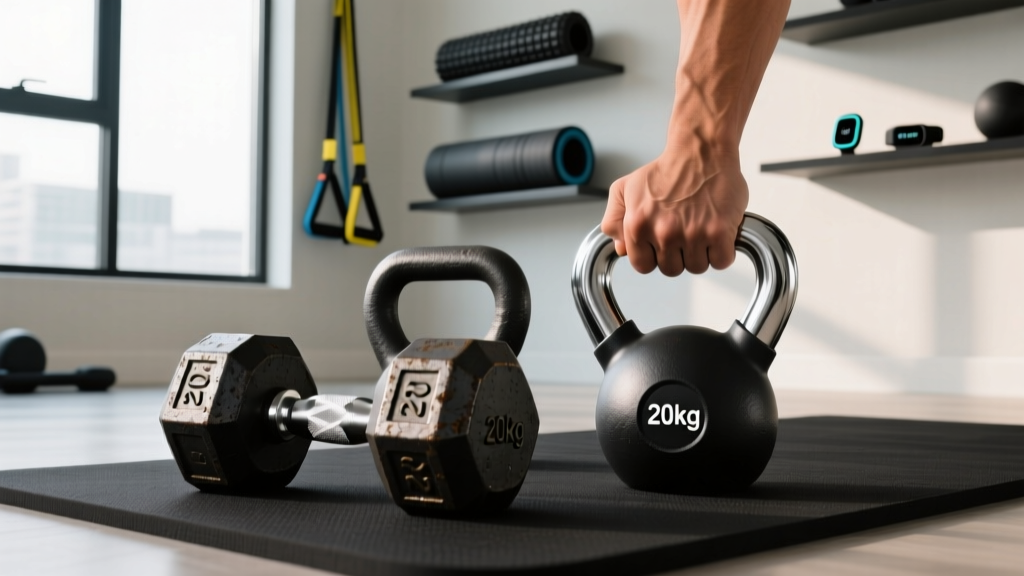
Beyond How to Use a Dumbbell: Cast Iron vs Competition Kettlebells
2026 Budget Breakdown: Bumper vs Iron Plates & Dumbbell Lat Raises

2026 Dumbbell Rack Trends: The Dumbbell Incline Bench Chest Press

Setup Guide: Neoprene Dumbbell Workout to Tone Arms at Home

Barbell Collar & Clamp Types: Seated Dumbbell Rows to Squats
