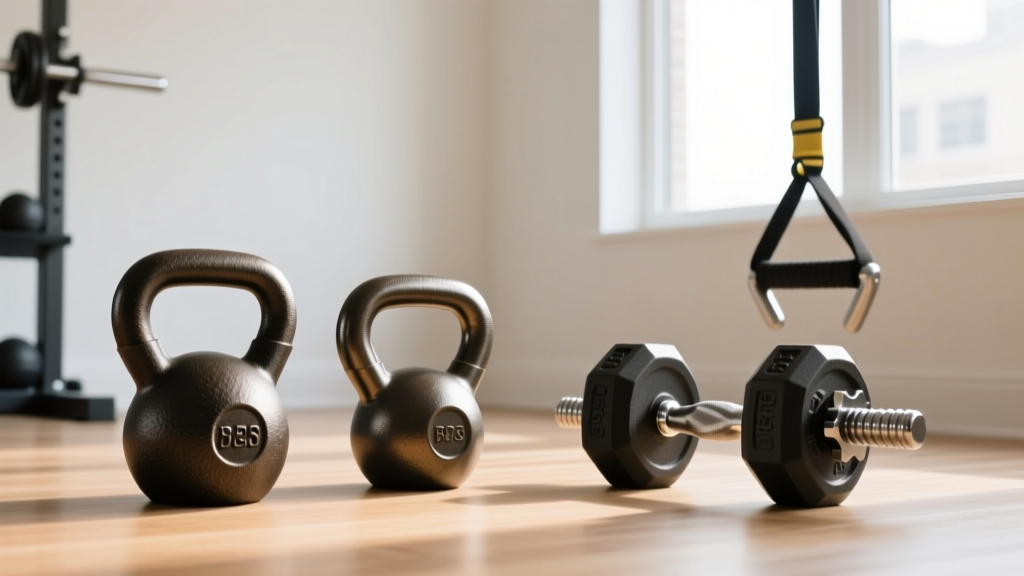
Kettlebell Layouts: Cast Iron vs Competition & The Pullover Dumbbell
Optimize your home gym footprint. Compare cast iron vs competition kettlebell dimensions and integrate a space-saving pullover dumbbell setup.

The Spatial Economics of Free Weight Zones
When engineering a high-density home gym in 2026, every square foot of floor space carries a tangible cost. The modern garage gym is no longer just a place to store iron; it is a meticulously calculated layout where clearance zones, rack footprints, and equipment geometry dictate functionality. For athletes prioritizing space optimization, the decision between cast iron and competition kettlebells extends far beyond aesthetics or grip feel—it is fundamentally a spatial geometry problem. Furthermore, integrating complementary movements without sacrificing valuable real estate requires strategic tool selection, such as rethinking the traditional bench setup in favor of a dedicated pullover dumbbell strategy.
Spatial Rule of Thumb: A standard 4x6 foot rubber mat provides 24 square feet of working area. Your static storage footprint (racks and cradles) should never exceed 15% of your total dynamic movement zone to ensure safe clearance for ballistic exercises.Dimensional Data: Cast Iron vs. Competition Kettlebells
To optimize your layout, you must first understand the physical geometry of your implements. Cast iron kettlebells scale in physical size as the weight increases. An 8kg cast iron bell might be compact enough to fit in a cubby, while a 48kg beast requires massive horizontal clearance. Competition kettlebells, conversely, adhere to a strict uniform dimension regardless of weight, standardized for international sport.
| Specification | Cast Iron (e.g., Rogue / Rep) | Competition (e.g., Kettlebell Kings) |
|---|---|---|
| Height (Standard 16kg) | ~225 mm (Variable) | 280 mm (Fixed) |
| Width / Diameter | ~210 mm (Scales up) | 210 mm (Fixed) |
| Horn Thickness | 30mm - 40mm (Scales) | 35mm (Fixed) |
| Average Cost per lb (2026) | $1.60 - $2.20 | $2.80 - $4.50 |
| Rack Compatibility | Requires adjustable/stepped tiers | Fits uniform flat-grid shelving |
According to Rogue Fitness specifications, the uniform 280x210mm footprint of competition bells allows for highly predictable, grid-based storage. If you are building a custom wall-mounted shelf or a compact corner rack, competition bells allow you to design a single-tier, high-density row. Cast iron bells, however, force a 'spatial Tetris' scenario where heavier bells must be stored on the floor or on reinforced, staggered lower tiers, eating into your vertical clearance and floor mat space.
Rack Footprints and Swing Clearance Zones
The storage rack is only half the spatial equation; the dynamic clearance zone is where layouts often fail. The National Strength and Conditioning Association (NSCA) and leading home gym equipment reviewers consistently emphasize the necessity of a minimum 36-inch radius clearance for two-handed kettlebell swings and snatches.
- Cast Iron Storage: Because a 32kg cast iron bell is significantly wider and taller than a 12kg bell, a vertical A-frame rack will have a widening footprint at the base. Expect a 24-inch wide base that tapers to 16 inches at the top, occupying roughly 3.5 square feet of floor space.
- Competition Storage: A uniform horizontal wall shelf or a straight vertical post rack maintains a strict 14-inch to 18-inch footprint from top to bottom, maximizing the adjacent floor area for your dynamic movements.
The Pullover Dumbbell: Solving the Bench Space Problem
When designing a compact gym, dedicating 12 to 16 square feet of prime real estate to a flat utility bench and a full set of fixed dumbbells is a poor spatial investment. The traditional dumbbell pullover is a staple for latissimus dorsi and serratus anterior development, but it inherently demands a bench to allow for sagittal plane shoulder extension. This is where the modern adjustable pullover dumbbell strategy reclaims your floor plan.
Floor-Based Mechanics and Wedge Integration
By utilizing a single, high-capacity adjustable model as your dedicated pullover dumbbell, you eliminate the need for a bench entirely. Models like the Nuobell 80lb or the PowerBlock Pro EXP offer a condensed center of mass. When paired with a compact, high-density foam wedge (measuring roughly 18x12 inches), you can perform floor-based pullovers with a slightly reduced but highly effective range of motion, while keeping the equipment footprint under 2 square feet.
Biomechanical Note: While a floor-based pullover dumbbell routine limits terminal shoulder extension by roughly 15-20 degrees compared to a flat bench, it drastically reduces the risk of anterior capsule overstretching in tight spaces where spatial awareness is compromised by nearby racks.
Instead of storing a 50-pound fixed dumbbell that takes up a massive 14-inch cradle, an adjustable pullover dumbbell like the Nuobell rests in a sleek 17.5 x 8.5 inch tray. This allows you to slide the tray directly under your kettlebell rack, utilizing 'dead space' that would otherwise collect dust.
2026 High-Density Layout Blueprint
To synthesize these spatial principles, here is a step-by-step framework for arranging a 5x5 foot (25 sq ft) high-density free weight zone that accommodates both heavy kettlebell ballistics and targeted hypertrophy work.
- Anchor the Wall (0-12 inches): Mount a uniform-depth steel shelf or vertical post rack designed specifically for competition kettlebells. The uniform 210mm width ensures the bells sit flush without overhanging into your walking path.
- Establish the Ballistic Arc (12-60 inches): Leave a strict 48-inch clearance directly in front of the rack. This is your non-negotiable swing and snatch zone. Do not place any static equipment in this corridor.
- Integrate the Pullover Station (Adjacent Corner): Position your adjustable pullover dumbbell cradle in the adjacent corner, exactly 60 inches from the center of your ballistic arc. This ensures that if a kettlebell is dropped or swung off-axis, it will not strike the adjustable dumbbell mechanism.
- Deploy the Wedge: Store your 18x12 inch foam pullover wedge vertically against the wall beside the dumbbell cradle. When ready to perform your pullover dumbbell sets, simply drop the wedge into the center of the mat, execute your sets, and return it to its 1-inch vertical wall profile.
Final Verdict for Compact Gyms
Space optimization is an exercise in ruthless prioritization. If your budget allows, competition kettlebells are the undisputed champions of spatial predictability. Their uniform geometry allows for flush, high-density racking that maximizes your dynamic floor space. Cast iron bells are more cost-effective per pound, but their scaling dimensions will force you to compromise on rack design and floor clearance.
Simultaneously, rethinking your accessory movements is critical. Swapping a bulky bench-and-fixed-iron setup for a streamlined, floor-based pullover dumbbell protocol utilizing an adjustable model and a foam wedge can save upwards of 10 square feet of vital gym space. In the modern home gym, the most effective layout is not defined by how much iron you can hoard, but by how intelligently you engineer the negative space around it.
More gear to consider
All reviews
EZ Curl Bar vs Straight Bar: Training for a 350 lb Dumbbell

Neoprene 5lb Dumbbell Set: Home Gym Setup & Storage Guide
Bowflex vs Nuobell: Best for Dumbbell Chest Flys on Bench?

Rubber Hex vs Urethane: Maintaining Your 40 lb Dumbbell Pair

Rubber Hex vs Urethane: Gym Layouts and Hip Abduction with Dumbbells
