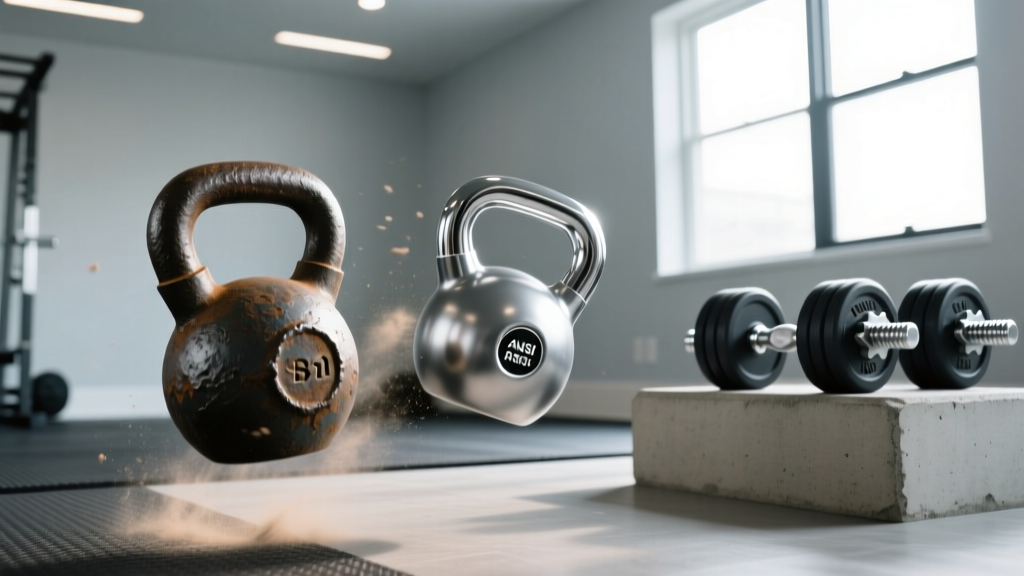
Kettlebell Halos vs Dumbbell Arm Circle: Cast Iron & Competition
Compare cast iron vs competition kettlebells for rotational flows and the dumbbell arm circle. Expert reviews, dimensional specs, and biomechanics.

The Evolution of Rotational Shoulder Mobility
When building resilient, mobile shoulders, most lifters begin with the traditional dumbbell arm circle. This foundational movement teaches basic scapular tracking and rotator cuff activation using a perfectly centered center of mass. However, as athletes progress toward more dynamic, multi-planar strength training, the kettlebell halo and kettlebell arm circle become superior tools for integrating core stability with shoulder mobility. This transition brings up a critical equipment debate: should you use a traditional cast iron kettlebell or a standardized competition kettlebell for these rotational flows?
In this 2026 expert buying guide, we break down the biomechanical differences between cast iron and competition kettlebells. We will explore how the geometry of the bell impacts your transition from a standard dumbbell arm circle to advanced offset-load rotational work, and provide hands-on reviews of the top models on the market.
Dimensional Breakdown: Cast Iron vs. Competition
The primary difference between cast iron and competition kettlebells lies in dimensional consistency. Cast iron bells scale in physical size as the weight increases. A 12kg cast iron bell is significantly smaller than a 32kg bell, meaning the clearance between the bell's body and your forearm changes with every weight jump. Competition kettlebells, conversely, maintain uniform dimensions regardless of weight, filled with internal steel shot or calibrated inserts to reach the target mass.
| Feature | Cast Iron Kettlebell | Competition Kettlebell |
|---|---|---|
| Bell Dimensions | Variable (scales with weight) | Uniform (approx. 210mm x 168mm) |
| Handle Diameter | Variable (usually 30mm - 35mm) | Strictly 33mm (35mm for some heavy) |
| Center of Mass | Offset, shifts closer to handle on larger bells | Consistent offset, lower in the bell |
| Wrist Clearance | Decreases as weight increases | Consistent across all weight classes |
| Primary Use Case | Grinds, heavy swings, general fitness | Snatches, cleans, rotational flows, sport |
For a comprehensive look at how these dimensions affect overall lifting mechanics, industry experts at BarBend consistently note that uniform handle diameters are crucial for athletes who frequently switch between different weights during a single flow routine.
Biomechanics: Offset Mass and the Rotator Cuff
Why does the bell geometry matter for shoulder circles? When you perform a standard dumbbell arm circle, the load is perfectly balanced in the palm of your hand. The torque applied to the glenohumeral joint is predictable and linear. A kettlebell introduces an offset center of mass—typically hanging 2 to 3 inches below and away from the handle axis.
Expert Insight: The Leverage Multiplier
During the bottom phase of a kettlebell halo (when the bell is behind your neck), the offset mass of a competition bell creates a longer lever arm compared to a compact 12kg cast iron bell. This demands significantly more eccentric control from the infraspinatus and teres minor. If you are transitioning from a dumbbell arm circle, starting with a competition bell provides a more consistent, predictable leverage curve across different weights, allowing your nervous system to adapt to the offset load without also adjusting to a changing bell size.
According to rotational strength methodologies taught by StrongFirst, mastering the halo requires precise wrist flexion and extension to keep the forearm in contact with the bell. Because competition bells have a wider, flatter horn (the sides of the handle), they rest more comfortably against the forearm during the rack position and the transition phases of a halo, reducing the bruising often caused by the aggressive curvature of cheaper cast iron models.
Expert Hands-On Reviews: 2026 Top Picks
After testing dozens of models in our home gym lab, we have selected the top performers for athletes focusing on rotational mobility and offset-load strength.
1. Eleiko Competition Kettlebell (Best for Rotational Flows)
Price Range: $190 - $280 (depending on weight)
Best For: Advanced halos, arm circles, snatches, and complex flows.
Eleiko remains the gold standard for competition kettlebells. The 33mm handle is coated in a specialized textured chrome that provides exceptional grip without the need for chalk—vital when your hands are inverted during an arm circle or halo. The bell is perfectly spherical with a flat base, and the internal calibration means a 16kg bell feels exactly the same in your hand spatially as a 24kg bell. The wide horn design completely eliminates forearm bruising during high-repetition cleans and rack-position flows. If you are replacing your dumbbell arm circle routine with a dedicated kettlebell mobility flow, the Eleiko's consistent geometry is unmatched.
2. Rogue E-Coat Cast Iron Kettlebell (Best for Raw Strength & Budget)
Price Range: $80 - $180
Best For: Heavy grinds, swings, and general strength conditioning.
For those who prefer the classic feel of cast iron, the Rogue E-Coat series is a standout. Unlike thick powder coatings that can chip and alter the handle diameter over time, Rogue's E-coat is incredibly thin, preserving the exact 35mm handle tolerance and allowing the natural cast iron texture to grip your skin. However, because it is cast iron, the physical footprint of the bell grows as you move from 16kg to 24kg to 32kg. This means your wrist clearance during a halo will shrink as you lift heavier, requiring micro-adjustments in your mobility. It is an excellent, cost-effective tool, but less ideal for pure, standardized rotational flow work than a competition bell. You can view their full lineup and current stock on the Rogue Fitness equipment page.
Programming Protocol: From Arm Circles to Halos
If you are migrating from a traditional dumbbell arm circle to kettlebell rotational work, follow this progressive overload protocol to protect your rotator cuff while adapting to the offset load:
- Phase 1: The Eccentric Halo (Weeks 1-2)
Use a light competition bell (8kg-12kg). Perform the halo in reverse (eccentric focus), taking 4 full seconds to move the bell from the front of your chest, around the back of your neck, and back to the front. This builds tissue tolerance to the offset leverage. - Phase 2: Alternating Arm Circles (Weeks 3-4)
Hold a moderate bell by the horns. Perform large, controlled arm circles in the sagittal and frontal planes. Focus on keeping the ribcage pinned down to prevent lumbar extension, a common failure point when the bell passes overhead. - Phase 3: Flow Integration (Weeks 5+)
Combine the halo with a reverse lunge and a prying goblet squat. The uniform dimensions of a competition bell make transitioning between these gripping positions seamless, whereas a cast iron bell's changing horn width can disrupt your flow state.
Edge Cases and Failure Modes
When selecting your equipment, be aware of these common failure modes associated with each kettlebell type:
- Cast Iron Handle Tearing: Many budget cast iron bells have a visible 'seam' running down the center of the handle from the molding process. During high-rep arm circles or snatches, this seam will shred your calluses. Always inspect the handle or sand it down before use.
- Competition Bell Wrist Bruising: While competition bells are great for halos, their large, uniform 210mm diameter can cause severe wrist bruising during heavy cleans if your racking technique is poor. The flat, wide surface area transfers more blunt force to the radius bone than a smaller, curved cast iron bell.
- Powder Coat Build-Up: Avoid cheap cast iron bells with thick, matte powder coatings. The coating adds 1-2mm to the handle diameter, making a 33mm handle feel like a 35mm handle, which accelerates grip fatigue during extended mobility flows.
Final Verdict
The transition from a standard dumbbell arm circle to advanced kettlebell rotational flows is a hallmark of intermediate-to-advanced shoulder conditioning. If your primary goal is complex mobility work, juggling, and seamless flow transitions, invest in a Competition Kettlebell like the Eleiko. The uniform dimensions and wide horn design remove the variables of changing bell sizes, allowing you to focus purely on movement quality and joint health. However, if your focus is on raw power, heavy swings, and budget-friendly strength building, a high-quality Cast Iron Kettlebell like the Rogue E-Coat remains an indispensable tool in the home gym arsenal.
More gear to consider
All reviews
Barbell Collar Types: Secure Your Single-Arm Dumbbell Pullover

Dumbbell Exercise Program for Beginners: Bumper vs Iron

Bumper vs Iron Plate Care & Incline Dumbbell Skull Crusher Longevity

Beginner Guide to Dumbbell Rows With Neoprene Weights

Leg Workout at Home With Dumbbells: Neoprene Setup & Walkthrough
