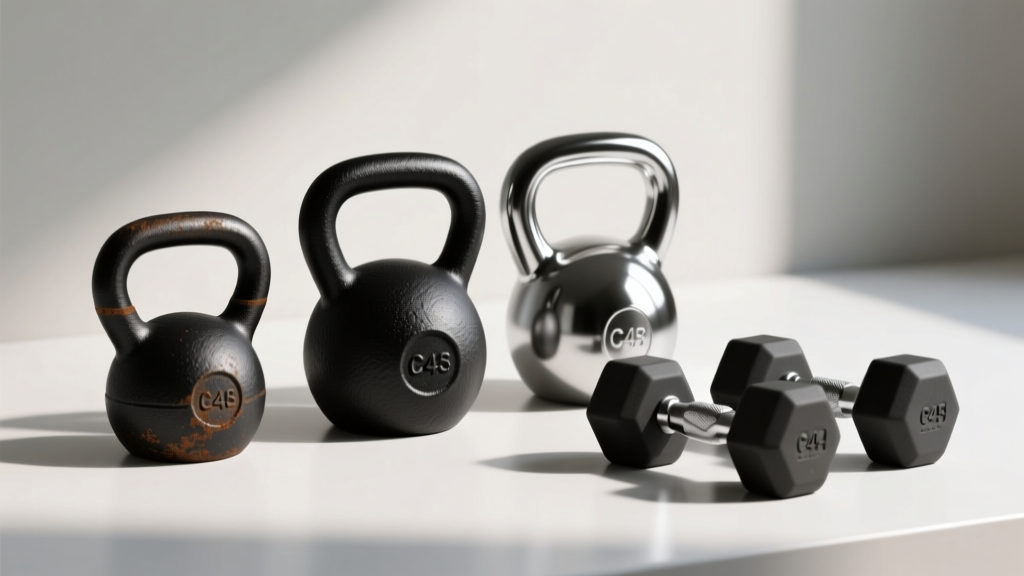
Cast Iron vs Competition Kettlebells: Budget & Dumbbell Chart PDF
Compare cast iron vs competition kettlebells for your 2026 budget. We break down cost-per-pound, durability, and when to use a dumbbell exercise chart PDF.

The Home Gym Crossroads: Kettlebells vs. Dumbbells
When outfitting a home gym on a strict budget, the crossroads of free weights often leads to a common dilemma: Do I buy adjustable dumbbells and rely on a generic dumbbell exercise chart pdf for my programming, or do I invest in kettlebells? While dumbbells are exceptional for isolated hypertrophy, kettlebells unlock an entirely different dimension of ballistic, flow-based, and functional strength training. If you have decided that kettlebells are the right tool for your 2026 fitness goals, your next critical financial decision is choosing between traditional cast iron and uniform competition-style kettlebells.
This budget breakdown and value analysis will dissect the true cost of ownership, durability, and performance metrics of both styles. We will also address how your programming needs—whether you are following a complex kettlebell flow or still referencing that dumbbell exercise chart pdf for accessory work—should dictate your purchase.
Cast Iron Kettlebells: The Budget-Friendly Workhorse
Cast iron kettlebells are the traditional choice, characterized by their rounded bodies, varying dimensions based on weight, and arched handles. For the budget-conscious lifter, they offer the lowest barrier to entry.
Pricing and Cost-Per-Pound Analysis
As of 2026, supply chain stabilizations have kept cast iron prices relatively steady. You can expect to pay between $2.00 and $3.50 per pound, depending on the brand and coating.
- Yes4All / CAP Barbell: Typically $1.80 to $2.20 per pound. However, these budget options often suffer from inconsistent handle diameters and rough casting seams that can tear calluses during high-rep snatches.
- Titan Fitness: Averages $2.50 per pound. Their powder-coated options offer a solid middle ground with free shipping, which is a massive hidden value.
- Rogue Fitness (Cast Iron): Averages $3.25 to $3.80 per pound. The Rogue E-Coat and Powder Coat lines are industry benchmarks. According to Rogue Fitness, their machining process ensures a consistent 33mm to 35mm handle diameter across most weights, which is rare in the cast iron market.
Failure Modes and Edge Cases
The primary failure mode of budget cast iron is coating degradation. Cheap enamel or low-grade powder coat will chip away after 500+ repetitions of hard-style swings or drops onto rubber matting. Once the raw iron is exposed to ambient humidity, surface rust develops within 48 hours. Furthermore, the physical footprint of cast iron changes with weight; a 12kg bell is significantly smaller than a 32kg bell, meaning your rack position and clean mechanics must constantly adapt to the changing dimensions of the bell's 'window'.
Competition Kettlebells: The Premium Investment
Competition kettlebells are manufactured to strict International Union of Kettlebell Lifting (IUKL) specifications. Whether the bell weighs 8kg or 48kg, the physical dimensions remain exactly the same: 280mm tall, 210mm wide, with a 33mm handle diameter and a 35mm handle window.
Pricing and Cost-Per-Pound Analysis
Competition bells command a premium due to the precision engineering required to maintain uniform volume. Lighter bells are hollow and filled with steel shot or specialized filler, while heavier bells are solid steel or dense cast iron. Expect to pay between $4.50 and $7.50 per pound.
- Kettlebell Kings (Standard Competition): Roughly $5.00 per pound. Excellent steel handles that require minimal chalk.
- Eleiko Competition: Upwards of $7.50 per pound. The gold standard for Olympic-level lifting, featuring impeccable base flatness and handle knurling/texturing.
The Value of Uniformity
Why pay double for the exact same weight? Muscle memory and technical consistency. When you are learning the jerk or the snatch, the trajectory of the bell and the depth of the rack position must be identical every time. As noted by strength educators at StrongFirst, technical mastery requires eliminating variables. Competition bells eliminate the variable of changing dimensions, allowing your central nervous system to lock in the motor pattern without micro-adjustments for different bell sizes.
Head-to-Head Comparison Matrix
| Feature | Cast Iron (Premium) | Competition (Standard) |
|---|---|---|
| Average Cost (16kg) | $65 - $85 | $110 - $135 |
| Handle Diameter | Varies (32mm - 38mm) | Strict 33mm |
| Base Flatness | Slightly rounded / Uneven | Machined perfectly flat |
| Coating / Material | E-Coat, Powder Coat, Urethane | Bare Steel or Painted Steel |
| Best For | Grinds, Hypertrophy, Budget Gyms | Ballistics, Sport, Technical Mastery |
The Dumbbell Overlap: Programming Your Purchase
Many home gym builders start by buying a pair of adjustable dumbbells and immediately search the web for a dumbbell exercise chart pdf because they lack structured programming. Dumbbells are incredible for bilateral and unilateral isolation work (e.g., lateral raises, Romanian deadlifts, floor presses). However, they are notoriously poor for explosive, multi-planar ballistic movements.
Programming Insight: When to Ditch the Chart
If your downloaded dumbbell exercise chart pdf focuses heavily on high-rep swings, cleans, and snatches, you are using the wrong tool. Dumbbells have a fixed center of mass that pulls awkwardly on the wrist during racking and cleaning. Kettlebells feature an offset center of mass that rests naturally on the forearm in the rack position. If your goal is metabolic conditioning or ballistic power, transition your budget toward a 16kg and 24kg kettlebell pair, and use the dumbbells strictly for the accessory isolation work outlined in your chart.
Hidden Costs: Shipping, Maintenance, and Floor Protection
A true budget breakdown must account for the hidden costs of heavy iron.
1. The Shipping Trap
Kettlebells are incredibly dense. Buying a single 24kg (53lb) cast iron bell from a budget retailer might cost $60, but shipping can easily add $35 to $50 at checkout. Value Tip: Only buy cast iron from retailers that offer flat-rate or free shipping thresholds (like Rogue or Titan), or buy locally from used markets to bypass freight costs entirely.
2. Maintenance and Chalk
Competition kettlebells feature bare or lightly treated steel handles. While they resist the chipping and rusting of painted cast iron, they require regular wiping and occasional sanding with a wire brush to maintain grip. Bare steel also demands the use of lifting chalk. Factor in $15-$20 a year for chalk and a wire brush. Cast iron powder coat, conversely, can often be used sweat-free, but requires immediate drying to prevent rust.
3. Floor Protection
Competition bells have perfectly flat, machined bases. When you set them down or drop them from a rack, the force is distributed evenly across a wider surface area. Cheap cast iron bells often have rounded or slightly convex bases, concentrating the impact force into a single point, which can crack expensive rubber horse-stall mats over time. According to equipment maintenance guidelines from the American Council on Exercise (ACE), protecting your training surface is vital for long-term joint health and equipment longevity.
Final Verdict: Where Should Your Money Go?
Your purchasing decision should be dictated by your training age, budget, and specific modality goals.
- Buy Cast Iron If: You are on a strict budget (under $150 total), your programming focuses on heavy grinds (goblet squats, strict presses, heavy farmer carries), or you are supplementing a dumbbell routine where you still rely on a dumbbell exercise chart pdf for isolation movements.
- Buy Competition If: You are training for kettlebell sport, you prioritize high-rep ballistics (snatches, jerks, long-cycle), or you are a coach who needs uniform equipment to teach standardized mechanics to multiple clients.
Ultimately, the best value in 2026 is a hybrid approach. Invest in a single, high-quality 16kg or 20kg competition kettlebell to master your ballistic technique, and fill out the rest of your weight spectrum with budget-friendly cast iron bells for heavy, low-rep strength work. This strategy maximizes your budget while ensuring your technique remains flawless.
More gear to consider
All reviews
EZ Curl Bar vs Straight Bar: Man Full Body Dumbbell Workout PDF Care
Cast Iron vs Competition Kettlebells: Beyond the Single Dumbbell RDL
EZ vs Straight Bar: Value & Dumbbell Bicep Curl Incline Bench Setup

EZ Bar vs Straight Bar & Rear Delt Exercises at Home with Dumbbells

Dumbbell Rack Maintenance for the Perfect Static Dumbbell Curl
