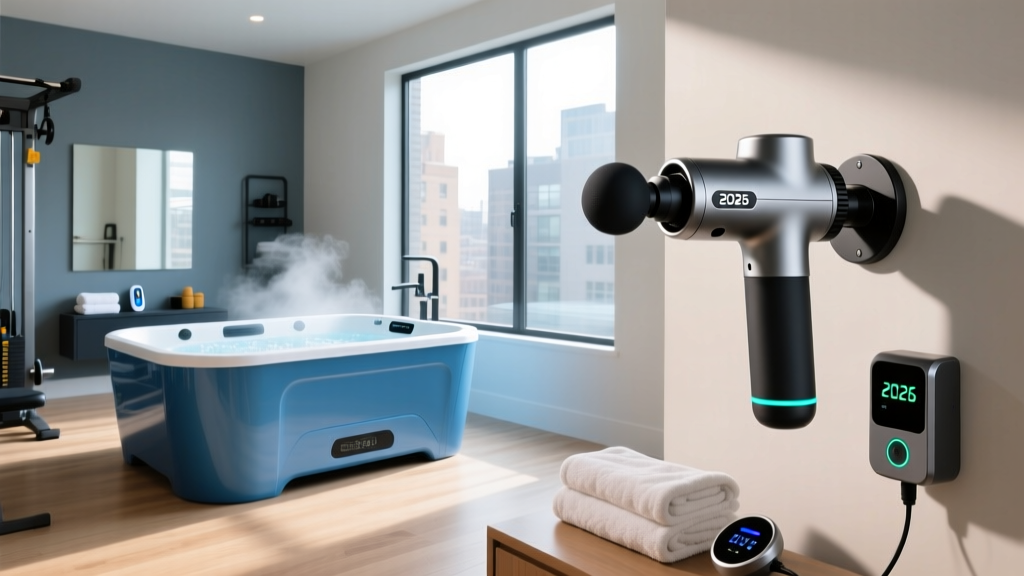
2026 Home Recovery Budget: Ice Bath vs Massage Gun for Relaxation
Compare the 2026 costs and ROI of home ice baths versus a premium massage gun for relaxation. Expert budget breakdown and value analysis inside.

The 2026 Home Recovery Dilemma: Plunge or Percuss?
As we move through 2026, the home recovery space has evolved from a luxury reserved for elite athletes into a standard pillar of holistic wellness real estate. Homeowners and renters alike are allocating significant portions of their wellness budgets to optimize their nervous systems. However, when capital is limited, a critical financial and physiological crossroads emerges: should you invest in a dedicated home ice bath and cold plunge tub, or allocate those funds toward a premium massage gun for relaxation and a comprehensive somatic toolkit?
This budget breakdown and value analysis dissects the upfront capital expenditure (CapEx), ongoing operational costs (OpEx), hidden failure modes, and neurological return on investment (ROI) of both modalities. Whether you are outfitting a garage gym or designing a dedicated recovery sanctuary, understanding the true cost of ownership is essential.
Capital Expenditure: Cold Plunges vs. Percussive Therapy
The True Cost of Home Ice Baths and Cold Plunges
The market for home cold plunge tubs has matured significantly. In 2026, you are no longer limited to DIY chest freezers; the market is dominated by integrated, aesthetically pleasing, and technologically advanced systems. However, this convenience commands a premium.
- Entry-Level Inflatable Systems (e.g., Nurecover Pod, The Ice Barrel Flex): Ranging from $1,200 to $2,500. These require manual ice loading or rely on small, inefficient external chillers that struggle to maintain temperatures below 50°F (10°C) in ambient heat.
- Mid-Tier Acrylic & Chiller Combos (e.g., The Plunge Evolve Series): Priced around $4,990 to $6,500. These feature integrated 1/2 HP to 3/4 HP chillers, UV-C sanitization, and acrylic shells that resist cracking and algae buildup.
- Premium Architectural Plunges (e.g., Sun Home Saunas Cold Plunge, Plunge Pro XL): Costing between $7,500 and $12,000+. These offer 1 HP commercial-grade chillers, redwood or cedar cabinetry, and advanced ozone filtration systems capable of maintaining 39°F (3.8°C) year-round, regardless of climate.
Premium Massage Guns: The Accessible Alternative
Conversely, the percussive therapy market has stabilized, with top-tier devices offering medical-grade amplitude and smart features at a fraction of a cold plunge's cost. When sourcing a high-end massage gun for relaxation, you are looking at devices that prioritize low-decibel operation, ergonomic grips, and intelligent speed modulation.
- Theragun PRO Plus (5th Gen): Retailing at $599, this device features a built-in OLED screen, Bluetooth connectivity for guided relaxation routines, and a 16mm amplitude. It is the gold standard for clinical-grade percussive therapy.
- Hyperice Hypervolt 2 PRO: Priced at $399, it offers a quieter motor profile (ideal for evening wind-down routines) and a 14mm amplitude, making it highly effective for superficial fascial release without triggering a sympathetic pain response.
Initial Budget Verdict: A top-tier cold plunge requires 10x to 15x the upfront capital of a flagship massage gun.
Expert Insight: The 'Relaxation' Configuration
Many users mistakenly use percussive devices solely for deep-tissue pain. When configuring a massage gun for relaxation, the goal is parasympathetic activation. Use the dampener or soft foam attachment, restrict the speed to 1750 RPM or lower, and apply broad, sweeping strokes along the calves, forearms, and upper trapezius. This rhythmic, low-intensity input signals the vagus nerve to lower heart rate and reduce cortisol, mimicking the 'rest and digest' state without the thermal shock of cold water.
Operational Costs and Hidden Failure Modes
The sticker price is only the beginning. True value analysis requires examining the total cost of ownership over a 5-year horizon.
Ice Bath Maintenance, Energy Drain, and Plumbing
Cold plunge tubs are essentially refrigerators that hold water. Running a 1/2 HP chiller (approx. 400-600 watts) continuously to maintain 45°F in a 75°F ambient environment will add roughly $35 to $65 per month to your electrical bill, depending on local utility rates and insulation quality. Furthermore, water treatment is non-negotiable. Even with UV and ozone systems, you must use hydrogen peroxide or specialized spa shock weekly ($10-$15/month) and replace UV-C bulbs annually ($40).
Failure Modes: The most common point of failure in home ice baths is the chiller compressor or the internal water pump. Out-of-warranty compressor replacements in 2026 average $800 to $1,200, plus labor. Additionally, outdoor acrylic shells exposed to direct UV sunlight without covers can suffer from micro-fractures and delamination within 3 to 4 years.
Massage Gun Battery Degradation and E-Waste
Percussive devices have virtually zero operational energy costs (charging a 2.5A battery costs pennies). However, they suffer from lithium-ion battery degradation. A premium massage gun used daily for 20 minutes will typically experience a 20% to 30% reduction in battery capacity by year three.
Failure Modes: Internal battery swelling or motor brush wear. While Therabody and Hyperice offer 2-year warranties, out-of-warranty battery replacements are often cost-prohibitive (frequently exceeding $150), leading many consumers to simply replace the entire unit, contributing to e-waste.
Neurological ROI: Cold Shock vs. Parasympathetic Shift
To determine which investment offers better 'value,' we must look at the physiological outcomes. According to research published in the European Journal of Applied Physiology, cold water immersion triggers a massive catecholamine release, increasing dopamine levels by up to 250% and norepinephrine by 530%. This provides a profound, hours-long mood elevation and mental resilience benefit that no mechanical device can replicate.
'While cold exposure forces the body to adapt to acute stress, building top-down mental fortitude, mechanical therapies like massage facilitate a bottom-up relaxation response, directly down-regulating the sympathetic nervous system.' - Synthesized from Frontiers in Psychology autonomic nervous system studies.
Therefore, the value depends entirely on your primary deficit. If you struggle with lethargy, brain fog, and need a neurochemical reset, the cold plunge offers unparalleled ROI. If your primary barrier to recovery is chronic muscular tension, high evening cortisol, and an inability to transition into sleep, a high-quality massage gun for relaxation provides immediate, daily utility.
Value Analysis Matrix: 5-Year Horizon
| Metric | Mid-Tier Home Cold Plunge | Flagship Massage Gun |
|---|---|---|
| Upfront Cost (2026) | $5,500 - $7,000 | $399 - $599 |
| Annual Energy Cost | $420 - $780 | < $10 |
| Consumables/Maintenance | $150 - $200 / year | $0 (Replace heads every 6 mos) |
| Space Footprint | 15 - 25 sq. ft. (Requires drainage/ventilation) | < 1 sq. ft. (Drawer storage) |
| Primary Neurological Benefit | Dopamine/Norepinephrine spike, alertness | Parasympathetic shift, cortisol reduction |
| Expected Lifespan | 7-10 years (with compressor service) | 3-5 years (battery limited) |
| Estimated 5-Year Total Cost | $8,350 - $11,900 | $399 - $650 (including replacement) |
Decision Framework: Which Should You Fund?
When auditing your 2026 wellness budget, apply the following decision matrix to ensure your capital is deployed effectively:
Scenario A: The High-Stress Executive
Profile: Works 60+ hours a week, experiences chronic lower-back tension, struggles to 'turn off' at night, and travels frequently.
Recommendation: Skip the cold plunge. The friction of maintaining a home ice bath, combined with the travel schedule, will result in an expensive, stagnant water feature. Invest $599 in the Theragun PRO Plus. Utilizing a massage gun for relaxation during evening wind-down routines, paired with a $200 smart heating pad for the lumbar spine, will yield a vastly superior daily ROI for tension management and sleep architecture.
Scenario B: The Endurance Athlete & Biohacker
Profile: Trains for marathons or triathlons, prioritizes systemic inflammation reduction, has dedicated outdoor or garage space, and seeks mental resilience training.
Recommendation: The cold plunge is a mandatory investment. The systemic vasoconstriction and subsequent vasodilation (the 'pump' effect) aid in clearing metabolic waste from heavy training blocks. Budget $6,000 for a reliable mid-tier plunge with a commercial-grade chiller to avoid the headache of daily ice runs. Supplement with a budget-friendly $150 percussive device for localized warm-ups.
Scenario C: The Holistic Optimizer (The Hybrid Approach)
Profile: Has a $10,000 recovery budget and wants both systemic and localized benefits.
Recommendation: Do not compromise on the chiller. Purchase a premium $7,500 architectural cold plunge that guarantees 39°F capabilities and includes an extended 5-year warranty on the compressor. Allocate the remaining $2,500 to a Theragun PRO Plus ($599), a high-quality infrared sauna blanket ($400), and a professional-grade compression boot system like the Normatec 3 ($1,200). This diversified portfolio covers cold shock, heat shock protein synthesis, percussive relaxation, and pneumatic lymphatic drainage, creating a comprehensive, resort-grade recovery ecosystem in your home.
Final 2026 Buying Advice: Never finance a cold plunge tub using high-interest consumer debt. The physiological benefits of cold therapy are rapidly negated by the psychological stress of financial burden. If the $5,000+ CapEx and $100/month OpEx of a home ice bath strain your budget, master the art of using a massage gun for relaxation, prioritize sleep hygiene, and utilize your local gym's or community center's plunge facilities until your capital allows for a stress-free home installation.More gear to consider
All reviews
Foam Roller Density Guide: Space Layouts for Smart Recovery Tools

TSA Approved Massage Gun vs. Travel Stretching Equipment

Brad Common Mistakes: Critical Errors in Equipment Recovery That Cost Time, Money, and Safety

Compression Boot Reviews & Massage Gun Wholesale Suppliers Guide

Renpho Massage Gun RF-GM169: 2026 Buyer & Troubleshooting Guide
