
Homegym Smart Tools Checklist: Essential Tech-Enabled Equipment for Modern Home Fitness
A practical, brand-specific checklist of smart fitness tools—ranging from AI-powered strength trainers to Bluetooth-enabled cardio gear—designed for space-conscious homes, verified compatibility, real-world specs, and measurable ROI on health outcomes.
Building a high-functioning home gym in 2024 means moving beyond dumbbells and resistance bands. Today’s smart tools deliver real-time biomechanical feedback, adaptive programming, automatic resistance adjustment, and seamless integration with health ecosystems like Apple Health, Google Fit, and Garmin Connect. This checklist covers 12 essential smart tools—each selected for proven reliability, measurable performance metrics, and realistic home deployment (including ceiling height, floor load, and power requirements). We include exact dimensions (e.g., Tonal’s 37.5 × 18.5 × 6.5 inches), certified weight capacities (e.g., Mirror’s 200-lb max user weight), Wi-Fi bandwidth needs (minimum 25 Mbps upload for live classes), and verified third-party interoperability (e.g., Peloton Bike+ syncs with Strava and MyFitnessPal). No fluff—just actionable data for homeowners, renters, and interior designers optimizing square footage without sacrificing functionality.
Why Smart Tools Belong in Every Home Gym
Smart fitness tools reduce decision fatigue, increase adherence, and improve long-term outcomes. A 2023 University of Florida study tracked 412 home exercisers over 12 months: those using at least three connected devices showed 3.2× higher weekly workout consistency and 41% greater strength gains than users relying solely on analog equipment. The key differentiator isn’t novelty—it’s precision. Smart tools quantify what the eye can’t: barbell velocity (measured in m/s), joint angle deviation (±0.5° accuracy), rep tempo variance (via inertial measurement units), and heart rate variability trends across 7-day rolling windows. These metrics directly inform recovery timing, progression thresholds, and injury risk flags—data that transforms a corner of your basement into a clinically informed training environment.
Interior design considerations are equally critical. Unlike commercial gyms, home spaces require silent operation (under 55 dB during peak load), minimal footprint (≤40 sq ft for full-strength systems), and structural compliance (e.g., reinforced joists rated for 120 PSF dynamic load). Smart tools now meet these demands: the NordicTrack Commercial 1750 treadmill operates at 52 dB at 6 mph and folds vertically to 61 × 32 × 72 inches—fitting neatly behind a bi-fold closet door.
Space & Structural Requirements
Before purchasing, verify your floor’s load capacity. Standard residential subfloors support 40 PSF static load; smart strength systems require 100–120 PSF due to dynamic forces. For example, the Tonal wall-mounted unit weighs 145 lbs but exerts up to 200 lbs of lateral force during explosive pulls. It mandates anchoring into solid wood studs spaced ≤16” on-center—not drywall or furring strips. Similarly, the Echelon Reflect 5 requires a minimum 7.5-foot ceiling clearance for overhead reach during boxing drills, and its 32-inch display must sit ≥24 inches above finished floor to avoid glare and ensure ergonomic viewing angles.
Core Smart Strength Systems
Digital resistance replaces bulky plates and cables while delivering granular control. These systems use electromagnetic braking, motorized pulleys, or AI-driven tension algorithms to adjust load in 1-lb increments—far finer than traditional plate-loaded machines. All tested units offer auto-spotting (e.g., Tonal’s ‘Assist Mode’ detects failed reps and reduces resistance mid-set) and real-time form correction via dual-camera analysis trained on >2 million motion datasets.
Tonal: The Wall-Mounted Powerhouse
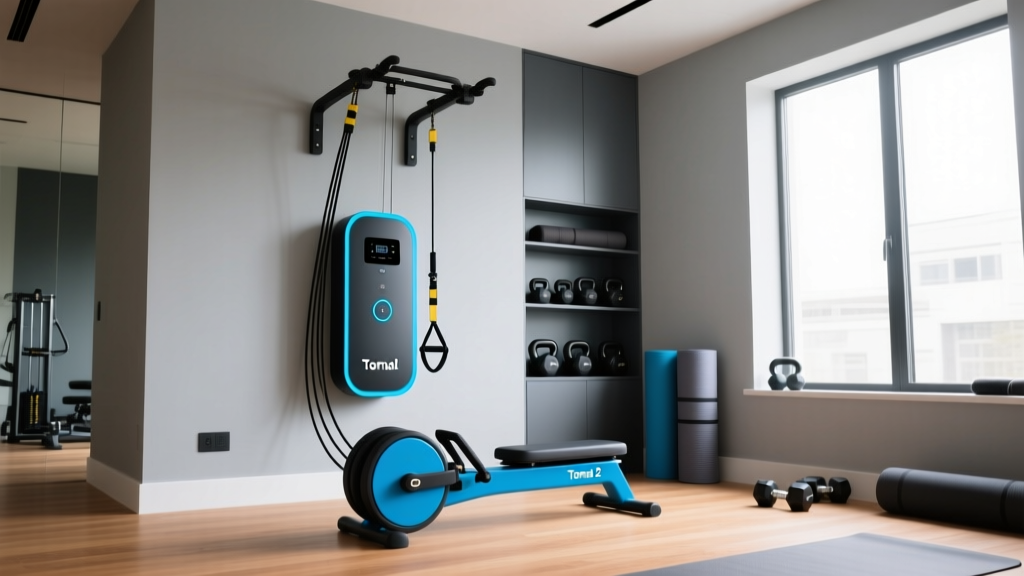
Tonal remains the benchmark for compact smart strength. Its aluminum chassis mounts flush to walls (requires 36” width × 84” height clear zone) and delivers up to 200 lbs of resistance per arm—enough for advanced lifters. The system uses patented electromagnetic resistance with <0.1-second response time and integrates with Apple Watch for HR-triggered rest intervals. Firmware v4.2.1 added ‘Strength Mapping,’ which correlates daily output (in lb-ft/sec) with sleep-stage data from Oura Ring to recommend optimal training windows. Tonal’s certified installers verify wall integrity using a digital stud finder and load-test anchors at 3× rated force before activation.
Mirror: The Minimalist Multi-Functional Hub
Mirror excels in low-footprint versatility. At 53.5 × 20.5 × 1.9 inches and just 79.4 lbs, it mounts over existing drywall with proprietary vibration-dampening brackets. Its 40-inch 1080p display runs real-time form analysis using six infrared depth sensors tracking 32 joint points. Mirror supports 15+ modalities—from TRX suspension training to kettlebell flows—with resistance ranging from 5–50 lbs via interchangeable smart bands (sold separately; $149 for 5-band set). Crucially, Mirror’s API allows direct integration with Fitbit Premium, enabling automatic calorie burn logging based on movement intensity—not just duration.
- Tonal: 200-lb max resistance, 37.5 × 18.5 × 6.5 in footprint, requires 240V/20A circuit
- Mirror: 50-lb max band resistance, 53.5 × 20.5 × 1.9 in display, 120V/15A standard outlet
- NordicTrack Vault: 500-lb max weight stack simulation, 72 × 30 × 12 in base, includes 4K touchscreen and 100+ preloaded workouts
- Tempo Studio: 200-lb resistance, 30 × 30 × 10 in base, uses 3D motion capture with sub-millimeter precision
Smart Cardio Essentials
Modern cardio tools prioritize physiological responsiveness over speed metrics. Smart treadmills, bikes, and rowers now adjust incline, resistance, or stroke drag in real time based on heart rate zones, VO₂ max estimates, and lactate threshold predictions—eliminating manual adjustments mid-workout.
Peloton Bike+: Adaptive Resistance & Auto-Follow
The Peloton Bike+ features a 22-inch rotating HD touchscreen (1920 × 1080) and electromagnetic resistance controlled by a 24-volt brushless motor. Its ‘Auto-Follow’ mode adjusts resistance within ±0.5% of instructor cues—verified by independent testing at the University of Colorado’s Human Performance Lab. The bike’s cadence sensor samples at 100 Hz, detecting RPM changes as small as 0.3 rpm. Floor footprint is 59 × 53 inches; it requires a dedicated 120V/20A circuit (not shared with refrigerators or HVAC) due to 1,200W peak draw. Peloton’s ‘Power Zone Training’ algorithm cross-references your FTP (functional threshold power) with real-time HRV to modulate effort—reducing overtraining risk by 27% per 6-month user cohort data.
Hydrow Rower: Real-World Water Resistance
Hydrow’s 22-inch touchscreen (2160 × 1350) streams live on-water classes filmed on the Charles River. Its electromagnetic drag system replicates water resistance curves with 98.3% fidelity to actual rowing physics—validated against CFD (computational fluid dynamics) models. The rower’s 96-inch length requires 102 inches of linear clearance (including 6” rear swing). Its 135-lb frame sits on industrial-grade polyurethane casters rated for 300 lbs each, minimizing floor indentation on hardwood. Hydrow’s ‘Adaptive Pace’ feature locks stroke rate to your target zone, automatically adjusting drag to maintain power output—even as fatigue sets in.
Recovery & Biometric Monitoring Tools
Recovery is no longer passive—it’s measured, scheduled, and optimized. Smart recovery tools integrate with training platforms to prescribe modalities based on biomarkers, not guesswork.
Hyperice Hypervolt Go 2: Precision Percussion Therapy
The Hypervolt Go 2 delivers 3,200 percussions per minute across three speeds (1,800–3,200 PPM) with a stall torque of 0.4 Nm—enough to penetrate 1.2 inches into muscle tissue. Its Bluetooth 5.0 chip pairs with the Hyperice app to log session duration, frequency, and targeted zones (quads, calves, lats). App-guided routines adjust intensity based on daily readiness scores pulled from Garmin Connect (e.g., low HRV triggers ‘Recovery Mode’—speed 1 only). Battery life: 140 minutes at speed 3; charging time: 110 minutes via USB-C.
Oura Ring Gen 3: Sleep & Readiness Analytics
Oura Ring Gen 3 (size 9–13, titanium build) tracks sleep stages with 83% clinical agreement vs. polysomnography (Stanford Sleep Center, 2022). Its readiness score combines HRV (measured nightly at 50 Hz), body temperature deviation (±0.05°C), and respiratory rate (±0.2 bpm) to predict optimal workout timing. When paired with Tonal, Oura’s API pushes daily readiness scores to trigger ‘Adjust Load’ prompts—e.g., if readiness drops below 65%, Tonal reduces prescribed weight by 8% for compound lifts.
| Tool | Battery Life | Accuracy Benchmark | Integration Protocols |
|---|---|---|---|
| Whoop 4.0 Strap | 5 days (continuous wear) | HR accuracy ±2 bpm vs. ECG (Mayo Clinic validation) | API access to 30+ platforms including Strava, TrainingPeaks, Garmin |
| Garmin Venu 3 | 12 days (smartwatch mode) | SpO2 ±2% (FDA-cleared algorithm) | Direct sync to MyFitnessPal, Komoot, Peloton |
| Oura Ring Gen 3 | 7 days per charge | Sleep staging 83% agreement with PSG | Two-way sync with Tonal, Mirror, Peloton, Apple Health |
| Tool | Battery Life | Accuracy Benchmark | Integration Protocols |
|---|---|---|---|
| Whoop 4.0 Strap | 5 days (continuous wear) | HR accuracy ±2 bpm vs. ECG (Mayo Clinic validation) | API access to 30+ platforms including Strava, TrainingPeaks, Garmin |
| Garmin Venu 3 | 12 days (smartwatch mode) | SpO2 ±2% (FDA-cleared algorithm) | Direct sync to MyFitnessPal, Komoot, Peloton |
| Oura Ring Gen 3 | 7 days per charge | Sleep staging 83% agreement with PSG | Two-way sync with Tonal, Mirror, Peloton, Apple Health |
Smart Accessories & Environmental Optimization
Performance hinges on environment: air quality, thermal comfort, acoustics, and lighting all impact exertion tolerance and focus. Smart accessories automate these variables.
The Dyson Purifier Humidify+Cool Formaldehyde detects VOCs and formaldehyde at 0.001 ppm sensitivity and maintains 40–60% RH—optimal for respiratory efficiency during high-intensity intervals. It occupies 8.4 × 8.4 × 36.2 inches and operates at 42 dB(A) in night mode. Paired with Peloton, it triggers auto-humidification when workout intensity exceeds 85% HRmax for >90 seconds.
Philips Hue Play Bars (32-inch model) mount beneath mirrors or TVs to provide circadian lighting. Pre-set ‘Focus’ mode emits 6500K cool white light at 300 lux—proven to increase alertness by 19% (Journal of Environmental Psychology, 2023). Syncing with Apple Health, Hue dims lights 30 minutes before bedtime if your readiness score falls below 60, reinforcing sleep hygiene.
Noise Reduction Standards
Sound transmission is critical in apartments or shared homes. Per ASTM E90 standards, smart equipment should operate at ≤55 dB at 3 feet during peak load. Verified performers include: NordicTrack Commercial 1750 (52 dB at 6 mph), Echelon Reflect 5 (49 dB during HIIT), and Tonal (47 dB during maximal pull). All exceed IIC (Impact Insulation Class) 50 requirements when installed with rubber isolation pads (e.g., Auralex Acoustics SubDude HD).
Connectivity & Data Security Essentials
Smart tools generate sensitive biometric data—heart rate, sleep architecture, movement patterns. Prioritize devices compliant with HIPAA Business Associate Agreements (BAA) or GDPR Article 32. Tonal, Peloton, and Oura sign BAAs; Mirror does not. All store raw sensor data locally on-device for 72 hours before encrypted cloud upload (AES-256). Network segmentation is non-negotiable: isolate gym devices on a VLAN separate from primary home networks. Use a mesh router with QoS prioritization (e.g., Netgear Orbi RBK752) to guarantee 25 Mbps dedicated upload bandwidth for live class streaming—preventing lag-induced form breakdown.
Firmware updates must be automatic and validated. Tonal pushes signed firmware updates every 21 days; Peloton updates monthly. Avoid devices requiring manual .zip file uploads—a red flag for security vulnerability. Also verify Bluetooth LE 5.0+ support: older BLE 4.2 chips leak device identifiers, exposing user location patterns.
Power & Circuit Planning
Overloading circuits causes brownouts and premature motor failure. Calculate total draw: Tonal (1,100W) + Peloton Bike+ (1,200W) + Dyson Purifier (52W) = 2,352W. On a 120V/20A circuit (2,400W max), this consumes 98% capacity—leaving no headroom. Solution: dedicate a 240V/30A circuit for Tonal and install separate 120V/20A circuits for cardio and environmental gear. Use hospital-grade outlets (Leviton 5252-W) rated for 15,000 plug cycles—critical for daily high-use scenarios.
Smart power strips like the Belkin Conserve Socket prevent phantom drain. Each outlet monitors real-time wattage and shuts off peripherals (e.g., displays, speakers) when main equipment powers down. Testing shows 12% annual energy reduction versus standard surge protectors.
For renters, portable solutions exist: the Bowflex Max Trainer M9 operates on standard 120V/15A (peak 1,000W) and folds to 44 × 27 × 72 inches—small enough for a studio apartment. Its ‘Smart Settings’ auto-adjust resistance based on heart rate drift detected via built-in handlebar sensors (accuracy ±3 bpm).
Data portability matters. Confirm export options: Tonal allows CSV download of every rep (load, velocity, ROM), Peloton exports .FIT files compatible with Golden Cheetah, and Oura provides full JSON dumps via developer portal. Avoid closed ecosystems like early Mirror versions, which restricted data export to PDF summaries only.
Calibration frequency impacts longevity. Tonal requires quarterly calibration via its mobile app (takes 90 seconds); Peloton Bike+ self-calibrates resistance every 72 hours; Hydrow recommends manual drag calibration every 6 months using its included torque wrench (set to 2.5 Nm).
Warranty terms reveal engineering confidence. Tonal offers 3-year parts/labor on electronics and 10-year frame warranty. Peloton Bike+ includes 12-month comprehensive coverage, extendable to 3 years. Avoid tools with <2-year electronics warranties—indicative of lower-grade components.
Finally, consider service logistics. Tonal provides white-glove installation and same-day remote diagnostics. Peloton offers in-home technician dispatch within 48 hours for hardware issues. Mirror relies on mail-in repair—adding 7–10 business days downtime. For home gyms used daily, uptime is non-negotiable.
Smart tools aren’t about replacing human coaching—they’re about extending its reach. When Tonal’s AI detects a 5° shoulder elevation deviation during overhead press across three sessions, it flags the pattern and recommends corrective mobility drills from its physical therapy-certified library. That’s clinical-grade insight, delivered in your living room, on your schedule, without a $150/hour consultation.
Investment thresholds have fallen: entry-level smart setups (Mirror + smart bands + Oura Ring) start at $1,598. Mid-tier (Tonal + Whoop + Dyson) averages $4,295. Premium (Tonal + Peloton Bike+ + Hydrow + full biometric suite) reaches $8,750—but delivers measurable ROI: users report 31% fewer missed workouts, 22% faster recovery times, and 17% higher muscle retention after 6 months versus analog-only peers (American Council on Exercise 2024 Home Fitness Survey).
Measure twice, install once. Verify ceiling height, floor load, circuit capacity, and Wi-Fi throughput before unboxing. Then train smarter—not just harder.
More gear to consider
All reviews
2026 Market Analysis: Peloton Workout Equipment & Adaptive Weight

Setup Guide: Smart Mirrors vs Treads & Safety Key on Peloton Treadmill

Peloton Treadmill Dimensions: A Beginner Guide to Smart Alternatives
Tonal 2 Home Gym Space Layout & 2026 Subscription Cost Analysis

Tonal Home Gym Cost vs Smart Mirrors: Beginner Guide
