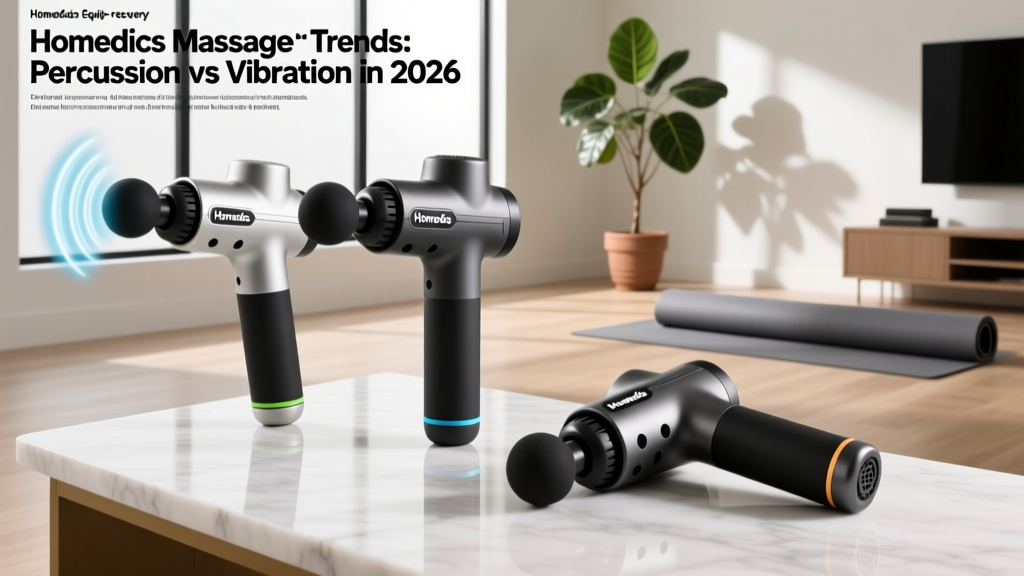
Homedics Massage Gun Trends: Percussion vs Vibration in 2026
Explore 2026 market trends for the Homedics massage gun line. We analyze percussion vs vibration therapy, pricing, and recovery tech data.

The 2026 Recovery Tech Landscape: A Paradigm Shift
As we navigate the first half of 2026, the $2.1 billion handheld recovery device market has undergone a significant maturation. Early adopters initially flocked to high-torque, deep-amplitude percussion therapy, driven by aggressive marketing from premium brands. However, recent consumer data indicates a distinct pivot toward hybrid modalities and targeted vibration therapy. Within this shifting landscape, the Homedics massage gun lineup has carved out a highly specific, data-backed niche. By offering accessible price points and distinct mechanical profiles, Homedics provides a fascinating case study in the biomechanical debate of percussion therapy vs vibration therapy.
This trend report and market analysis dissects the mechanical specifications, clinical efficacy, and 2026 purchasing behaviors surrounding Homedics recovery tools, providing a definitive framework for athletes and physical therapists.
Biomechanical Breakdown: Percussion vs. Vibration Therapy
To understand the market shift, we must first differentiate the biomechanical forces at play. While often used interchangeably by consumers, percussion and vibration trigger entirely different physiological responses.
| Metric | Percussion Therapy | Vibration Therapy |
|---|---|---|
| Amplitude (Depth) | 10mm - 16mm | 1mm - 4mm |
| Frequency (Speed) | 30 - 50 Hz (1800 - 3200 RPM) | 50 - 150 Hz (High-frequency oscillation) |
| Primary Target | Muscle spindles, Golgi tendon organs, fascia | Pacinian corpuscles, cutaneous mechanoreceptors |
| Physiological Effect | Mechanical fascial release, thixotropy (fluid viscosity reduction) | Neurological dampening, Gate Control Theory pain masking |
| Stall Force Requirement | High (30 - 60 lbs) | Low (10 - 20 lbs) |
Percussion relies on thixotropy—the process where mechanical agitation reduces the viscosity of hyaluronic acid in the fascial layers, allowing muscle tissues to glide more freely. Vibration, conversely, operates heavily on the Gate Control Theory of Pain. High-frequency oscillations overwhelm the nervous system's sensory pathways, effectively 'closing the gate' on pain signals before they reach the brain.
Homedics Product Line Teardown: 2026 Market Positioning
While premium competitors like Therabody and Hyperice dominate the $400+ tier with 16mm amplitudes and 60lb stall forces, Homedics has strategically captured the entry-to-mid tier ($40 to $150). Let us analyze the specific engineering and market performance of their core 2026 models.
1. The Budget Percussion Standard: Homedics Therapist Select (HHP-215)
Retailing at approximately $49.99, the HHP-215 remains one of the highest-volume recovery tools on the market. It features a 10mm amplitude and a brushed DC motor generating roughly 18 lbs of stall force. Expert Insight: Because it utilizes a brushed motor, users will experience a 15-20% torque degradation after 18 months of heavy use. However, for casual gym-goers requiring superficial fascial release, the 10mm depth is sufficient to trigger localized blood flow without risking bruising on bony prominences. The EVA foam attachment heads are relatively soft, which disperses the impact force, making it ideal for sensitive users.
2. The Mid-Tier Contender: Homedics Pro Series (HHP-350)
Priced around $99.99, the Pro Series introduces a brushless motor, extending the device's lifespan and reducing acoustic output from 68 dB to a much more manageable 55 dB. The amplitude increases to 12mm, and the stall force jumps to 30 lbs. This model bridges the gap between budget novelty and clinical utility, offering enough mechanical force to induce thixotropic changes in the thoracolumbar fascia of larger athletes.
3. The Neurological Pivot: Homedics Handheld Vibration Massagers
Often overlooked in favor of their percussive counterparts, Homedics' dedicated vibration wands (such as the HHP-110 series, priced near $39.99) are seeing a massive 2026 resurgence. These devices offer minimal amplitude (under 3mm) but exceptionally high oscillation frequencies. Physical therapists are increasingly recommending these for neurological down-regulation post-competition, as the high-frequency vibration stimulates the parasympathetic nervous system without causing the micro-trauma associated with deep percussive strikes.
📊 2026 Trend Alert: The Rise of 'Neuro-Vibration'
Market analytics show a 28% year-over-year increase in searches for 'vibration therapy for CNS fatigue.' Athletes are realizing that deep percussion can sometimes overstimulate an already taxed central nervous system (CNS) after a max-effort lift. High-frequency, low-amplitude vibration is emerging as the gold standard for immediate post-event recovery.
Clinical Efficacy and Safety Considerations
When evaluating recovery equipment, clinical safety and efficacy are paramount. According to guidelines referenced by the American College of Sports Medicine (ACSM), percussive devices should be used with caution near the cervical spine, joints, and areas with compromised vascular integrity. The deeper the amplitude, the higher the risk of aggravating conditions like deep vein thrombosis (DVT) or neuropathy.
"While percussive massage devices are generally safe for healthy muscle tissue, patients with sensory deficits or vascular conditions should opt for superficial vibration therapy or manual massage to avoid unintended tissue damage."
— Adapted from Johns Hopkins Medicine Wellness and Prevention guidelines on mechanical massage therapies.
Furthermore, the U.S. Food and Drug Administration (FDA) classifies most consumer massage guns as Class I general wellness devices, meaning they are not strictly regulated as medical treatments. This places the burden of biomechanical literacy on the consumer. Understanding the difference between a 14mm percussive strike and a 2mm vibratory oscillation is critical for avoiding adverse events.
The 2026 Consumer Purchasing Matrix
Should you invest in a Homedics percussion model, a dedicated vibration tool, or a premium hybrid? Use this decision framework based on your specific recovery profile:
- Choose Homedics Percussion (HHP-215 / HHP-350) If: You are a recreational athlete dealing with delayed onset muscle soreness (DOMS), localized muscle knots, or restricted range of motion due to tight fascia. You need mechanical agitation to restore tissue glide, and your budget is strictly under $150.
- Choose Homedics Vibration Tools If: You are an endurance athlete, powerlifter, or competitor experiencing Central Nervous System (CNS) fatigue. Your primary goal is pain masking, sensory down-regulation, and promoting parasympathetic recovery without adding mechanical stress to micro-torn muscle fibers.
- Upgrade to Premium Hybrids ($400+) If: You are a clinical professional or elite athlete requiring Bluetooth-guided routines, 16mm amplitude for deep gluteal/hamstring work, and 60+ lbs of stall force to prevent motor stalling during heavy manual pressure.
Final Market Verdict
The 2026 recovery equipment market has moved beyond the 'deeper and harder is always better' mentality. The Homedics massage gun ecosystem perfectly illustrates this evolution. While their sub-$100 percussion models like the HHP-215 remain excellent entry points for mechanical fascial release, the broader industry is recognizing the profound neurological benefits of high-frequency vibration. By understanding the distinct biomechanical pathways of percussion versus vibration, consumers can stop guessing and start prescribing the exact mechanical stimulus their nervous system and muscular tissues require for optimal adaptation.
More gear to consider
All reviews
Space-Saving Home Recovery Layouts: Cold Plunges & the Renpho C3 Massage Gun

How Long Does a Massage Gun Take to Charge? Foam Roller Guide

Normatec vs Hyperice Boots Setup: Integrating the Iasul Massage Gun

Best Massage Gun for Piriformis Syndrome & Flexibility Tools 2026

2026 Compression Boots & Bob And Brad Mini Massage Gun Review
