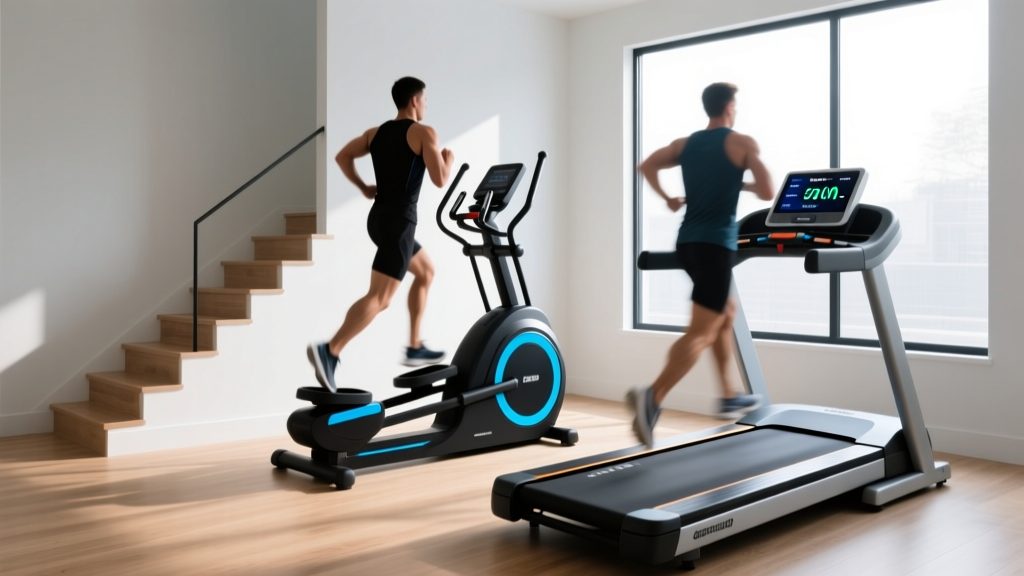
Beat Shin Pain on Treadmill: Home Stair Climber Guide
Escape shin pain on treadmill workouts. This step-by-step guide helps beginners transition to low-impact home stair climbers for pain-free cardio.

The Biomechanics: Why Treadmills Trigger Shin Splints
If you are a beginner experiencing sharp or aching shin pain on treadmill decks, you are not alone. This discomfort, clinically known as Medial Tibial Stress Syndrome (MTSS), is one of the most common barriers to cardiovascular consistency. According to the Mayo Clinic, shin splints are primarily caused by repetitive stress on the shinbone and the connective tissues that attach your muscles to the bone.
When you walk or run on a treadmill, your heel strikes the belt, forcing your anterior tibialis (the muscle on the front of your shin) to contract eccentrically to lower your foot and absorb shock. With every step, your lower leg absorbs up to 2.5 times your body weight. Over time, this repetitive braking motion causes micro-tears and inflammation. The solution is not always more stretching or better shoes; often, it requires changing the biomechanical movement pattern entirely.
⚠️ Warning: Never attempt to 'push through' acute shin pain on treadmill sessions. Continuing to load an inflamed anterior tibialis can escalate MTSS into a tibial stress fracture, requiring months of immobilization.Step 1: Choosing Your Home Stair Climber (2026 Market Breakdown)
A stair climber eliminates the eccentric heel-strike impact. Instead of braking your body weight with your shins, you are performing concentric muscle contractions—pushing down to lift your body up. This shifts the load entirely to your glutes, quadriceps, and calves, giving your shins a complete rest while actually increasing your caloric expenditure.
When selecting a machine for home use, you must balance your budget, ceiling height, and floor space. Below is a comparison of the top three home stair climber categories available in 2026.
| Machine Type | Top 2026 Model | Price Range | Footprint | Shin Impact |
|---|---|---|---|---|
| Hydraulic Mini-Stepper | Sunny Health SF-S902026 | $350 - $450 | 23" x 18" | Zero |
| Air-Resistance Climber | Bowflex Max Trainer M9 | $1,899 - $1,999 | 49" x 30" | Zero |
| Motorized StepMill | StairMaster SM3 | $3,199 - $3,499 | 46" x 24" | Zero |
Expert Insight: If you live in an apartment with standard 8-foot ceilings, avoid motorized StepMills. The step height plus your own height will cause you to hit the ceiling. For standard homes, the Bowflex Max Trainer M9 offers the best blend of low-impact climbing and upper-body engagement without the vertical clearance issues of a traditional revolving staircase.
Step 2: Dialing in Your Climber Biomechanics
Transitioning away from the treadmill is only half the battle. Poor form on a stair climber can lead to lower back pain or knee strain. To ensure a pain-free transition, follow this strict biomechanical checklist:
- The 'No-Lean' Rule: Never drape your torso over the handrails. Leaning reduces caloric burn by up to 20% and shifts your center of gravity, placing undue shear force on your lumbar spine. Keep your chest proud and shoulders pulled back.
- Full Foot Placement: Do not climb on your tiptoes. Pressing only with the balls of your feet overworks the calves and Achilles tendon. Drive through your entire foot, focusing on pushing down through your heel to activate the gluteus maximus.
- Shoe Selection: Ditch the heavily cushioned, high-drop running shoes you used on the treadmill. A shoe with a 10mm heel drop alters your ankle angle on a stair pedal. Switch to a cross-training shoe with a 4mm to 6mm drop (like the Nike Metcon or Reebok Nano) for a stable, flat base on the pedals.
Step 3: The 4-Week Treadmill-to-Climber Transition Protocol
The American Heart Association recommends at least 150 minutes of moderate-intensity aerobic activity per week. To rebuild your cardiovascular base without re-injuring your shins, use this progressive 4-week protocol.
- Week 1: Neurological Adaptation (10 Minutes/Day)
Focus purely on form. Set the machine to a slow, manageable resistance (Level 2-3). Aim for 40 to 50 steps per minute (SPM). Do not use the handrails for support; lightly rest your fingertips on them for balance only. Your calves will likely be sore—this is normal as they adapt to the new concentric load. - Week 2: Building the Aerobic Base (15 Minutes/Day)
Increase your cadence to 60 SPM. Introduce interval training: climb at a moderate pace for 3 minutes, followed by 1 minute of high-intensity climbing (80+ SPM). This mimics the heart-rate spikes you previously got from treadmill jogging, but with zero impact on the tibia. - Week 3: Muscular Endurance (20 Minutes/Day)
Increase the resistance level rather than the speed. A higher resistance forces deeper knee flexion, which recruits more muscle fibers in the quadriceps and glutes. Maintain a steady 60 SPM. You should be sweating heavily but still able to speak in short sentences. - Week 4: The 150-Minute Milestone (25-30 Minutes/Day)
Combine moderate resistance with a cadence of 70 SPM. By the end of this week, you will have successfully replaced your treadmill cardio with a higher-calorie-burning, zero-impact alternative. Your anterior tibialis will be fully rested and recovered.
Pro Tip: Track your heart rate using a chest strap monitor rather than the machine's built-in pulse sensors. Stair climbers require you to move your arms for balance, making it difficult to keep your hands on the metal sensors consistently.
Frequently Asked Questions
Will my shin pain eventually go away if I just keep walking on the treadmill?
In some cases, beginners experience 'conditioning' shin splints that fade after 3 to 4 weeks as the bone density and muscle tissue adapt. However, if the pain is sharp, localized to a specific spot on the bone, or persists long after your workout, it is a sign of chronic MTSS. Switching to a stair climber is the safest way to maintain fitness while allowing the tissue to heal.
Are mini-steppers as effective as full-sized stair climbers?
For pure cardiovascular conditioning, full-sized climbers like the Bowflex M9 or StairMaster allow for a greater range of motion and higher step height (typically 8 inches), leading to higher caloric expenditure. However, hydraulic mini-steppers are highly effective for beginners, physical rehabilitation, and small spaces, providing a similar zero-impact benefit for the shins at a fraction of the cost and footprint.
Can I still do lower body weight training while recovering from shin splints?
Yes, but avoid high-impact plyometrics (like box jumps) and heavy barbell back squats if they cause pain. Focus on leg presses, hamstring curls, and seated calf raises. The stair climber protocol outlined above pairs perfectly with a hypertrophy-focused leg day, as the climbing motion actively promotes blood flow and recovery in the lower extremities without eccentric joint loading.
By making the strategic pivot from the treadmill belt to the stair climber pedal, you protect your joints, cure your shin pain on treadmill routines, and unlock a more efficient, glute-dominant cardiovascular workout right in your living room.
More gear to consider
All reviews
Curved Manual vs Motorized Fixes & The Hot Tub With Treadmill Trap
Bike Types vs Treadmill Workout with Dumbbells: Space Guide
Echelon Stride 4S Treadmill Review: Ultimate Belt Maintenance Guide
Stair Treadmill & Cardio Machine Noise: 2026 Buyer Guide
How Does an Anti-Gravity Treadmill Work vs Budget Stationary Bikes?