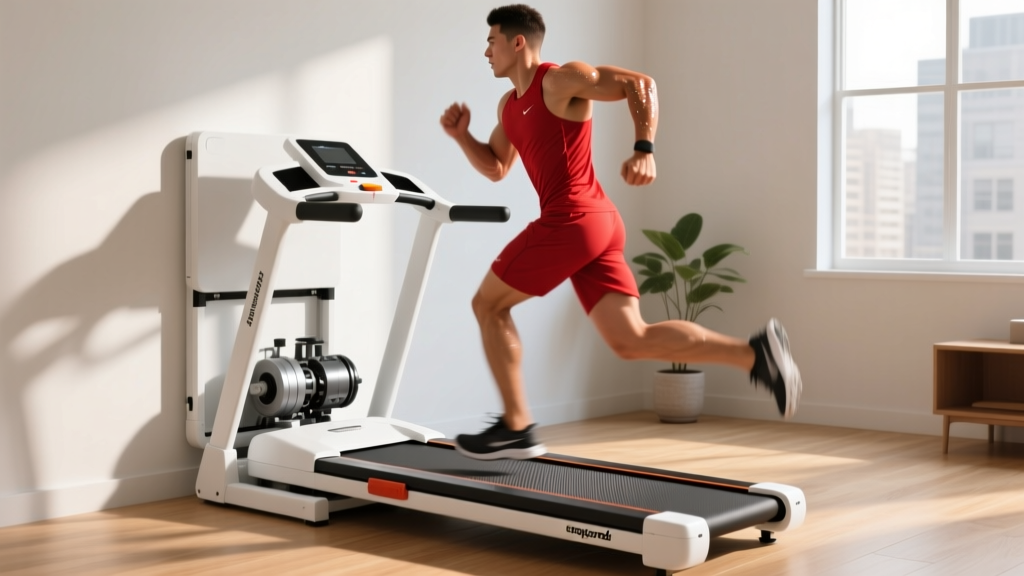
Small Space Folding Treadmill Review: Sprint Exercises on Treadmill
Reviewing top folding treadmills for small spaces. We break down budgets and test if you can safely do sprint exercises on treadmill models under $1,000.

The Biomechanical Clash: High-Intensity Sprints vs. Compact Folding Frames
Living in a compact apartment or condo often forces a compromise on fitness equipment. The folding treadmill for small spaces has become a staple in urban homes, offering a way to maintain cardiovascular health without sacrificing precious square footage. However, a major point of friction arises for athletes and fitness enthusiasts who want to incorporate High-Intensity Interval Training (HIIT) into their routines. Specifically, can you safely and effectively perform sprint exercises on treadmill models that fold in half and weigh under 150 pounds?
From a biomechanical standpoint, sprinting generates immense downward force and horizontal shear. According to research on treadmill sprint kinetics published in the National Institutes of Health (NIH), the peak ground reaction forces during all-out sprints can exceed three times a runner's body weight. When you apply this physics to a budget-friendly folding treadmill, the results can range from premature motor burnout to catastrophic frame failure.
In this 2026 budget breakdown and value analysis, we dissect the small-space folding treadmill market to determine exactly where your money should go if sprinting is a non-negotiable part of your training regimen.
Warning: The Peak HP TrapManufacturers of sub-$400 folding treadmills frequently advertise '3.0 HP' motors. This is almost always Peak Horsepower—the maximum output the motor can hit for a fraction of a second before tripping the thermal breaker. For sprint exercises on treadmill units, you must look exclusively at Continuous Horsepower (CHP), which measures sustained output under heavy load.
2026 Budget Breakdown: Small Space Treadmills Rated for Sprints
To provide a clear value analysis, we have categorized the current market into three distinct budget tiers. We evaluated these based on motor CHP, belt dimensions, frame rigidity, and long-term value for high-intensity users.
| Budget Tier | Representative Model | Motor (CHP) | Belt Size | Sprint Viability |
|---|---|---|---|---|
| Tier 1: $300 - $500 | NordicTrack T Series 5 | 2.0 HP (Peak) | 18' x 50' | Dangerous / Not Recommended |
| Tier 2: $600 - $800 | Horizon Fitness T101 | 2.25 CHP | 20' x 55' | Moderate (Jogging/Light Intervals) |
| Tier 3: $900 - $1,200 | Sole Fitness F63 | 3.0 CHP | 20' x 60' | Excellent (True HIIT Capable) |
Tier 1: The Sub-$500 Trap (Zero Sprint Value)
Treadmills in the $300 to $500 range, such as entry-level models from ProForm or NordicTrack, are engineered strictly for walking and light jogging. The 18-inch width restricts natural arm carriage, and the 50-inch length is a severe hazard for sprinting. An average adult male's stride length during a full sprint can exceed 7 feet. On a 50-inch belt, performing sprint exercises on treadmill decks of this size guarantees that your foot will strike the front motor hood or slip off the rear roller, leading to severe friction burns or impact injuries. Value Verdict: Wasted money if HIIT is your goal.
Tier 2: The $600–$800 Compromise
The Horizon T101 and similar models in this bracket offer a 55-inch belt and a true 2.25 CHP motor. This is the absolute minimum threshold for interval training. You can perform 'strides' (accelerations up to 80% of your max speed), but true 100% max-effort sprints will cause the belt to momentarily stutter as the motor struggles to match the sudden kinetic demand of your foot strike. Over time, this stuttering stretches the belt and wears down the drive roller. Value Verdict: Good for general fitness and steady-state cardio, but limits your athletic ceiling.
Tier 3: The $999 Sweet Spot for True HIIT
The Sole F63 has long been the gold standard for folding treadmills that bridge the gap between compact storage and commercial-grade performance. Priced around $999 in 2026, it features a 3.0 CHP motor and a robust 20' x 60' belt. The 60-inch length provides the necessary runway for full stride extension, while the heavy-duty steel frame (weighing over 160 lbs) absorbs the violent lateral forces of sprinting without wobbling. Value Verdict: The highest ROI for serious athletes in small spaces.
Hidden Costs: Motor Burnout and Maintenance Realities
When conducting a budget breakdown, the initial purchase price is only half the equation. Attempting to force a Tier 1 or Tier 2 treadmill to handle sprint exercises on treadmill routines will trigger hidden maintenance costs that destroy any upfront savings.
- Thermal Breaker Trips: Sudden acceleration draws massive amperage. Budget motors will overheat, triggering the internal thermal breaker. You will be forced to wait 20-30 minutes mid-workout for the machine to cool down.
- Belt Delamination: The friction generated by aggressive foot strikes on a thin, single-ply belt (standard in sub-$600 models) will cause the belt to delaminate and fray within 6 to 9 months of HIIT use. Replacement belts cost between $150 and $250.
- Warranty Voids: Most budget treadmill warranties explicitly state that 'commercial or high-impact athletic use' voids the motor warranty. If your 2.0 HP motor fries during a Tabata sprint session, the manufacturer will likely deny your claim.
'The cardiovascular benefits of high-intensity treadmill intervals are well-documented, significantly improving VO2 max and metabolic rate in shorter timeframes. However, the mechanical stress placed on the equipment requires a stable, high-torque platform to ensure user safety.'
— Adapted from guidelines on HIIT safety by the American Heart Association
Space Planning: Safety Clearances for Small Apartments
Buying a Tier 3 folding treadmill like the Sole F63 solves the mechanical issues, but it introduces a spatial challenge. To safely execute sprint exercises on treadmill units, you must adhere to strict spatial clearance rules. Many small-space dwellers push the back of the treadmill against a wall or a glass door. This is a critical safety hazard.
The 48-Inch Rule:You must maintain a minimum of 48 inches (4 feet) of clear, unobstructed space directly behind the treadmill. If you lose your footing during a 10 MPH sprint, the belt will eject you backward. Hitting a wall, a radiator, or a glass patio door at that velocity can result in catastrophic injury. If your apartment layout does not allow for this rear clearance, you must restrict your treadmill use to steady-state jogging, regardless of the machine's motor capacity.
Folding Footprint vs. Deployed Footprint
When evaluating small space treadmills, consumers often fixate on the folded dimensions (e.g., 30' x 30' x 65'). However, the deployed footprint is what dictates your room's usability. A 60-inch belt treadmill will require roughly 75 inches of total length when deployed, plus the 48-inch safety zone. You are effectively dedicating a 10-foot by 3-foot corridor in your home exclusively to the treadmill while it is in use.
Value Analysis Matrix: Cost-Per-Sprint Session
To truly understand the value, let us apply a Cost-Per-Use framework over a standard 3-year ownership cycle, assuming the user performs 3 HIIT sprint sessions per week (approx. 468 sessions over 3 years).
- Tier 1 ($400 Machine): Requires belt replacement in Year 2 ($200) and motor replacement in Year 3 ($350). Total cost: $950. Cost per session: $2.02 (plus high injury risk).
- Tier 2 ($700 Machine): Requires one belt tension adjustment and minor maintenance. Total cost: $750. Cost per session: $1.60 (but capped at 80% max effort).
- Tier 3 ($999 Machine): Zero major repairs required under standard warranty and robust build. Total cost: $999. Cost per session: $2.13 (for 100% max effort, commercial-grade safety, and full stride accommodation).
While the Tier 3 machine has a slightly higher raw cost-per-session than a perfectly maintained Tier 2, the functional value is exponentially higher because it actually allows you to perform the intended sprint exercises safely and effectively.
The Verdict: Where Should Your Budget Go?
If your primary goal is daily walking, light jogging, or staying active while watching television, a $500 folding treadmill is a perfectly reasonable investment for a small apartment. However, if your programming demands true sprint exercises on treadmill equipment, you must abandon the sub-$800 category entirely.
The physics of high-velocity running simply cannot be negotiated with. Investing $999 in a robust, 3.0 CHP folding treadmill with a 60-inch belt is not just a matter of performance; it is a critical investment in your physical safety and long-term equipment reliability. Measure your space, verify your rear clearance, and allocate your budget toward continuous horsepower rather than flashy touchscreens or Bluetooth speakers.
More gear to consider
All reviews
The Patricia Tarka Treadmill Effect: 2026 Under-Desk Office Trends
Do Treadmills Work Better With High HP? Setup Guide

Elliptical vs Treadmill: Value & How to Apply Treadmill Lubricant

Rowing Technique & Buying Guide: How to Fold NordicTrack Treadmill
Skipping Rope vs Treadmill: Upright, Recumbent & Spin Bike Trends
