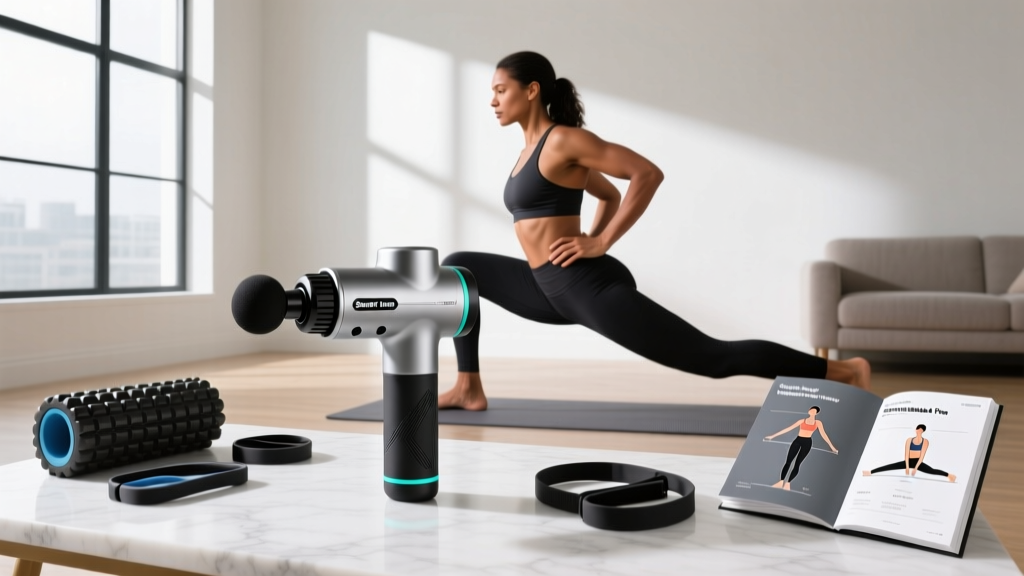
Compact Recovery: Foam Roller Guide & Trigger Points Massage Gun Chart
Optimize your home recovery zone with our foam roller density guide and spatial layout tips using a trigger points massage gun chart for small spaces.

The Architecture of a Compact Recovery Zone
As urban living spaces shrink and home gym footprints become more constrained in 2026, the architecture of a personal recovery zone requires meticulous spatial planning. Gone are the days of dedicating an entire spare bedroom to sprawling recovery equipment. Today's optimal recovery layout demands a synthesis of high-density myofascial tools and targeted percussion therapy, organized within a functional workflow triangle. To design an efficient space, you must first understand the physical properties of your tools—starting with a comprehensive foam roller types, density, and size guide—and then map your spatial clearances using a trigger points massage gun chart.
This guide provides exact material specifications, spatial footprints, and layout frameworks to help you build a high-performance recovery zone in spaces as small as 50 square feet.
Foam Roller Types, Density, and Size Guide
Selecting the right foam roller is not just about muscle tension; it is a spatial decision. A roller's diameter and length dictate its storage requirements, while its material density determines its lifespan and failure modes. According to research published in the National Center for Biotechnology Information (NCBI), the mechanical properties of foam directly influence tissue deformation and recovery outcomes.
Material Density and Degradation Profiles
- Soft (EVA Foam, 30-40 kg/m³): Ideal for acute pain or beginners. However, EVA suffers from "compression set"—a permanent deformation where the foam loses its cylindrical shape after 90 to 120 days of daily use. Spatial Note: Because they degrade faster, soft rollers are poor candidates for permanent wall-mounted displays.
- Medium (EPP Foam, 45-60 kg/m³): Expanded Polypropylene is closed-cell, meaning it resists moisture absorption and retains its structural integrity for years. It offers a balance of tissue penetration and comfort.
- Firm (ABS Core with EVA/EPP Shell): Features a rigid plastic hollow core wrapped in high-density foam. These have an virtually infinite structural lifespan but can delaminate if stored in direct UV light or extreme heat (e.g., near a sunny window or garage heater).
Size Dimensions and Spatial Footprints
Choosing the correct length is critical for small-space optimization. The following matrix breaks down standard sizes and their spatial impact:
| Size | Diameter | Storage Footprint | Best Use Case | Spatial Layout Tip |
|---|---|---|---|---|
| 12-inch (Travel) | 5.0" | 0.4 sq ft | Targeted limbs, travel, small apartments | Store vertically in a standard 5-gallon utility bin or drawer. |
| 18-inch (Standard) | 5.5" | 0.6 sq ft | Unilateral leg work, upper back | Mount horizontally on a slatwall using heavy-duty PVC pipe brackets. |
| 24-inch (Mid-Size) | 5.5" | 0.8 sq ft | Bilateral glute/hamstring rolling | Requires dedicated under-bench storage or a 2-foot horizontal rack. |
| 36-inch (Full Body) | 6.0" | 1.5+ sq ft | Full spinal extension, Pilates | Avoid in rooms under 150 sq ft; disrupts the Recovery Triangle workflow. |
Spatial Mapping: Using a Trigger Points Massage Gun Chart
While foam rollers require floor space for use, percussion therapy devices like the Theragun PRO Plus ($699) or Hyperice Hypervolt 2 ($299) require clearance space. When consulting a trigger points massage gun chart, you are not just looking at anatomy; you are mapping the spatial geometry required to reach those anatomical landmarks without striking your surroundings.
Expert Layout Insight: A standard massage gun with a 16mm amplitude stroke requires a minimum of 4 inches of clearance just for the device head. However, targeting the rhomboids, posterior deltoids, or lateral lats requires the user to extend their arm backward at an awkward angle. If your recovery mat is placed flush against a wall, you will physically lack the elbow clearance to apply the device to these posterior trigger points.
The Clearance Rule of Thumb
Based on ergonomic mapping from posterior chain trigger points massage gun chart data, your primary recovery mat (standard 24" x 68") must be positioned with at least 36 inches of lateral clearance on the dominant-hand side. This allows the user to sit cross-legged or lie supine and maneuver the 2.5 lb device around the scapula without the motor housing impacting the drywall or baseboard.
Designing the Layout: Vertical Storage and Workflow Triangles
To optimize a compact room, implement the "Recovery Triangle" concept, adapted from kitchen design principles. This triangle connects three zones: the Active Zone (mat space), the Tool Zone (vertical storage), and the Transition Zone (seating/hydration).
Vertical Storage Solutions for Recovery Tech
Floor space is a premium. Utilizing vertical wall space is mandatory for small layouts.
- Magnetic Wall Docks: Devices like the Theragun PRO Plus feature magnetic charging docks. Failure Mode Warning: The device weighs nearly 3 lbs. Do not mount the magnetic dock using standard drywall anchors. The dynamic load of removing and replacing the gun will rip the anchor out within weeks. You must locate a wall stud or use a toggle bolt rated for at least 50 lbs of shear force.
- Acrylic Roller Holsters: For 12-inch and 18-inch EPP rollers, wall-mounted acrylic tubes (often used for poster storage) provide a sleek, dust-free vertical housing that protrudes only 6 inches from the wall.
- Pegboard Accessory Bins: Mount a 24" x 48" steel pegboard above the Tool Zone. Use it to store massage gun attachments (dampers, cones, wedges), heat wraps like the Hyperice Venom 2 ($299), and topical recovery balms. This keeps small items from cluttering the floor and mat space.
Environmental Edge Cases: Temperature and Humidity
When designing your layout, environmental factors dictate where certain tools can be stored. The American Council on Exercise (ACE) emphasizes that equipment longevity is heavily tied to environmental controls.
- Garage Gym Battery Degradation: If your recovery zone is in an uninsulated garage, do not leave lithium-ion massage guns on their charging docks during winter. Temperatures below 40°F (4°C) during charging can cause lithium plating, permanently reducing battery capacity. Store the device indoors and bring it to the garage only when needed.
- Humidity and EVA Foam: In high-humidity environments (like a converted bathroom or basement), soft EVA foam rollers can absorb ambient moisture, leading to microbial growth and a degraded surface texture. In these layouts, strictly use closed-cell EPP rollers or ABS-core models, and mount them vertically to allow 360-degree air circulation.
Frequently Asked Questions
Can I use a 36-inch foam roller in a small apartment?
While physically possible, a 36-inch roller requires a 4-foot horizontal storage solution or must be left on the floor, creating a tripping hazard and visual clutter. For apartments under 150 square feet, a 12-inch or 18-inch roller combined with a percussion massage gun provides superior targeted relief without the spatial penalty.
How do I clean my foam roller without damaging the material?
Avoid harsh chemical solvents or bleach, which will break down the cellular structure of EVA and EPP foams, causing them to flake and compress prematurely. Use a mild dish soap and water solution on a microfiber cloth. Wipe the roller down and immediately store it vertically in a dry area to prevent moisture from pooling in the textured grooves.
What is the best attachment for reaching the middle back?
According to any comprehensive trigger points massage gun chart, the middle back (thoracic spine and rhomboids) is best treated with a Dampener or Soft Ball attachment. The Standard Ball is often too firm for the bony prominences of the scapula and spine. Ensure your layout provides enough side clearance to reach over the shoulder at a 45-degree angle.
More gear to consider
All reviews
Foam Roller Density Guide & Blackleaf Massage Gun Value

Massage Gun for Lower Back Pain: 2026 Guide & Top Mistakes

Phoenix A2 Massage Gun vs Infrared Sauna Blanket & Panel Guide

Do Massage Guns Really Work? Cupping Therapy Equipment Review

C2 Massage Gun vs Foam Rollers: Density & Budget Guide