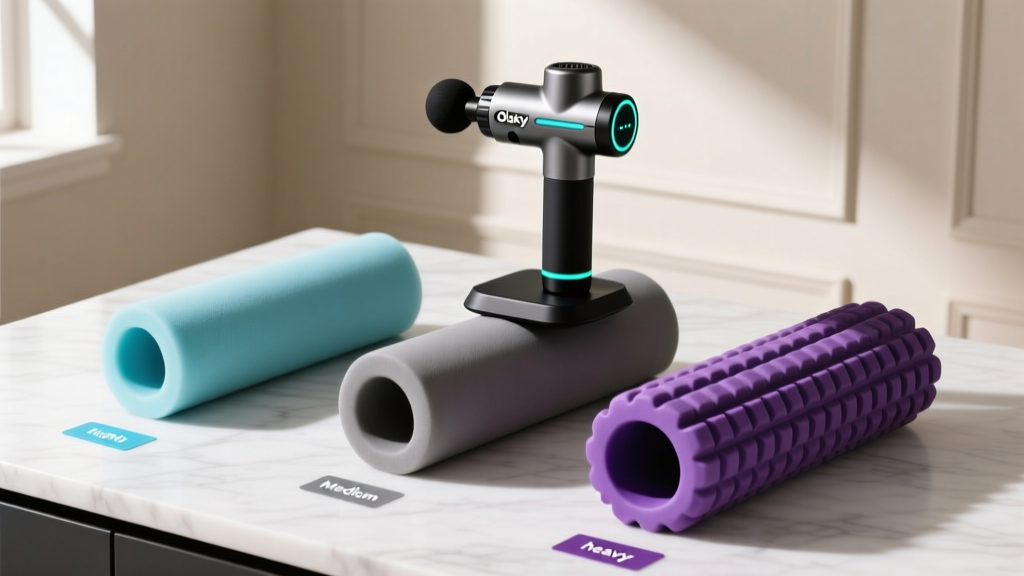
Foam Roller Density Guide & Olsky Massage Gun: Budget Breakdown
Compare the ROI of foam roller densities vs the Olsky massage gun. Our 2026 budget breakdown reveals the best recovery value for your dollar.

The 2026 Recovery Dilemma: Manual Compression vs. Budget Percussion
As inflation continues to reshape the fitness equipment market in 2026, premium recovery tools like the $599 Theragun Pro or $250 RadRunner compression boots remain out of reach for many everyday athletes. This has triggered a massive surge in two distinct budget-friendly recovery categories: traditional foam rollers and sub-$50 percussive devices. If you are building a home gym or optimizing your post-workout routine on a strict budget, you are likely weighing a comprehensive foam roller setup against the viral, ultra-cheap Olsky massage gun.
But which option actually delivers the best biomechanical ROI? To answer this, we must first break down the exact material science, density metrics, and sizing parameters of foam rollers, and then run a hard financial and physiological comparison against the Olsky's percussive output.
Decoding Foam Roller Density: Material Specs and Tissue Response
Foam roller density is not just a marketing buzzword; it is a measurable metric defined by the foam's compression deflection and material composition. According to the American Council on Exercise (ACE), selecting the wrong density can either fail to stimulate mechanoreceptors or trigger a protective stretch reflex that actually tightens the muscle.
The Density Cheat Sheet
- Soft (Low Density): Typically made from open-cell EVA foam with a density of ~1.5 lb/ft³. Yields easily under 20 lbs of pressure. Best for: Beginners, cervical spine, and highly inflamed tissues.
- Medium (Standard Density): Crafted from closed-cell EPP (Expanded Polypropylene) at ~2.5 lb/ft³. Maintains structural integrity under 150+ lbs of body weight. Best for: Daily maintenance, quads, lats, and glutes.
- Firm (High Density): Features a rigid ABS plastic core wrapped in a thin layer of EVA/EPP, yielding an effective density of >4.0 lb/ft³. Best for: Deep fascial adhesion breakdown, IT band, and heavy lifters.
From a budget perspective, soft EVA rollers are the cheapest ($15–$25) but suffer from permanent compression deformation after 6 to 9 months of heavy use. Medium EPP rollers ($20–$35) offer the highest lifespan-to-cost ratio, while firm ABS-core rollers ($30–$50) are virtually indestructible but can be painfully aggressive for unconditioned users.
Sizing Your Roll: 12", 18", or 36"?
Size dictates leverage, stability, and the surface area of myofascial release. Research published in the National Center for Biotechnology Information (NCBI) highlights that larger surface areas promote broader parasympathetic nervous system down-regulation, while smaller tools allow for precise trigger-point isolation.
The 36-Inch Workhorse
Measuring exactly 36 inches long with a standard 6-inch diameter, this size is mandatory for thoracic spine (T-spine) extensions and bilateral quad rolling. It provides a stable base that prevents the user from rolling off the edge during dynamic movements. Budget Cost: $22–$40.
The 18-Inch Hybrid
The 18-inch roller is the ultimate space-saver. It is long enough to roll both hamstrings simultaneously but short enough to store in a standard closet. It excels at targeting the latissimus dorsi and calves. Budget Cost: $15–$28.
The 12-Inch Travel & Target Tool
At 12 inches, this tool is strictly for isolation. It is ideal for targeting the TFL (tensor fasciae latae), pecs, and forearms. It is also the only viable option for travel. Budget Cost: $12–$25.
Enter the Olsky Massage Gun: Specs, Limits, and Value
The Olsky massage gun represents the flood of white-label, budget-tier percussive devices that dominate online marketplaces. Priced aggressively between $35 and $50, it undercuts name-brand entry-level guns by over 60%. But what are you actually getting for that price point in 2026?
- Motor & Stall Force: The Olsky typically houses a 30W brushless motor generating roughly 25 to 30 lbs of stall force. (For context, premium guns offer 60+ lbs).
- Amplitude: It features a shallow 8mm to 10mm stroke length. This means it provides superficial 'tapping' rather than the deep 16mm tissue displacement required for true deep-tissue percussive therapy.
- RPM Range: 2,000 to 3,200 RPM across 4 to 6 speed settings.
- Acoustics: Operating at roughly 60-65 decibels, it is noticeably louder than premium models due to inferior internal dampening.
"Budget percussion guns like the Olsky are excellent for superficial blood flow stimulation and waking up the nervous system pre-workout. However, their shallow amplitude and low stall force make them inadequate for breaking up deep fascial adhesions in large muscle groups like the gluteus maximus."
The $100 Recovery Budget Matrix
To determine the ultimate value, we have modeled three distinct recovery setups, all hovering around or below the $100 mark. This matrix compares the initial cost, estimated lifespan, and cost-per-use over a two-year period.
| Setup Configuration | Initial Cost | Est. Lifespan | Primary Biomechanical Benefit |
|---|---|---|---|
| Setup A: The Purist 36" Medium EPP + 12" Firm ABS Grid | $55 | 5+ Years | Deep fascial stretch, broad parasympathetic down-regulation. |
| Setup B: The Tech Minimalist Olsky Massage Gun Only | $45 | 12-18 Months | Superficial blood flow, localized trigger point tapping, zero floor mobility required. |
| Setup C: The Hybrid 18" Medium EPP + Olsky Massage Gun | $75 | 3 Years (Gun) / 5 Years (Roller) | Comprehensive coverage; roller for large groups, Olsky for localized calf/pec work. |
Long-Term Value and Durability Edge Cases
When conducting a budget breakdown, you must account for failure modes. Foam rollers are essentially dumb pieces of extruded plastic; their failure mode is purely cosmetic or structural crushing. If you leave an EVA foam roller in a hot car (above 110°F), it will warp and permanently lose its cylindrical shape. EPP and ABS-core rollers, however, are highly heat-resistant and will easily survive a decade of daily abuse.
The Olsky massage gun, conversely, is an electronic device with a lithium-ion battery. The most common failure mode for budget massage guns is battery degradation and motor stalling. Users frequently report that after 12 to 18 months of regular charging cycles, the battery no longer holds a charge past the 20-minute mark, or the motor completely stalls when applied with more than 15 lbs of manual pressure. Furthermore, replacement batteries for white-label brands like Olsky are virtually impossible to source, rendering the entire unit e-waste once the battery dies.
When to Choose the Olsky Over the Roller (And Vice Versa)
Despite its limitations, the Olsky massage gun holds a distinct advantage in accessibility. If you suffer from limited floor mobility, wrist pain, or obesity, getting onto the floor to leverage your body weight over a foam roller can be a painful or impossible endeavor. The Olsky allows you to achieve localized percussive relief while seated or standing, making it an invaluable tool for desk workers with cervical and upper trap tension.
However, if your goal is structural tissue remodeling, improving hip flexor length, or addressing dense IT band friction syndrome, the foam roller is vastly superior. The ability to use 40% to 70% of your total body weight as compressive force on a high-density ABS roller achieves a mechanical tissue deformation that a 30-lb stall force budget massage gun simply cannot replicate.
The Final Verdict for 2026
If your budget is strictly capped at $50, skip the Olsky massage gun and invest in a high-quality 36-inch EPP foam roller and a targeted 12-inch firm roller. The long-term cost-per-use of manual myofascial release tools vastly outperforms budget electronics. However, if you can stretch your budget to $75, the Hybrid Setup provides the ultimate synergy: utilizing the foam roller for heavy, large-scale tissue work, and deploying the Olsky for quick, accessible flushes on the calves, forearms, and neck.
More gear to consider
All reviews
Is It OK to Use a Massage Gun While Pregnant? Safe Stretching Tools

Cold Plunge Tub vs Bliss Massage Gun Travel Set: 2026 Budget

Your Theragun Massage Gun Black Friday Haul: Setup & Comparison

Troubleshooting Ekrin Bantam Massage Gun & Normatec vs Hyperice Boots

Legiral Massage Gun Not Charging? Top Stretching Equipment Compared
